
 Pearl
Pearl Bitway
 Zcash
Zcash Walrus
 Aerodrome Finance
 Starknet
 NEAR Protocol

Key Insights:
- Stablecoin Supply Hits Record $225B, Up 63% Year-Over-Year
- Bitcoin Holds Strong Support Between $56K and $71K Range
- Short-Term Stablecoin Holdings Suggest Reentry Plans Are Building
Crypto market dynamics are shifting as Bitcoin undergoes a correction. Despite this, stablecoin liquidity continues to grow, signaling that funds are prepared to flow into the market.
Historically, the market recovery tends to be robust when Bitcoin achieves stability and stablecoin supply grows. The March 2024 correction period saw stablecoin supply stay stable at the same level as Bitcoin retraced.
The current market showcases a trend opposite to earlier periods. Stablecoin’s supply is increasing while Bitcoin remains stable. Hence, the market shows improved conditions for a quick recovery because abundant liquidity is available.
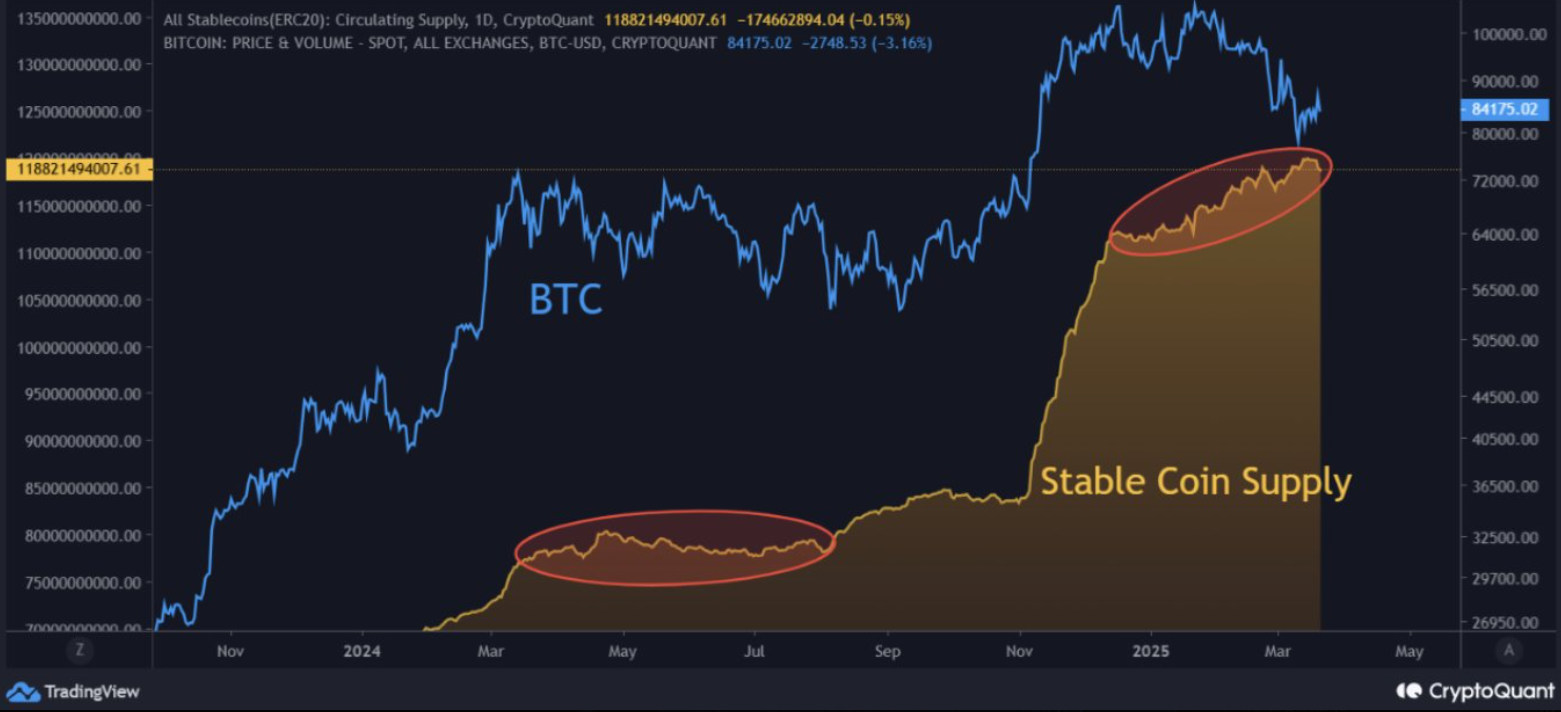
According to CryptoQuant, the total ERC-20 stablecoin supply reached $118.82 Billion. On the other hand, it experienced a minor $1.74 Billion (-0.15%) decrease. However, it has demonstrated positive growth during the past weeks.
Meanwhile, Glassnode indicated that stablecoins have achieved their highest total supply (ATH). Furthermore, the five leading stablecoins maintain over $200 Billion in circulation.
The growing stablecoin supply indicates significant liquidity accumulation, likely driving investment into Bitcoin and altcoins.
Stablecoin Crypto Market Supply
The crypto market relies significantly on stablecoins. They act as “dry powder” for traders to use in operations. As stablecoin supply grows, the market gains additional investment capital. This surplus capital stays ready to re-enter the market.
Looking back, the increase in stablecoin production during the early months of 2021 led to Bitcoin surpassing $60,000. And now, the trend of rising stablecoin supply has continued to increase since mid-2024.
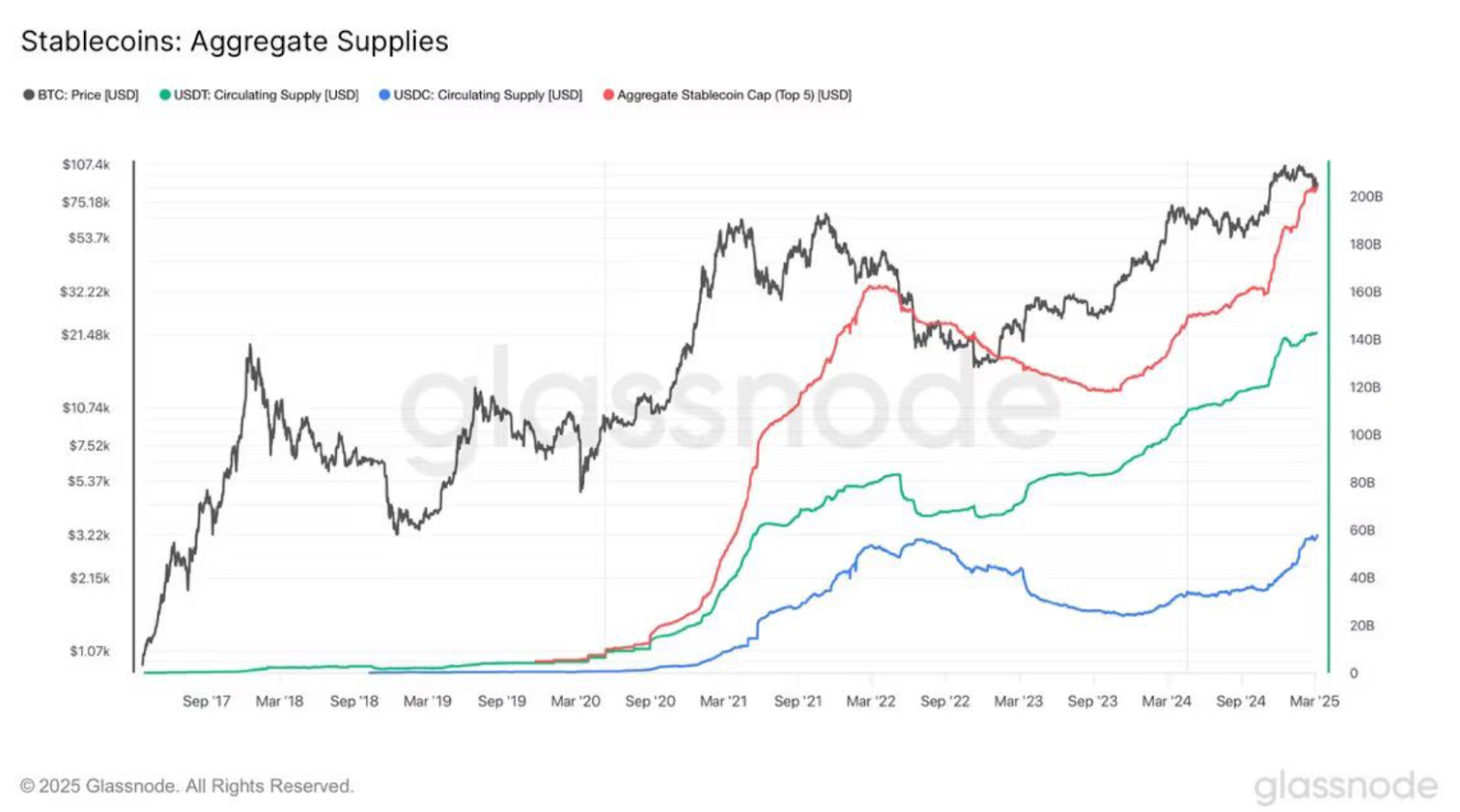
Bitcoin continues to hold its macro uptrend position at $84,175. It is recovering from its peak while staying above its current macro trend level.
During the March–July 2024 period, stablecoin supply experienced no change, while Bitcoin entered a period of market consolidation. However, this time, stablecoin supply growth indicates that investors are ready to return to the market.
ETF inflows, Federal Reserve policy adjustments, and rising institutional adoption could drive upward movement for Bitcoin. These factors collectively strengthen its position in the crypto market.
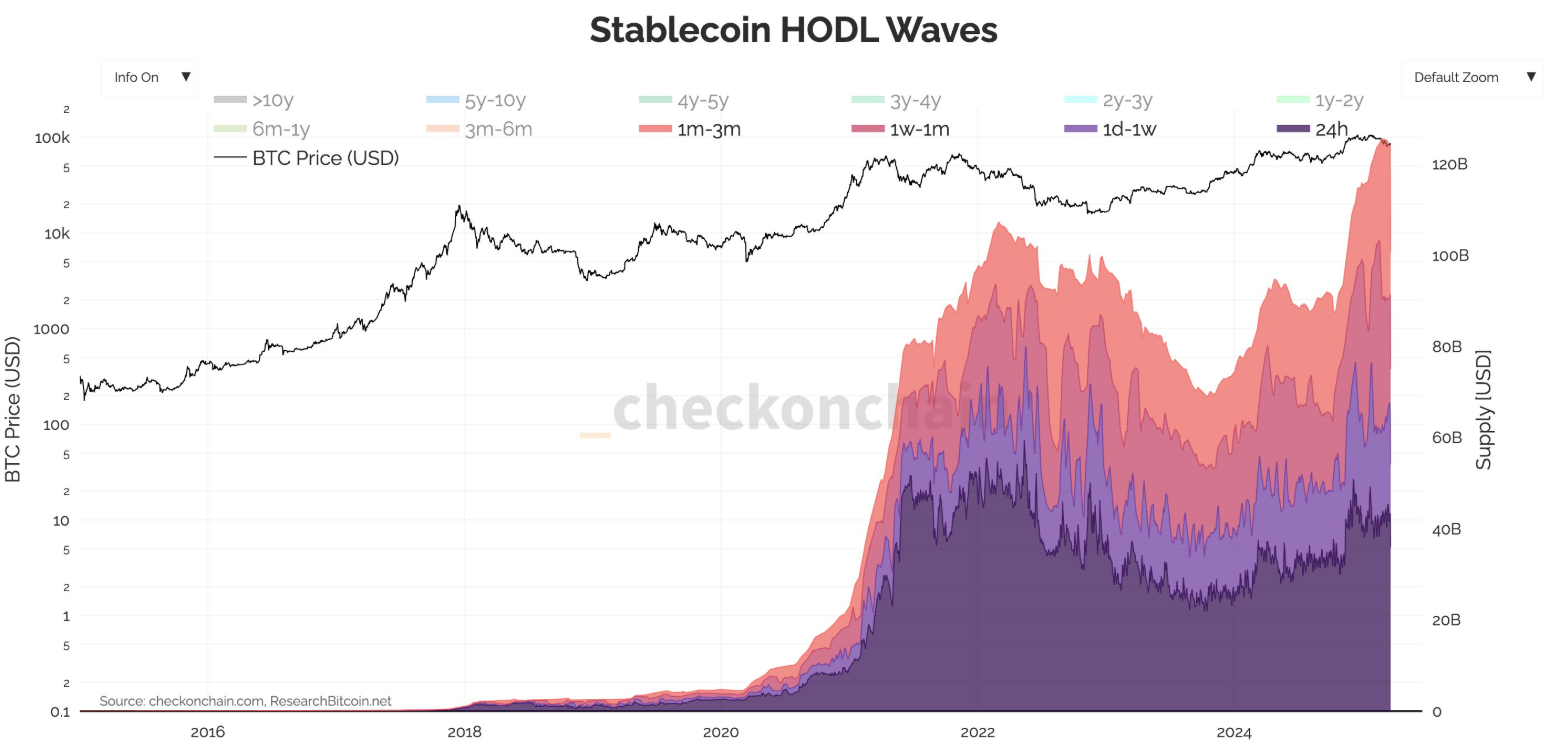
The Stablecoin HODL Waves chart from Checkonchain reveals that short-term stablecoin holdings have surpassed $120 Billion.
These holdings are less than three months old and reflect traders converting market profits into stable assets. This strategy allows them to wait for ideal opportunities to re-enter the market.
Stablecoin Supply Hits 63% Year-Over-Year Growth
According to Artemis data, the stablecoin supply saw remarkable growth over the past year. It expanded by 63%, rising from $138 Billion in February 2024 to $225 Billion in February 2025.
The annual growth of crypto liquidity reached significant levels, demonstrating that additional capital seeks to enter risk assets.
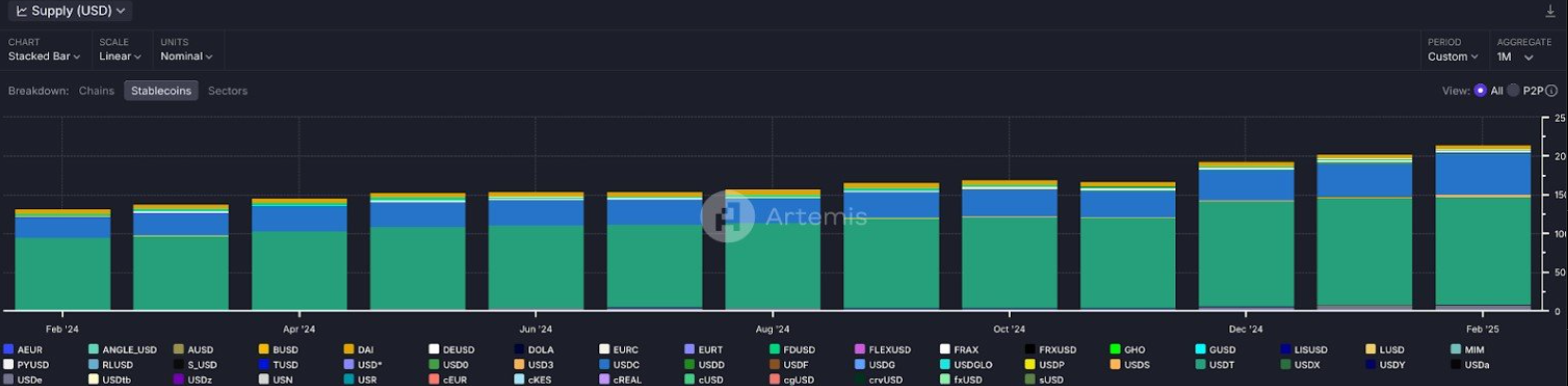
The stablecoin market continues to expand, with its supply showing significant growth. USDT (Tether) and USDC (USD Coin) retain their leadership, even as newer stablecoins like GHO and FDUSD emerge.
Stablecoins are experiencing increasing market demand due to their versatile uses. Traders rely on them for operations, cross-border payments, DeFi applications, and institutional settlements.
Bitcoin’s Strong Support Between $56K–$71K
On-chain analysis from Alphractal shows Bitcoin has strong support between $56,000 and $71,000. High transaction volumes reinforce this support. Additionally, miner revenue is growing, and the hash rate continues to increase.
Historically, significant transaction activity within specific price ranges has marked crucial accumulation zones for Bitcoin. These areas often precede the beginning of a new rally.
Additionally, the network demand remains high based on the increasing miner payment fees, an essential indicator of network activity.
The ongoing crypto market consolidation indicates strong buying activity. Both long-term holders and miners are accumulating Bitcoin instead of selling at current price levels.
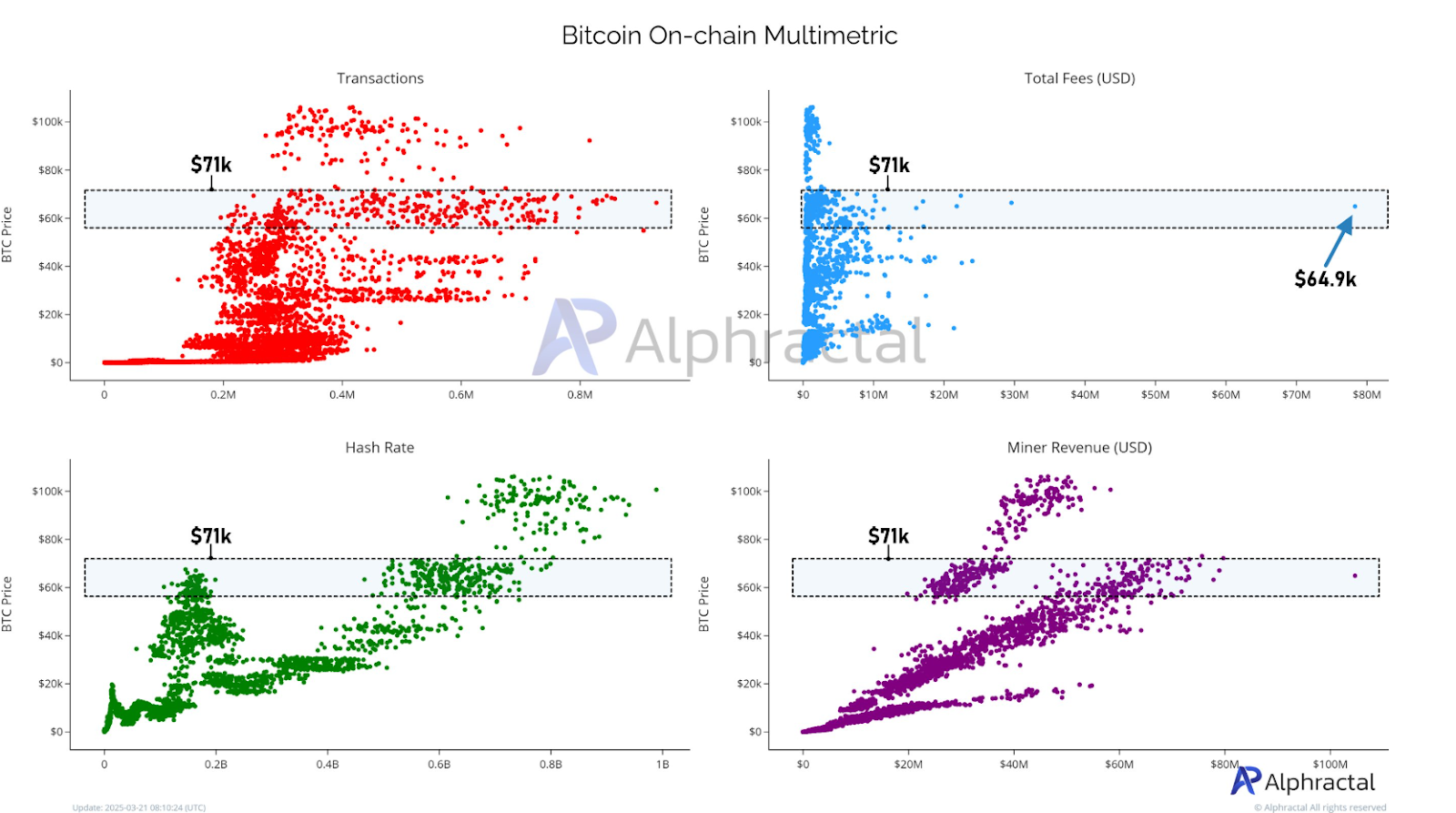
Moreover, Bitcoin followed the same accumulation behavior throughout its earlier market cycles. All on-chain clusters in the price ranges of $2K-$5K, $6K-$12K, and $15K-$26K preceded significant bull market runs.
If Bitcoin price stays within the $56K to $71K range, it may indicate the beginning of a new bottom formation. This could pave the way for upward movement.
The ongoing market correction sets the stage for a fresh crypto market expansion. Stablecoin supply reaching record highs supports this potential growth phase.
Disclaimer
In this article, the views and opinions stated by the author or any people named are for informational purposes only, and they don’t establish the investment, financial, or any other advice. Trading or investing in cryptocurrency assets comes with a risk of financial loss.



