
 Bitcoin
 Pearl
Pearl Quantus
 NEAR Protocol
 Ondo
Ondo Walrus
 Pudgy Penguins
Key Insights:
- Over 40 firms have applied for Hong Kong’s upcoming stablecoin license.
- Only a single-digit number of licenses will be granted under strict regulations.
- Major applicants include JD.com, Standard Chartered, Ant Group, and Circle.
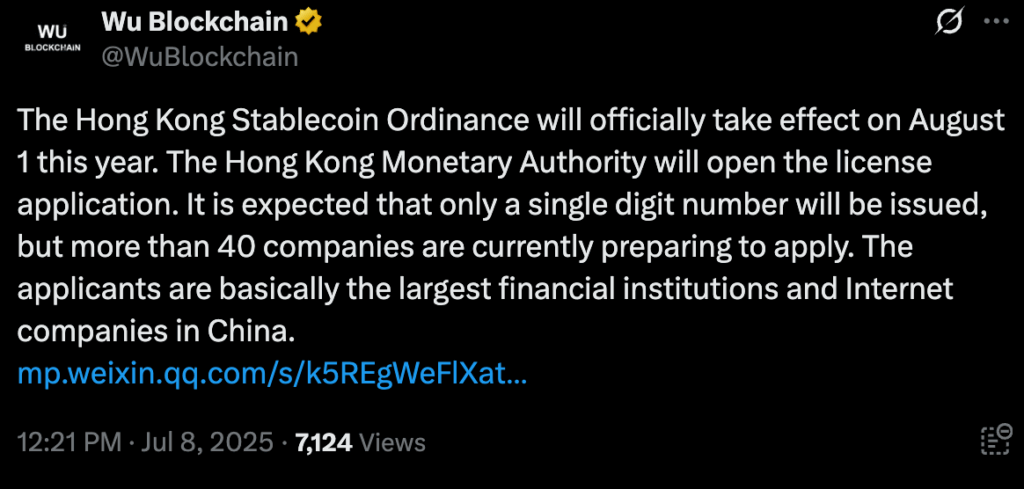
Hong Kong is going to roll out its long-awaited stablecoin licensing regime on August 1, marking a major milestone in its digital asset strategy. With more than 40 companies already in the race and dozens more in the pipeline. The competition is fierce.
However, regulatory authorities will issue a very limited number of licenses, focusing on compliance, transparency, and financial strength.
Strict Licensing Regime to Launch on August 1
The Hong Kong Monetary Authority (HKMA) will begin accepting applications under the new Stablecoin Ordinance starting August 1. Officials have confirmed that only a small number of licenses will be granted, likely no more than ten.
Those licenses focus on entities issuing fiat-referenced stablecoins backed fully by high-quality, liquid reserves.
Under the ordinance, issuers must demonstrate robust operational capabilities and full regulatory compliance. Companies must meet capital requirements, ensure complete transparency, and adhere to strict audit standards.
The framework forms part of Hong Kong’s broader “LEAP” digital asset strategy, focused on legal clarity and ecosystem development.
Regulators will prioritize firms with proven financial strength and scalable blockchain infrastructure. While large firms prepare detailed submissions, small and mid-sized players face near-impossible odds of qualifying.
The limited license count reflects Hong Kong’s cautious but focused approach to digital asset regulation.
Top Financial and Tech Giants Lead the Race
Major financial and technology companies have already entered the application process. The confirmed applicants are JD.com, Circle Innovation, Standard Chartered, and Ant Group. These firms invest heavily in infrastructure, compliance readiness, and blockchain integration to meet regulatory standards.
JD.com recently completed the second pilot phase for a Hong Kong dollar-backed stablecoin through its local unit. The firm plans to obtain its license by Q4 and launch operations by year-end. Through its international arms, Ant Group is also preparing its stablecoin ecosystem for deployment.
Other unnamed Chinese conglomerates in the supply chain and fintech sectors are hiring blockchain professionals to support license applications. Cross-border payment providers, wallet platforms, and Web2 firms shifting to Web3 models are also competing for a place in the new regime.
The sector’s transformation reflects the urgency felt by large corporations to stay relevant in the evolving digital finance landscape.
Middleware and Compliance Key to Web2 Integration
Traditional Web2 companies face serious challenges when adapting to blockchain systems. These firms often lack technical expertise but operate under strict compliance and financial regulations. To overcome this, they are partnering with middleware providers to build user-friendly blockchain interfaces.
Crypto-native practices like using USDT for gas fees remain complex for legacy firms. As a result, companies are building abstracted infrastructure to simplify user experiences and reduce operational risk.
Middleware solutions enable businesses to manage stablecoin transactions without exposing customers to underlying blockchain mechanics.
The market is also shifting from simple fiat-crypto conversion toward higher-value services. Companies are exploring stablecoin-based asset management tools, decentralized finance (DeFi) access, and liquidity services.
Profit margins on basic conversion have shrunk. That made innovation essential for long-term viability.
Hong Kong Pushes Broader Digital Asset Agenda
In parallel with the regulation of stablecoins, Hong Kong is actively supporting the tokenization of real-world assets (RWAs). The government will introduce tokenized government bonds regularly and increase support for tokenized ETFs and commodities.
The clarity of regulation is also improving to facilitate secondary market trading in tokenized instruments.
The Financial Services and the Treasury Bureau is collaborating with the HKMA in carrying out a legal review to simplify the processes on digital assets. Tax breaks to family offices and private funds are being offered as incentives to encourage institutional involvement.
There are also partnerships with academia to develop a robust talent pipeline in digital assets.
This strategy is based on the LEAP framework, which is focused on legal streamlining, expanding tokenization, advancing use cases, and developing people.
As mainland China continues to keep its restrictions on digital assets, Hong Kong has become the regional testing ground for innovation. The city-state is setting up as a major global financial center in the use of blockchain.



