
 Pearl
Pearl Zylo Ecosystem
 Bitway
 Derive
 Walrus
 Quantus
 Pudgy Penguins
In a recent Solana news update, the protocol, known for its fast speed, recently introduced a new consensus proposal, known as Alpenglow (SIMD-0326). According to an update from Wu Blockchain, Alpenglow has entered the community voting phase.
This phase will determine whether Solana is ready to trade its current framework for near-instant block finality.
Solana News: The Alpenglow Proposal and Benefits
The proposal requires two-thirds of the majority votes to pass. The community voting phase runs from Epochs 840 to 842. Each epoch lasts about 2 days.
As of now, voter turnout for Epoch 840 is around 11.64%, with approximately 11.52% in favor. This early lean toward approval is promising. However, the turnout needs to increase substantially to meet the more than 35% quorum and supermajority.
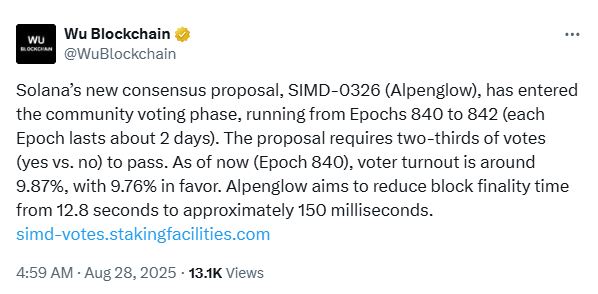
Alpengow is a landmark proposal for Solana that aims to reduce block finality time from 12.8 seconds to 150 milliseconds. The proposal would put Solana in the league of Visa and Mastercard for transaction processing speed if approved.
The proposal, developed by Anza, a Solana research group, replaces the existing Proof-of-History (PoH) and TowerBFT systems.
Although these systems power Solana’s high throughput, they have limitations like higher latency and on-chain voting overhead.
Alpenglow introduces two core innovations, Votor and Rotor. These innovations work together to simplify the protocol, reduce bandwidth usage, and enhance scalability.
Unlike TowerBFT, where validators submit on-chain vote transactions for every slot, Votor shifts voting off-chain.
On the other hand, Rotor uses a more efficient, tree-based dissemination with fewer hops. It optimizes bandwidth and reduces the risk of congestion during high-load periods.
Furthermore, Alpenglow introduces a fixed fee of 1.6 SOL per epoch, roughly 80% of voting costs, with funds burned to offset SOL inflation. Validators risk losing reward or being removed from the active set if they abstain or submit contradictory votes.
Solana Price in the Upcoming Altcoin Season
Amid the Alpenglow proposal discussions, the market attention has shifted to the price of SOL, especially in light of an upcoming altcoin season.
Popular analyst known on X as Scott Melker noted that the SOL/BTC charts are at a critical point.
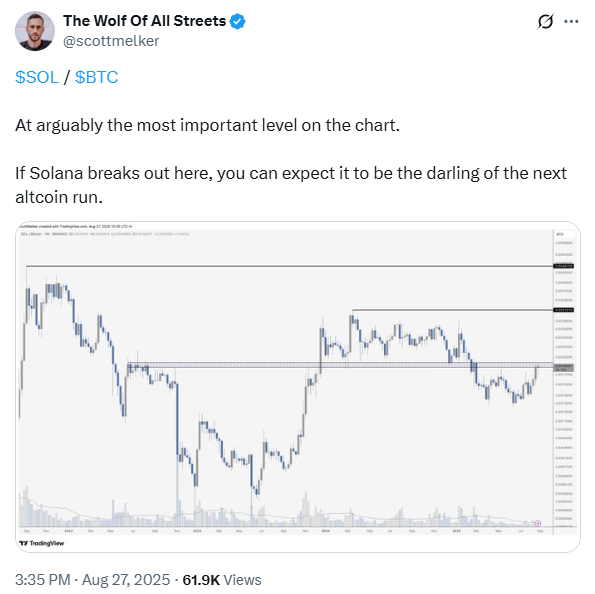
The technical setups show the SOL/BTC is testing a multi-month resistance zone around 0.0018 to 0.00185 BTC. Scott believes a decisive breakout from the resistance could position Solana as a leader in the next altcoin run.
If breakout is confirmed above 0.0018 BTC with volume, SOL accelerates toward 0.0031 BTC. If BTC holds current levels, this translates to targets between $320 and $350.
At press time, SOL price was traded at $212.96, up 3.8% over the past 24 hours. The daily trading volume also surged 43% to $13.6 billion, suggesting increased market activity.
Is a New ATH Possible for SOL?
In another Solana news update, SOL data shows it hit a new cycle high in today’s trading session, climbing past $215. This is the first time SOL has hit this level since February 4.
On the daily charts, SOL has formed a bullish ascending channel, with the price testing the upper boundary near $215 and $220.
The current breakout is driven by hype surrounding approvals of SOL exchange-traded funds (ETFs). The U.S. Securities and Exchange Commission (SEC) has extended reviews for multiple spot Solana ETF proposals.
As the Solana ETF approval deadline nears and more treasury firms emerge, SOL investors anticipate a big breakout for the coin. An ETF approval would validate SOL as a non-security, boosting liquidity and mainstream adoption.
Already, analysts have raised targets as high as $360 for SOL, citing bullish technical structures. Combined with Solana news featuring network throughput milestones and sustained support above $180, hitting a new ATH is not impossible for SOL.




