
 Pearl
Pearl Bitway
 Sui
Sui Pons
Pons Starknet
 Quantus
 Bitcoin
Key Insights:
- The statement by the US SEC and CFTC announced that registered exchanges would enable spot crypto trading.
- U.S. regulators aim to minimize fraud and increase confidence in crypto markets.
- The move indicates that the U.S. intends to become a major crypto hub.
The U.S. SEC and CFTC have jointly cleared the way for registered exchanges to facilitate spot crypto trading.
This decision marks a shift in U.S. regulatory policy and aims to reduce market fraud and manipulation. Also, this move could pave the way for broader institutional participation in the crypto market.
SEC and CFTC’s Joint Statement Supports Spot Crypto Trading
Both agencies announced in a joint statement that registered exchanges can now facilitate the trading of spot crypto products. This development followed the ongoing efforts of the US SEC and CFTC to regulate the digital asset market.
The statement emphasized that market participants should be free to choose where they trade spot crypto assets.
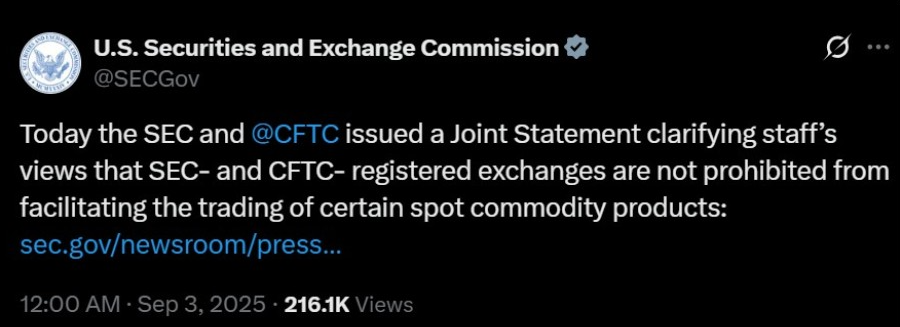
Both agencies have worked together under separate initiatives: the SEC’s “Project Crypto” and the CFTC’s “Crypto Sprint.”
These initiatives will establish clearer regulations and provide more oversight in the digital asset space. The SEC and CFTC statements encourage exchanges to engage with the agencies for further guidance.
A Break from Previous Regulatory Stance
The joint statement pointed to a reversal of the previous administration’s crypto regulation policy. CFTC Acting Chairman Caroline Pham said the agency’s new stance signals strong support for crypto market growth.
She emphasized it reflects a commitment to fostering innovation and development in digital assets. Regulatory signals were frequently conflated under the previous regime. Also, the crypto markets do not clearly understand compliance.
The new orientation of the SEC and CFTC reflected a more decisive regulatory policy and indicated readiness to promote innovation. The idea is to attract more investors, including institutional investors, to crypto trading.
With the increased transparency in crypto regulation, over 92 crypto ETF products were reported to the U.S. SEC in 2025.
This excess in filings demonstrated growing institutional interest and robust American investor demand. The ETFs filing wave will transform the industry with major crypto applications to Solana, XRP, and Ethereum.
The Role of Registered Platforms in Reducing Risks
Spot trading allows traders to buy and sell cryptocurrencies, unlike derivatives or futures contracts. This is a clearer and more open type of trading. By doing this, regulators aim to regulate spot crypto markets more.
The SEC and CFTC now allow registered exchanges to offer spot crypto trading. This move aims to reduce risks tied to unregulated platforms while boosting transparency and investor protection.
This is a step to improve market control and investor protection. The two agencies collaborated to ensure licensed exchanges comply with standards and prevent fraud in the crypto market.
Strengthening the U.S. Position as a Crypto Hub
Allowing registered exchanges to conduct spot crypto trading shows the U.S. is serious about regulating digital assets. It also signals a clear intent to maintain leadership in the global crypto market.
With more specific regulations, policymakers will ensure projects do not switch to other countries because of the poor regulatory environment. The US SEC and CFTC have clarified that they are willing to communicate with market participants.
This will help investors understand their rules and ensure exchanges adhere to regulations. As billions of dollars have already changed hands in spot crypto markets worldwide, the U.S. is preparing to cash in.
The U.S. President recently signed an executive order allowing crypto and alternative assets in 401(k) retirement plans. This move targets the $12.5 trillion retirement market, aiming to broaden investment options for American workers.
Disclaimer
This article is for informational purposes only and provides no financial, investment, or other advice. The author or any people mentioned in this article are not responsible for any financial loss that may occur from investing in or trading. Please do your research before making any financial decisions.




