
 Pearl
Pearl Bitway
 NEAR Protocol
 Sui
Sui Pudgy Penguins
 Starknet
 Pons
Pons

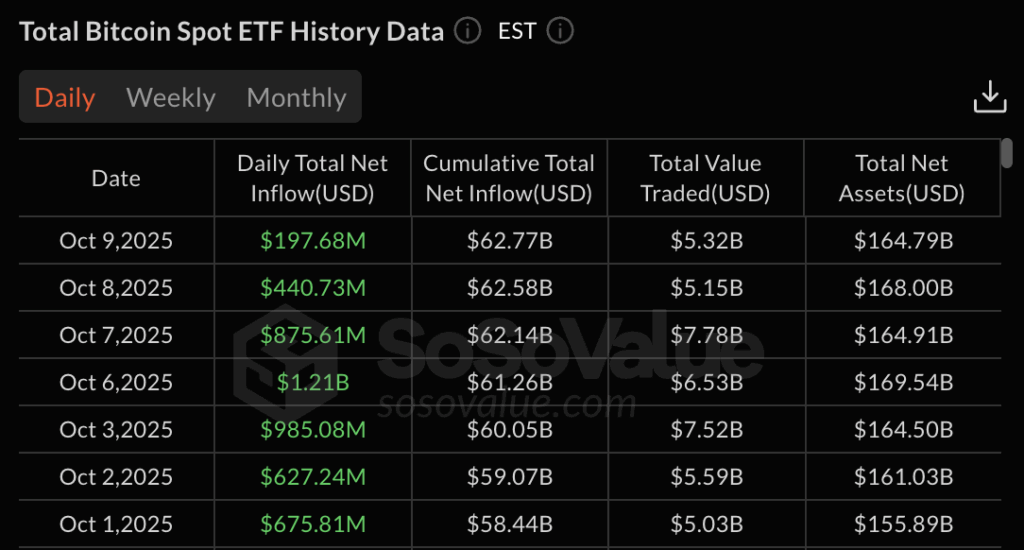
Bitcoin ETFs recorded $197.68 million in net inflows on October 9, extending positive flows to nine consecutive trading days while marking the weakest performance since the streak began.
Cumulative Bitcoin ETFs inflows remain strong at $62.77 billion as BlackRock’s IBIT contributed $255.47 million, offsetting Grayscale redemptions. Ethereum ETFs reversed course with $8.54 million in outflows, ending an eight-day positive streak.
Bitcoin ETFs Post Ninth Straight Inflow Day with Modest $197.68M
Bitcoin ETF products recorded $197.68 million in daily inflows on October 9, marking a continuation of positive institutional flows. However, this is the smallest daily figure since the current streak began.
The modest performance follows consecutive days of substantially larger inflows, including $1.21 billion on October 6, $875.61 million on October 7, and $440.73 million on October 8. The deceleration suggests institutional buying momentum has cooled from early October peaks.
BlackRock’s IBIT led daily inflows with $255.47 million. The fund has maintained $65.19 billion in cumulative inflows since its launch and is the largest single-product allocation. IBIT’s consistent performance offsets selling pressure from legacy products facing structural headwinds.
Bitwise BITB contributed $6.58 million in positive flows, the only other product recording net inflows during the session. Several mid-tier products, including HODL, BTCO, BRRR, EZBC, and BTCW, reported zero net flows, indicating minimal trading activity.
Grayscale products continued to face redemption pressure, with GBTC posting $45.55 million in outflows. The legacy fund maintains negative $24.18 billion in cumulative flows.
Fidelity’s FBTC recorded $13.19 million in outflows while ARKB contributed $5.63 million in redemptions.
Weekly data shows Bitcoin ETFs attracted $2.72 billion during the period ending October 9, down from $3.24 billion the previous week. The week of September 26 posted $902.50 million in outflows.
Ethereum ETFs Reverse Eight-Day Streak with $8.54M Outflows
According to SoSo Value data, Ethereum ETF products experienced $8.54 million in net outflows on October 9, ending an eight-day positive streak that had accumulated over $1.3 billion in institutional inflows.
The reversal follows October 7’s $420.87 million inflow peak, the largest single-day figure since Ethereum ETF launches. Cumulative Ethereum ETF inflows also stand at $15.08 billion.
BlackRock’s ETHA recorded $39.29 million in inflows, the only product posting positive flows during the session.
Fidelity’s FETH led outflows with $30.26 million in redemptions following strong performance earlier in the week. The fund maintains $2.72 billion in cumulative inflows.
Bitwise ETHW contributed $8.07 million in outflows while VanEck’s ETHV posted $4.75 million in redemptions. 21Shares TETH added $2.59 million in selling pressure.
Grayscale’s ETHE showed zero net flows during the session. The legacy product has a cumulative deficit of $4.55 billion.
The eight-day inflow streak demonstrated renewed institutional interest in Ethereum following an extended period of weakness. Daily figures included $420.87 million on October 7, $181.73 million on October 6, $233.55 million on October 3, and $307.05 million on October 2.
Analysts Evaluate Cycle Dynamics and Key Support Levels
Analyst Ted identifies $4,250 as critical support for Ethereum following recent bounce. The analyst states, “If this level holds, Ethereum will show some recovery.”
Failure to maintain $4,250 support could lead to a correction toward the $4,000 psychological level. The support zone has contained selling pressure during multiple tests over recent sessions.
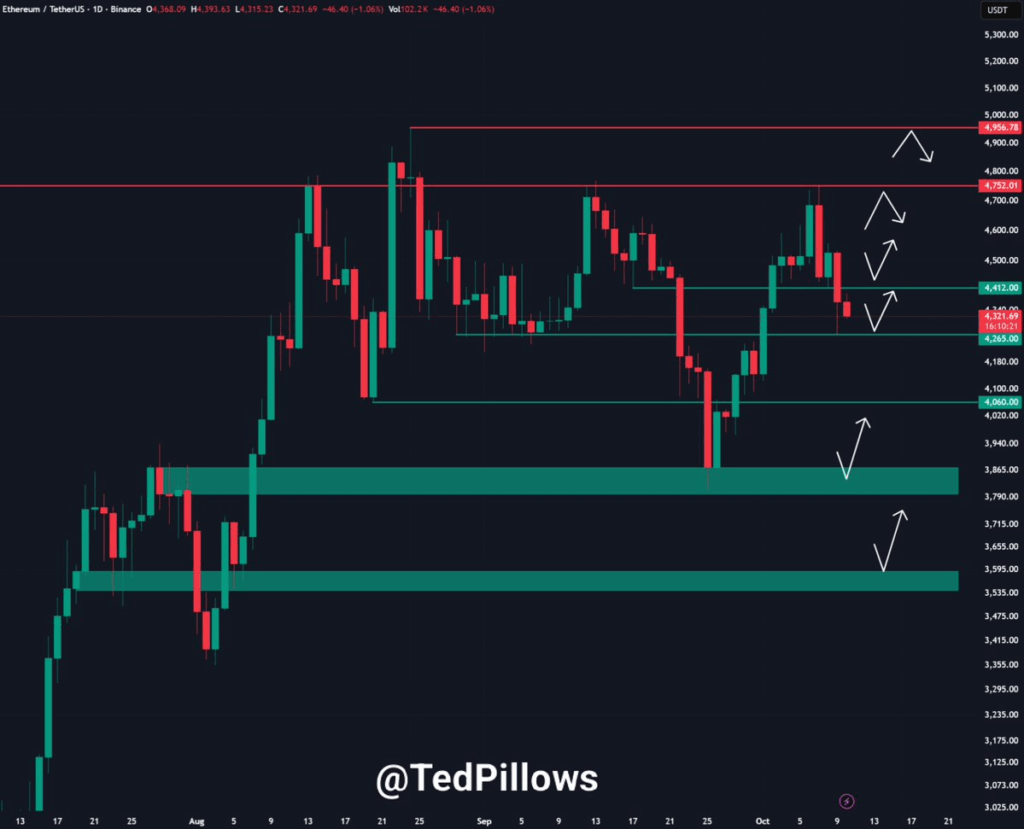
Previous breaks below $4,000 led to accelerated selling, resulting in a decline toward lower support around $3,800. Ted’s analysis suggests that the current consolidation will determine whether Ethereum can resume its uptrend or faces an extended correction.
Ted presents a contrarian view on the Bitcoin cycle and suggests the traditional 4-year cycle “might be over now.”
The analyst expects “liquidity to substantially increase in Q4 and Q1 2026,” supporting extended rally scenarios. Ted states, “Bitcoin might extend the rally in 2026 and could establish itself as a true macro asset.” The thesis suggests Bitcoin transitions from cyclical speculation to persistent store of value with reduced volatility.




