
 Puffer
 Bitcoin
 ZKsync
 NEAR Protocol
 Walrus
 Pearl
Pearl Ondo
Ondo
Softbank’s PayPay, one of the leading cashless payment service providers in Japan, has invested 40% in Binance Japan. The partnership focuses on expanding everyday access to digital assets and Web3 technologies in Japan.
The former Binance CEO, Changpeng Zhao (CZ), confirmed this news on X, writing, “Softbank & PayPay invests 40% in Binance Japan.” The crypto community responded positively, with top analysts saying, “This is a real bridge between crypto and everyday payments.”
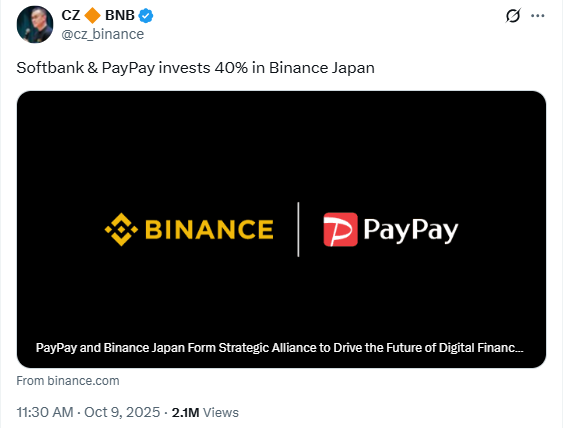
This partnership could be quite beneficial for Binance, as the blockchain firm gains access to a vast user base of PayPay Japan. The leading crypto exchange could onboard millions of new users quickly.
PayPay to Become a Key Player in Japan’s Digital Economy Evolution
Several regulatory, institutional, and market trends indicate that demands for effortless integration between digital assets and traditional finance are growing in Japan. PayPay acquired a 40% stake in Binance Japan to unlock this potential. Together, they aim to usher in a new era of digital finance.
Being the leading Japanese cashless payment app, PayPay gains a direct foothold in the rapidly expanding digital asset market. The Japanese fintech company’s collaboration with Binance will help it expand beyond payments into DeFi, crypto trading, and Web3 services.
This alliance could also help the digital payment provider diversify its revenue streams. Crypto-related services, such as trading fees, staking, token swaps, etc., could provide new income sources beyond traditional payment fees. The company can benefit from transaction-based revenue as the Japanese crypto market expands.
PayPay Japan will gain access to the leading crypto exchange’s compliance frameworks and blockchain infrastructure. It can also build its own blockchain technology-based payment innovations by working with Binance.
Japan’s leading banks, along with the national government, have been exploring Web3 and CBDC initiatives for the past few years. PayPay’s alliance with Binance Japan positions it as a key player in Japan’s digital economy evolution. It could become the market leader as cashless payments transform into tokenized ones.
This Alliance Could Make Crypto Part of Daily Life in Japan
PayPay serves over half of Japan’s population, making cashless payments easier. It has over 70 million registered users in the country. By partnering, Binance can gain access to that vast and trustworthy user base. It could rapidly onboard millions of new crypto users.
PayPay is a regulated fintech company. Its involvement could help Binance navigate Japan’s crypto compliance requirements seamlessly. Needless to say, this partnership will certainly boost Binance’s credibility in the region and draw many new users.
Company Leaders Shared Their Opinions
Masayoshi Yanase, Corporate Officer of PayPay Corporation and Head of the Finance Business Strategy Division, shared that PayPay has collaborated with companies in the financial sector to advance digital finance through smartphones.
He also stated:
“By investing in Binance Japan, the Japanese subsidiary of Binance, the world’s largest digital asset exchange by trading volume, we will provide Binance users with solutions that combine the convenience and security of PayPay. We will continue contributing to the development of Japan’s financial infrastructure by enabling a wide range of financial services tailored to user needs.”
Takeshi Chino, Binance Japan’s General Manager, considers this partnership an important step toward DeFi’s future in Japan. He stated:
“By combining PayPay’s extensive user scale with Binance’s innovative technology, we will be able to make Web3 more accessible to people across the country and deliver secure, seamless digital asset services.”
The Binance Japan GM also showed commitment to keep driving the growth of Japan’s Web3 ecosystem.
Both leaders believe this partnership between PayPay and Binance Japan could revolutionize the digital payments ecosystem in Japan. It could bridge fiat and crypto seamlessly, while accelerating Web3 adoption.
Proper regulatory support and execution quality in integrating the two ecosystems will determine how successful this strategic alliance will be.


