
 Pearl
Pearl Walrus
 Bitway
 Bitcoin
 Quantus
 Quant
Quant Pudgy Penguins

Harvard University has increased its Bitcoin ETF holdings by 237%, reaching $442.8 million, according to its third-quarter 13F filing.
Eric Balchunas noted that this is Harvard’s largest position. This move comes as institutions and investors continue to accumulate Bitcoin amid market changes.
Harvard’s Bitcoin Move and Market Signals
It is worth noting that Harvard’s latest 13F filing shows the university increased its Bitcoin ETF holdings by 237% in the third quarter.
Notably, the total now stands at $442.8 million. Bloomberg Senior ETF Analyst, Eric Balchunas, shared that this is Harvard’s largest position and its biggest increase in the quarter.
He mentioned that it is rare for large university endowments to take positions in ETFs so quickly.
Essentially, this investment accounts for approximately 1% of Harvard’s total endowment, ranking it as the 16th largest holder of the ETF.
Analysts mentioned that the move shows growing interest in Bitcoin from institutions.
Other large investors, including asset managers and sovereign wealth funds, have also been adding to their holdings this year.
During the same period, Bitcoin dropped from $126,210 on October 6 to $95,602 by November 15. This decline resulted in $19.13 billion in liquidations and led to the closure of 1.6 million retail accounts.
As reported, long-term holders transferred 62,000 coins mainly to BlackRock and Fidelity. Experts describe this as strategic accumulation rather than a market top.
Additionally, ETF inflows reached $24 billion this year, indicating that institutions continue to buy, despite retail investors selling.
Essentially, Harvard’s purchase could signal confidence in Bitcoin’s potential and may influence other academic or professional investors to consider digital assets.
Robert Kiyosaki Encourages Buying During Corrections
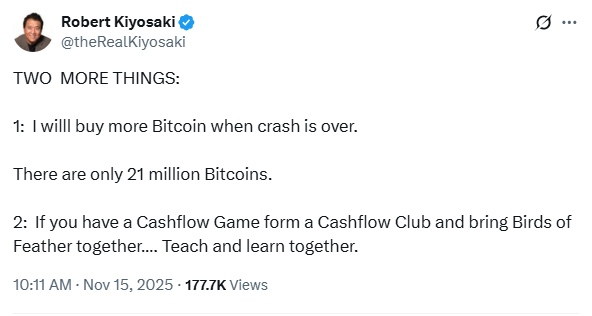
In a separate development, Financial educator Robert Kiyosaki emphasizes Bitcoin’s limited supply.
He pointed out that only 21 million coins will ever exist and recommends buying during market dips and holding for long-term growth.
Kiyosaki also encouraged investors to form learning groups, like Cashflow Clubs, to share strategies and knowledge.
His advice matched what is happening in the market. While retail investors panic, institutions continue to buy.
Meanwhile market watchers share the endorsements from public figures that can help people understand Bitcoin’s potential.
Still, indicators like the Puell Multiple at 0.91 and MVRV Z-Score at 2.06 show neutral signals, meaning the market may still have room to consolidate before prices rise sharply.
Forecasts suggest Bitcoin could reach $130,000 to $150,000 in six to 18 months if the market stabilizes.
In the longer term, prices could go higher if institutions and central banks increase holdings.
Notably, the combination of limited supply, institutional accumulation, and ETF infrastructure could push prices up over time.
Wall Street and Government Policies Influence the Market
Meanwhile, reports indicate that Wall Street is buying Bitcoin, while retail investors are selling at a loss.
Coordinated outflows, futures trading, and silent over-the-counter purchases near $95,000 helped institutions accumulate coins quietly.
Analysts describe this period as a transfer of Bitcoin from retail to institutional hands.
Similarly, Government policies, such as the Stablecoin rule in the Genius Act, have also made it easier for institutions to buy and hold Bitcoin.
It is important to add that ETF approvals provide legal and operational support for long-term investment.
With only 450 new coins mined daily after the last halving, supply may become more limited. Experts point out that previous Bitcoin corrections were followed by strong price gains.
The Harvard investment, combined with institutional accumulation and policy support, shows how academic, private, and government-linked investors are shaping the market.
It also shows how careful buying during corrections can benefit long-term investors. This period could set the stage for significant future growth in Bitcoin holdings and prices.



