Dacity Coin
 astronaut
 Celestia
 Injective
 Bittensor
 Quantus
 Pearl
Pearl

Crypto projects experienced an increase in attacks last month, following a period of approximately 15 major exploits, according to a report by Peckshield.
The incidents collectively resulted in approximately $194.27 million in losses, representing a nearly 1,000% month-over-month increase.
Crypto projects lose over $194 million
The total losses in November were 10x bigger than October’s $18.18 million theft, representing a 969% month-over-month increase.
The surge represents a return of theft activities after a period of significant slowdown in October. The uptick highlights persistent vulnerabilities in the crypto industry, particularly in DeFi protocols as well as centralized platforms.
According to PeckShield’s report, five incidents alone accounted for approximately $190 million of the total losses in November. These include the exploits on Balancer, Upbit, YearnFi, HLP Bad Debt, and Gana payment.
Balancer Hack Accounts for Over 50% of Stolen Funds
Balancer led the November exploits after attackers targeted its v2 forks, leading to about $134.7 million in losses. Though Balancer recovered $39 million of the stolen funds, this is not its first exploit.
The Nov. 2 attack represents the third major exploit on Balancer in recent years. PeckShield disclosed that Balancer’s forks were exploited across multiple chains, including Ethereum, Berachain, Arbitrum, Base, Optimism, Sonic, and Polygon.
The attacker reportedly targeted Balancer Pool Tokens (BPT), which represent user shares in liquidity pools. The vulnerability originated from Balancer’s calculation of pool prices during batch swaps. This allowed for logic manipulation to distort the internal price feed and create an artificial imbalance, enabling the withdrawal of tokens before corrections.
Interestingly, the attack occurred despite at least 11 audits conducted on Balancer by different firms in recent years. Market players highlighted that security audits do not guarantee safety in DeFi but instead reflect the unpredictability of decentralized systems.
DeFi Trust Collapse
Last month’s losses highlighted a major vulnerability in decentralized finance (DeFi) projects as they emerged as the biggest losers. These incidents sparked significant debates in the crypto community regarding the DeFi sector’s security.
DefiLlama data shows that DeFi projects lost about $168.7 million to hacks in November. This positioned the month as the third-biggest exploit month for DeFi projects this year. Specifically, November stands behind February’s $1.48 billion theft as well as May’s approximately $240 million loss.
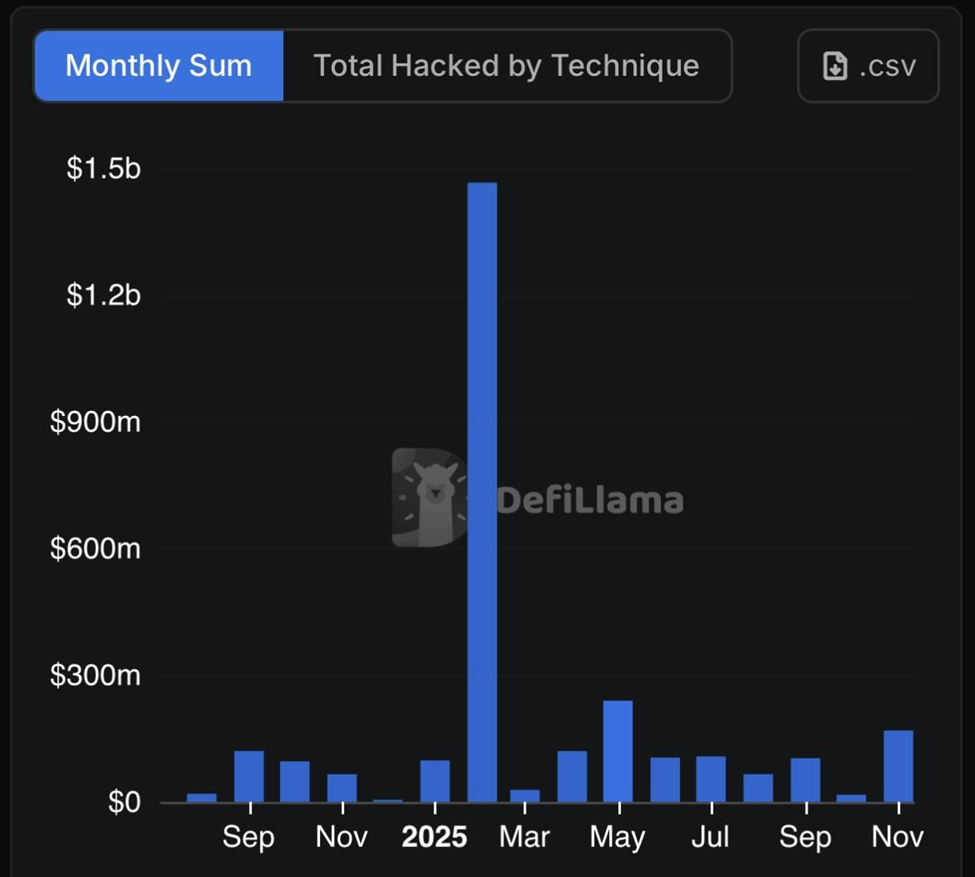
Lefteris Karapetsas, founder of the Rotki crypto platform, described the Balancer attack as a trust collapse for the DeFi sector. He opined that the exploit on Balancer, one of the longest-standing DeFi protocols, is a red flag for the sector.
He said:
“A protocol live since 2020, audited and widely used, can still suffer a near-total TVL loss. That’s a red flag for anyone thinking DeFi is “stable.” No serious capital allocates into systems that fragile.”
Industry players argued that the attack on Balancer implies that other prominent protocols may be vulnerable to exploits.
Cork Protocol founder, Robdog, opined that smart contract risks will remain in the market, despite DeFi’s increasing security efforts. Hence, he suggested the need to develop a more robust risk management infrastructure to support the DeFi sector.
Amid these concerns, the incident caused significant declines to the TVL value of several top blockchains. Ethereum lost 12% of its value, while Solana and BSC each lost 12% of their total value over the past week, according to data from Sentora.
However, additional data from DefiLlama indicates that Ethereum’s TVL loss increased to 22.6% over the course of one month. Solana and BSC also experienced declines of over 24.5% and 20%, respectively, last month. Experts believe that these declines follow fund withdrawals from investors due to fears of additional DeFi exploits.