
 Doge Pepe
 Bitway
 Optimism
 Pearl
Pearl Pons
Pons Quantus
 Starknet

Gold surged past $5,000 an ounce for the first time on Monday, while Bitcoin traded sideways near $87,000, underscoring a widening divergence between traditional safe havens and crypto markets during Asian trading hours.
Spot gold climbed above $5,000 before extending gains to around $5,080, according to market data, marking a historic milestone for the metal. Bitcoin, by contrast, hovered near $87,000 after briefly dipping below $86,000 late Sunday, erasing its gains for the year.
The split move mattered because investors increasingly treated gold as a durable hedge against geopolitical risk, trade tensions, and U.S. fiscal uncertainty. Crypto markets showed weaker conviction, with on-chain and derivatives data pointing to consolidation rather than renewed upside momentum.
Gold Price Rally Signals Shift in Risk Positioning
Gold’s breakout followed a sharp rise in demand for defensive assets as traders priced in mounting political and macro risks. Concerns over a potential U.S. government shutdown and renewed tariff threats added pressure to global markets.
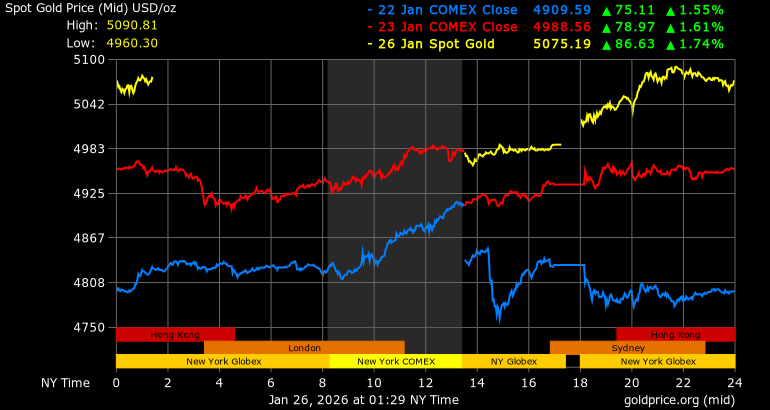
“A likely government shutdown just added fuel to the fire for precious metals,” the Kobeissi Letter said Monday, pointing to heightened demand for gold amid fiscal uncertainty.
Trade tensions also resurfaced after U.S. President Donald Trump threatened Canada with a 100% tariff tied to a China trade deal. The move added to broader unease around global trade and weakened confidence in risk assets.
Gold has gained roughly 17% so far this year and surged more than 80% from levels seen a year ago. Silver also followed the move, rising above $107 per ounce for the first time, according to market data.
Prediction markets reflected the shift. On Polymarket, traders increasingly priced scenarios where gold holds above $5,500 through mid-year, signaling expectations for sustained strength rather than a short-lived spike.
Bitcoin Price Struggles Under Supply Pressure
Bitcoin lagged the rally, trading in a tight range as internal market dynamics capped upside. The asset slipped to a five-week low near $86,000 on Coinbase late Sunday before stabilizing during Asian hours.
On-chain data suggested selling pressure from older holders weighed on price action. CryptoQuant said long-term Bitcoin holders began selling at a loss for the first time since October 2023, a pattern often linked with consolidation phases.
Glassnode noted that repeated rallies ran into sellers near recent cost bases, creating a supply overhang that stalled upward momentum. The firm said Bitcoin continued to struggle below short-term holder cost levels near $98,000, with dense supply above $100,000 limiting breakout attempts.
Derivatives data reinforced the cautious tone. Futures volumes remained thin, leverage stayed subdued, and price moves occurred without broader participation, signaling low conviction across traders.
Bitcoin has fallen about 30% from its October peak near $126,000 and now trails gold sharply on a year-over-year basis. While gold prices rose roughly 83% over the past year, Bitcoin declined about 17% over the same period.
Ether and Crypto Markets Lag Safe Havens
The divergence extended across the broader crypto market. Ether slipped below $2,800 over the weekend and remained more than 40% below its August all-time high near $4,946.
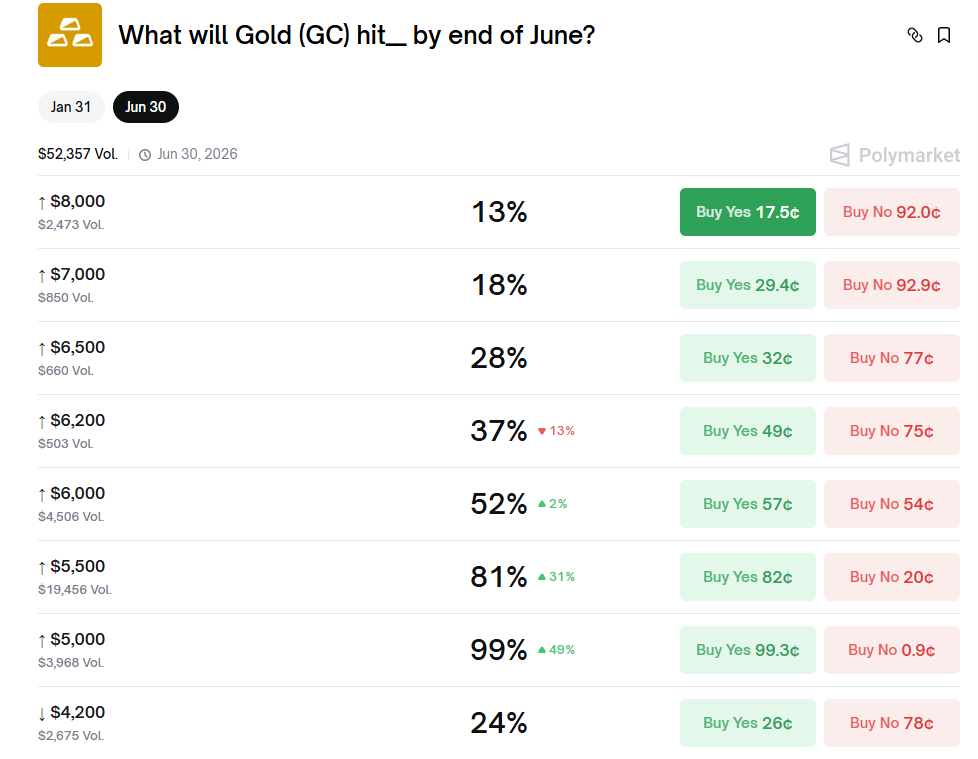
Gold also beat Ether to the $5,000 milestone, settling a Polymarket bet placed in October on which asset would reach the level first. The outcome highlighted the market’s shift away from higher-beta crypto assets toward defensive positioning.
Jeff Mei, chief operations officer at BTSE, said investors favored gold over both cryptocurrencies and U.S. Treasuries amid rising uncertainty.
“Normally, in uncertain times, capital moves toward safe-haven assets such as U.S. Treasuries and gold,” Mei said. “But concerns over a government shutdown and renewed tariff threats pushed investors more decisively toward gold.”
What Markets Watch Next
Traders now focused on whether gold can hold above the $5,000 level as geopolitical risks and fiscal uncertainty persist. Continued central bank demand and a weaker dollar remained key factors supporting the rally.
For Bitcoin, attention turned to support near $86,000 and resistance around $98,000. A sustained move above that zone appeared unlikely without stronger participation, higher futures volumes, or easing supply pressure from existing holders.
Macro developments, including U.S. fiscal negotiations and trade policy signals, remained immediate catalysts. Until those risks eased, gold appeared positioned to absorb stress, while Bitcoin stayed in digestion mode, working through internal supply rather than responding to external drivers.




