
 Bitcoin
 ZKsync
 Pudgy Penguins
 Pearl
Pearl Quantus
 Starknet
 NEAR Protocol

Crypto News showed that USDT and USDC no longer competed on one front. Dune’s Digital Asset Brief found that USDT led payments in early 2026, while USDC drove DeFi and trading activity across major chains.
That split mattered because stablecoins now function less like identical dollar tokens. Instead, network choice, wallet behavior, and product design shaped how users moved digital dollars.
Crypto News Shows USDT Payment Dominance
Dune’s Digital Asset Brief found that USDT settled about $95 billion in identified commerce payments during H1 2026. USDC handled $14 billion over the same period, which showed a clear payments gap.
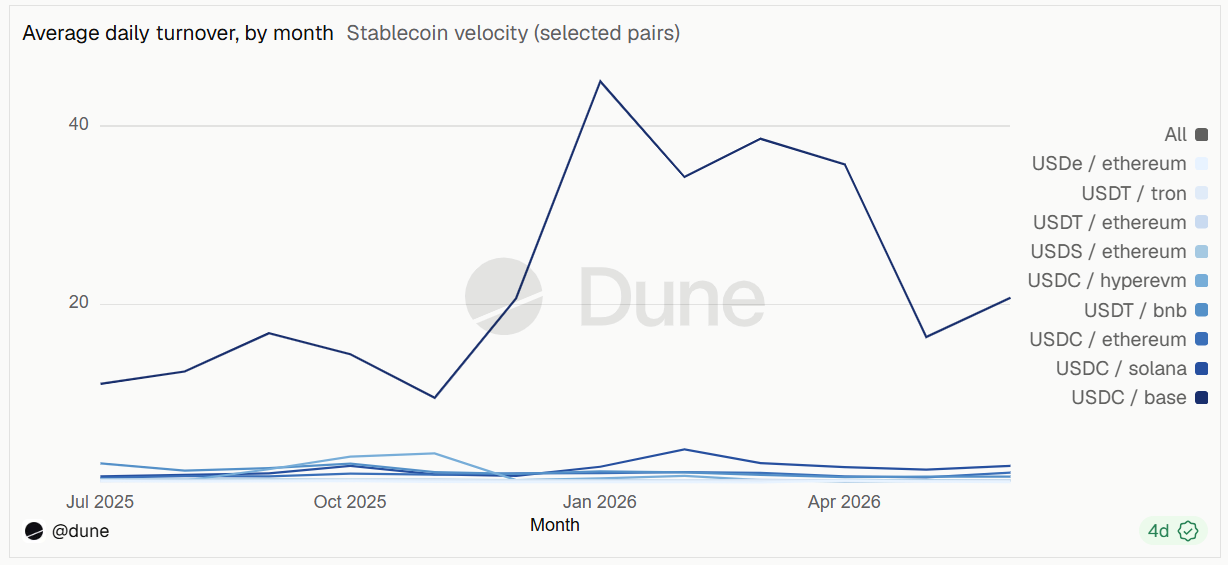
USDC on Base recorded daily velocity. Source: Dune
Business payment data showed the same pattern. USDT accounted for roughly 92% of the $48 billion business-to-business stablecoin volume tracked by Dune.
That dominance came largely from Tron. Dune found that ordinary wallets held around 93% of USDT supply on the network.
This distribution pointed to real transfer use rather than exchange-heavy positioning. It also aligned with remittance activity and low-cost settlement demand.
The data weakened the usual USDT-versus-USDC framing. Both tokens remained large, but users placed them into different financial roles.
USDT served payments and cross-border transfers. USDC moved deeper into decentralized applications, trading systems, and liquidity venues.
Crypto News Tracks USDC DeFi Strength
Dune’s Digital Asset Brief showed that USDC on Base processed roughly $2.6 trillion in transfer volume in June. That marked the largest token-chain pair measured in the report.
Ethereum added another layer to USDC activity. The stablecoin handled about $1.6 trillion on the network that same month.
Base data showed why USDC gained traction in DeFi. Dune recorded daily velocity near 20 times circulating supply for USDC on that chain.
High velocity suggested repeated reuse inside trading, lending, and settlement systems. It also showed that token supply alone gave an incomplete market view.
USDC’s role differed from USDT’s wallet-heavy payments profile. Circle’s stablecoin moved faster inside applications that required frequent asset rotation.
That activity linked USDC closely with Coinbase’s Base network. It also tied the token to DeFi users seeking faster settlement and lower fees.
The difference did not remove competition. It narrowed the battlefield to chain placement, issuer trust, and institutional access.
Crypto News Puts Stablecoin Rules In Focus
Dune tracked over 200 stablecoin tokens across multiple blockchains. Its brief showed that USDT and USDC together controlled roughly 83% of the sector’s $315 billion market value.
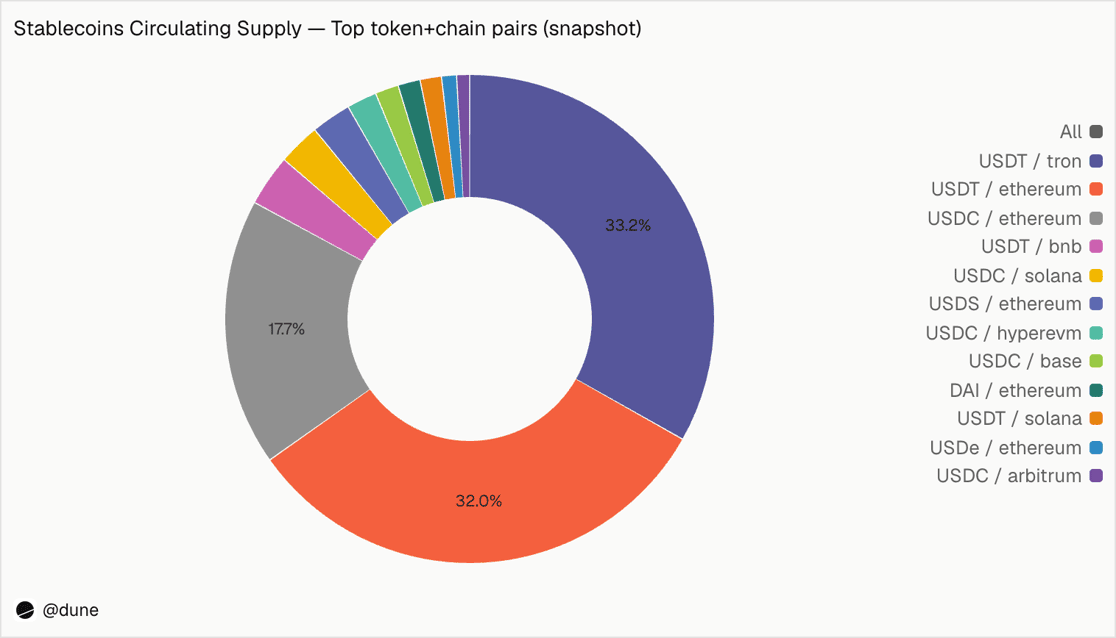
That concentration gave U.S. rulemaking more weight. The GENIUS Act, signed into law in 2025, created a federal framework for payment stablecoins.
The law gave banks and other firms a clearer route to issue dollar-pegged digital assets. It also turned reserve quality and redemption standards into larger market questions.
Lawmakers then shifted toward broader market structure through the CLARITY Act. The bill aimed to define when crypto assets fell under the Securities and Exchange Commission or Commodity Futures Trading Commission.
The bill did not regulate stablecoins directly. Still, it affected exchanges, DeFi platforms, and issuer distribution channels.
Galaxy Research recently cut its odds of CLARITY passage before the break to 50%. The firm cited calendar pressure as lawmakers approached the August recess.
That timing mattered for stablecoin markets. Clearer rules could widen institutional issuance, while delays may protect existing issuer dominance.
For now, Dune data showed a market split by function. USDT kept the payments lead, while USDC strengthened its DeFi base.
The next test will come from U.S. legislative timing and chain-level growth. If CLARITY stalls, issuer scale may matter more than new regulatory openings.



