Pearl
Pearl Puffer
 NEAR Protocol
 ZKsync
 Bitcoin
 Solana
 Starknet
- Josh Jarrett has filed a lawsuit against the IRS, challenging the taxation of staking rewards as income.
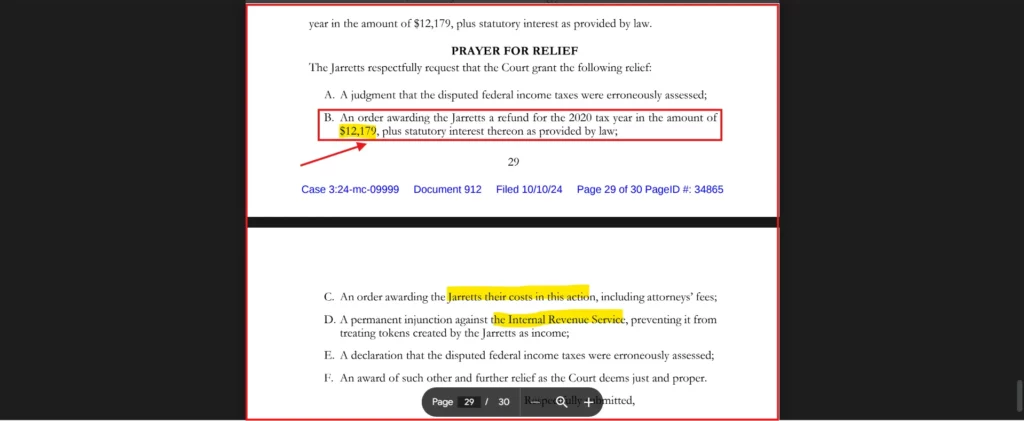
- Josh Jarrett is seeking a refund of $12,179 for taxes paid on his Tezos rewards.
- Supported by Coin Center, this lawsuit aims to address and prevent future tax complications related to staking rewards.
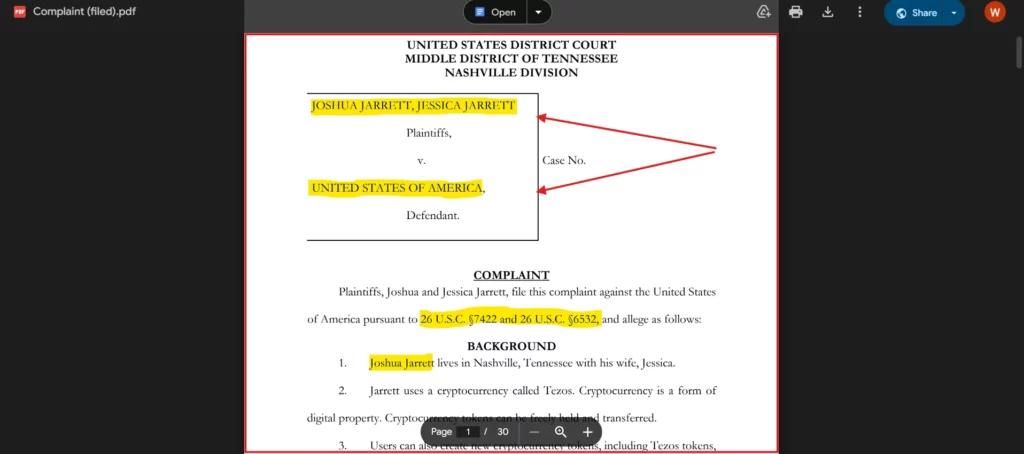
On October 10, 2024, Josh Jarrett, a Tezos validator node operator, filed a new lawsuit against the IRS. He has challenged its approach to taxing cryptocurrency staking rewards.
Supported by Coin Center, Jarrett argues that block rewards should not be taxed as income at the time of receipt. They should be taxed only when they are sold. He is seeking a refund of $12,179 in taxes paid on 13,000 XTZ purchased in 2020.
In his tweets, Jarrett expressed frustration over the IRS’s unclear stance on newly created property. He stated, “I shouldn’t be taxed when I create new tokens through staking. The law on newly created property is clear, but the IRS hasn’t been… and that’s why I sued.”
Second Lawsuit Versus the IRS Over Staking Rewards
This is the second time Josh Jarrett has taken legal action against the IRS over the taxation of staking rewards.
In 2021, he challenged his 2019 tax bills, arguing that staking rewards should only be taxed when sold. Although the IRS issued him a $4,000 refund, it did not address the core issue, leading to the case’s dismissal earlier this year.
Jarrett rejected the refund, seeking a definitive court ruling to clarify future tax obligations for staking rewards.
In 2023, the IRS issued new guidelines. It stated that staked rewards would be taxed as income upon receipt, contradicting the previous refund decision.
As for the Tezos network, Jarrett relies heavily on it. He received around 13,000 Tezos tokens through staking by the end of 2020. He further argues that these tokens should not be considered income until sold, as they are newly created property.
The IRS’s current stance on taxing staking rewards impacts many cryptocurrency users. It mainly affects those using proof-of-stake systems like Tezos. Jarrett’s lawsuit highlights the burden on taxpayers, who must value each reward for tax purposes regardless of their intent to sell.
He is looking for an injunction to prevent the IRS from applying the same tax treatment and refunds in the future.
ow “Taxing staking rewards as income when they’re created adds unnecessary complexity and over-taxation for individuals like me who engage in staking,” Jarrett stated, stressing the need for clear guidelines.
Josh Jarrett’s Staking Journey
In his lawsuit papers, Josh Jarrett detailed his journey of creating Tezos tokens through staking. Throughout 2020, Jarrett regularly engaged in staking activities.
On October 6, 2020, using a Mac laptop running Tezos software at his home, he successfully created Tezos block number 1,159,060. Furthermore, he created 40 new Tezos tokens. Creating and confirming blocks was repeated numerous times over the year.
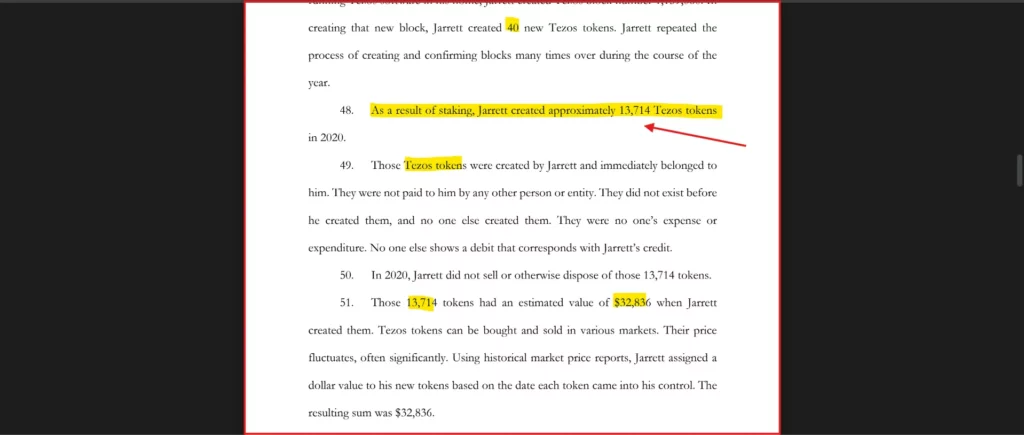
By the end of 2020, Jarrett had created approximately 13,714 Tezos tokens through his staking efforts. These tokens were entirely his creation and immediately belonged to him.
They were not paid to him by any person or entity, nor did they exist before he created them. There were no corresponding debits from others to match his credits.
Importantly, Jarrett did not sell any of these 13,714 tokens in 2020. At their creation, these tokens had an estimated value of $32,836. The value was determined using historical market price reports.
Jarrett used it to assign a dollar value to each token based on the date it came into his control. This valuation highlighted the fluctuating nature of Tezos token prices in various markets.
Jarrett’s Lawsuit Seeking Legal Clarity and Refund
In his latest lawsuit, Josh Jarrett is seeking a refund for the taxes he paid on his 2020 staking rewards. Additionally, he wants an injunction to prevent future taxation on unsold staking rewards.
He argues that the IRS still needs to address the core issue from his previous case fully. This has potentially left him with recurring tax liabilities in the coming years.
“We are supporting a new case to keep pressure on the IRS after it punted the first time”.
- stated by coin center, Neeraj K. Agrawal.
Coin Center, a nonprofit dedicated to cryptocurrency policy research, is backing Jarrett’s case. This lawsuit could set a crucial precedent for how staking rewards are taxed. It can impact many others involved in blockchain validation and staking.
“I’ll continue to provide updates as the case moves forward. This is about ensuring fair taxation and that the IRS can’t sidestep the law through uncertainty. Stay tuned.”
In a post on X, Jarrett mentioned that he will closely monitor the case and update the community on any new developments.
Disclaimer
In this article, the views, and opinions stated by the author, or any people named are for informational purposes only, and they don’t establish the investment, financial, or any other advice. Trading or investing in cryptocurrency assets comes with a risk of financial loss.