
 Doge Pepe
 Bitway
 Pearl
Pearl Pudgy Penguins
 Hyperliquid
 Starknet
 NEAR Protocol
- The Digital Chamber warns LB526 imposes discriminatory taxes on Bitcoin mining.
- LB526 could hinder Nebraska’s competitiveness in the digital economy.
- The Chamber proposes tax holidays to encourage renewable energy use.
The discussion around Bitcoin mining has been ongoing for quite some years now. But it recently accelerated following an interview on Fox News with Perianne Boring, the founder and CEO of the Digital Chamber of Commerce, and became a viral Bitcoin news.
In her appearance, she broke down the implications of President Donald Trump’s executive order on crypto and blockchain. Now that he is the 47th president, his visions could position the country as a leader in digital assets.
Boring emphasized that the executive order aims to protect financial freedom and bolster the dominance of the U.S. dollar. Also, Trump has made it clear that he envisions the U.S. as the crypto capital of the world during his term.
She also shared an introductory clip featuring David Sacks, who stated that his working group under the president is focused on fostering innovation and keeping the industry onshore rather than pushing it overseas, which happened with the previous administration under President Joe Biden.

Also, it is evident that, in a significant move, the SEC recently repealed its mandatory SAB 121 for financial institutions following Trump’s executive orders. This change adds a new layer of fundamental strength to the crypto space.
Echoing the call for innovation, the Digital Chamber has submitted a letter to the governor opposing Nebraska Legislative Bill 526 (LB526). They most probably hope for a similar outcome like the SAB 121 repeal, or changes in the bill to support innovation.
They view it that way and finds it necessary, as LB526 imposes discriminatory taxes and burdens on Bitcoin mining, which threatens innovation and economic growth in Nebraska. Continue reading.
Why Bitcoin Miners Are Facing Trouble in Bitcoin Mining Operations Under LB526?
Globally, it’s well understood that crypto mining involves spending electricity to earn Bitcoin, with the efficiency of mining machines playing a crucial role.
The cost of electricity is a significant factor in this process, alongside the type of hardware used, particularly the energy efficiency of ASIC miners. Every detail matters in Bitcoin mining to maximize daily revenue.
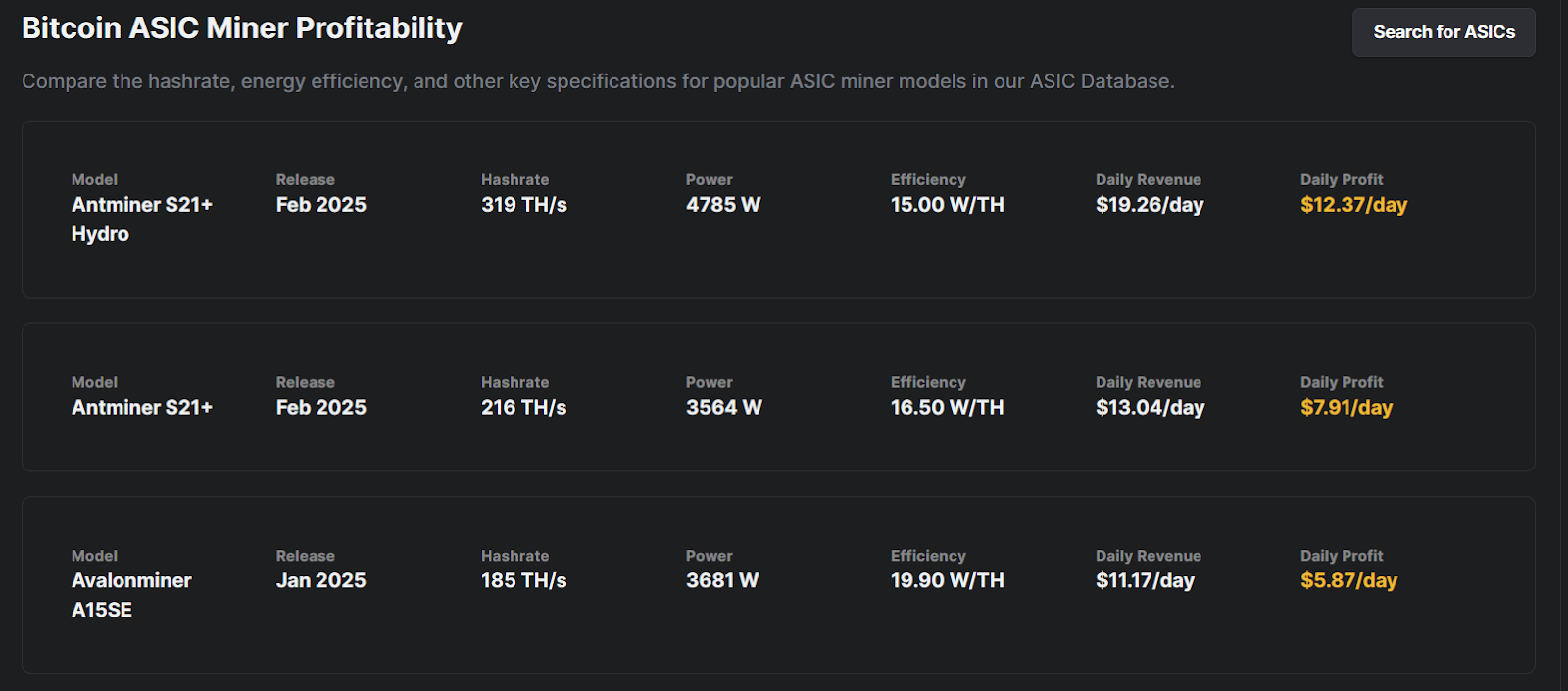
According to the Hashrate Index website, different Bitcoin mining machines consume varying amounts of power measured in watts.
For instance, a high-powered machine using 4,785 watts can generate a daily revenue of $19.26, while a less powerful model at 3,681 watts only brings in $11.17 per day, resulting in a mere $5.87 in daily profit for the miner.
This is where electricity costs become critical and over that to pay additional taxes reduces daily profits from generated revenue.
This bill imposes specific financial and operational conditions on Bitcoin mining, such as direct payments for infrastructure improvements and an excise tax. Which is hindering its growth and innovation.
Notably, these requirements do not extend to other energy-intensive sectors like data centers and cloud services. Which the Digital Chamber of Commerce argues that it creates a “discriminatory regime.”
In its statement, the Digital Chamber highlighted that many Bitcoin mining companies actively manage their energy consumption, reducing usage during peak demand times. This flexibility distinguishes the sector from others that operate continuously without such adjustments.
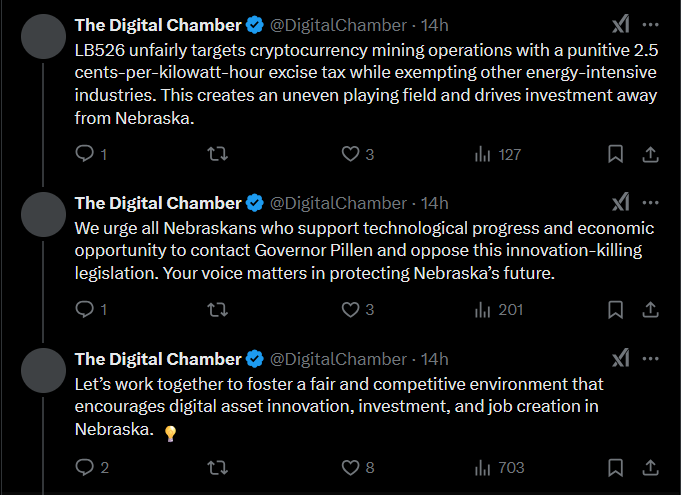
The Digital Chamber cautions that these restrictive policies could hinder State of Nebraska’s ability to attract investment. Especially it hinders when compared to states with more favorable regulations for investors.
Economic Growth, Tax Proposal, and Bitcoin Mining
Furthermore, the Digital Chamber emphasized that crypto mining not only creates jobs but also contributes to infrastructure development.
It acknowledged that mining operations collaborate with renewable energy providers, upgrade the power grid, and implement demand response strategies to enhance energy management.
However, the tax and prepayment requirements outlined in LB526 could deter these investments. In their letter, the Digital Chamber warned that “LB526 threatens Nebraska’s ability to compete in the growing digital economy,” urging policymakers to prioritize cooperation over penalties.
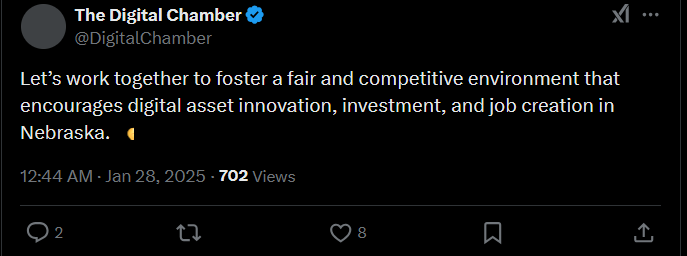
Moreover, LB526 permits public power districts to impose conditions on mining operations, such as requiring payments for infrastructure upgrades.
A growing number of cryptocurrency miners are discovering that using renewable energy sources is more efficient. Yet, the current tax and regulatory measures in LB526 could hinder these advancements in Nebraska.
To promote sustainable Bitcoin mining and attract more investment, the Digital Chamber proposed tax holidays or credits to incentivize miners to adopt renewable energy solutions.
In closing of its letter, the Digital Chamber urged Nebraska lawmakers to oppose LB526 and instead support more rational policies that would benefit the state’s economy and energy future. They argue that such actions could position Nebraska as a leader in the evolving digital economy.
Disclaimer
In this article, the views, and opinions stated by the author, or any people named are for informational purposes only, and they don’t establish the investment, financial, or any other advice. Trading or investing in cryptocurrency assets comes with a risk of financial loss.





