Dacity Coin
 astronaut
 streamoors
 Celestia
 NeoSoul
 Sui
Sui Injective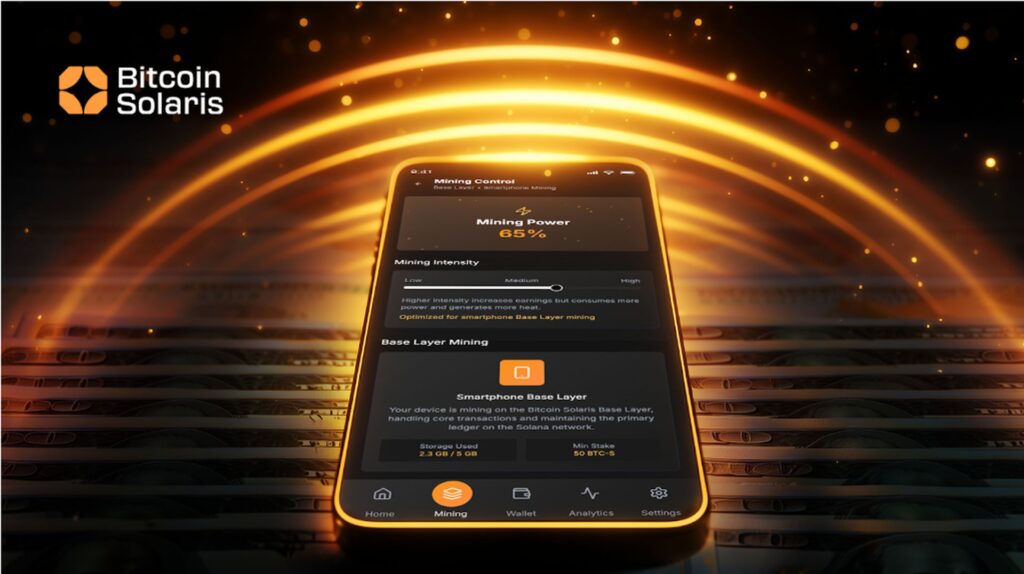
While altcoins drift and staking rewards shrink, a smaller group of users is quietly earning at the protocol layer. Bitcoin Solaris has introduced a mobile mining system through the Nova App that compensates users directly for contributing idle phone resources to the network. In closed beta, average participants reported 5.2% in weekly BTC-S earnings. There are no centralized exchanges or locked assets — just validation output from phones running in the background.
Bitcoin Solaris designed this system to bypass everything that keeps everyday users out of mining. Expensive hardware, technical configuration, and power bills are some of those things. What remains is a simple, scalable earning model anyone with a smartphone can access. Contributors don’t wait for token prices to spike. They mine at the root layer of the economy.
Engineered for Consistency, Not Hype
There’s no randomness in the way Bitcoin Solaris distributes value. The protocol runs on a hybrid architecture, pairing Proof-of-Stake and Proof-of-Capacity at the base with a high-speed layer using Proof-of-History and Proof-of-Time. It allows the network to reach over 10,000 transactions per second with two-second finality and extremely low resource demands.

The Nova App turns this infrastructure into earnings. Users allocate small portions of their phone’s storage and CPU power to validate blocks and confirm transaction sequences. The process doesn’t affect battery life or slow down the device. But the return, measured in BTC-S, is real, consistent, and compounding for users who keep contributing.
Instead of trying to copy Bitcoin’s past model, Solaris rewrote it. And the system works. People are mining on hardware they already own, earning from a network that can deliver.
A Supply Model That Protects the Miner
Tokenomics drive value. If there is an uncapped supply, the incentive to earn eventually collapses. Bitcoin Solaris came with a fixed supply ceiling: 21 million BTC-S tokens. That number will never increase. There’s no post-launch inflation, stealth minting, or team-held liquidity behind closed contracts.
Of that supply, 4.2 million tokens were available during presale. The platform is distributing the remaining tokens through mobile mining and ecosystem deployment. Each unit earned carries more weight as the circulating supply becomes more scarce. That’s why early contributors are in a structurally better position. They’re acquiring the rarest version of value in digital economies: capped, useful, and verifiable.
As of now, Bitcoin Solaris is in Phase 6 of its presale, priced at $6. The expected listing benchmark for BTC-S is $20. This spread is based on liquidity targets and onboarding velocity. That delta creates a second layer of leverage for those securing tokens before full exchange rollout.
Proof in the Code and the Team Behind It
Bitcoin Solaris hasn’t relied on anonymous promises. Every part of the project has been verified through a third-party evaluation. The Cyberscope audit reviewed the protocol’s core smart contracts, validating their functionality and resistance to manipulation. The Freshcoins audit specifically tested the Nova App’s mining model, confirming that it performs as claimed and cannot be gamed.
For additional transparency, the team underwent KYC verification, linking their identities directly to the project’s operational oversight. Few presale-stage projects go that far — and almost none with mobile-first mining architecture.
In his most recent review, Crypto Volt highlights how this layered verification structure makes Bitcoin Solaris stand out. It’s not just compliant — it’s already operational in a form users can measure. The growth potential isn’t a projection. It’s built into the mechanics.
More Than DeFi Yield
Decentralized finance platforms offered big returns in early phases, but most of that yield was backed by speculation, rebasing tricks, or TVL shuffling. Bitcoin Solaris isn’t playing the same game. Its earning model is native. You contribute, and the protocol responds. There’s no middle layer.
When miners join, they don’t pool tokens or stake LP pairs. They run a validation activity on a distributed ledger with fixed issuance. Their phones process transactions. The reward is based on work, not hype. And because the mining model spreads across global smartphones, participation scales cleanly, without bottlenecks or whales.
The Window is Still Open — for Now
There will always be headlines about missed chances. People who didn’t mine Bitcoin in 2011. Didn’t buy Ethereum under $5. Didn’t stake tokens before the APYs collapsed. It is a different phase, but the principle is the same. Bitcoin Solaris is rewarding people directly from its base layer, and the mechanism is already validated.
Beta users earned 5.2% per week with phones that barely noticed they were running. The Nova App rollout will expand that access to the broader public. The earnings curve will tighten as more users onboard and mining grows more competitive.

Website: https://bitcoinsolaris.com/
X: https://x.com/BitcoinSolaris
Telegram: https://t.me/Bitcoinsolaris
Disclaimer: Any information written in this press release or sponsored post does not constitute investment advice. Themarketperiodical and all its authors do not, and will not endorse any information on any company or individual on this page. Readers are encouraged to make their own research and make any actions based on their own findings and not from any content written in this press release or sponsored post. Themarketperiodical.com is and will not be responsible for any damage or loss caused directly or indirectly by the use of any content, product, or service mentioned in this press release or sponsored post.