Pearl
Pearl Bitway
 Monad
Monad Ondo
Ondo Derive
 Walrus
 Zcash
Zcash

Key Insights:
- Ethereum exchange supply drops as 30% of supply remains locked.
- Whales bought 200,000 ETH amid growing accumulation trends.
- ETH outperformed Bitcoin in Q2 2025 returns.
Ethereum exchange supply drops below 18 million as whales scoop up 200,000 ETH. With Q2 returns beating Bitcoin and a new $10K push, ETH may be gearing up for volatility.
Ethereum (ETH) may be setting the stage for aggressive price moves as on-chain metrics point to tightening supply, renewed whale activity, and continued outperformance versus Bitcoin (BTC) in 2025.
Kyle Chassé, founder of Master Ventures, flagged a critical decline in exchange reserves. In a July 8 post on X, Chassé noted that over 30% of ETH supply is now locked, while exchange holdings have dropped to below 18 million ETH, according to data from CryptoQuant. “It’s about to get frothy,” he wrote, signaling tightening market liquidity.
The shrinking exchange reserve has historically preceded major market swings. With less ETH available for sale on centralized exchanges, supply-side pressure may build as demand rises—especially from institutional and whale wallets.
Whales Quietly Accumulate 200,000 ETH Ahead of Supply Crunch
Supporting the tightening narrative, Ali Martinez of CryptoQuant reported that whales accumulated 200,000 ETH over the weekend.
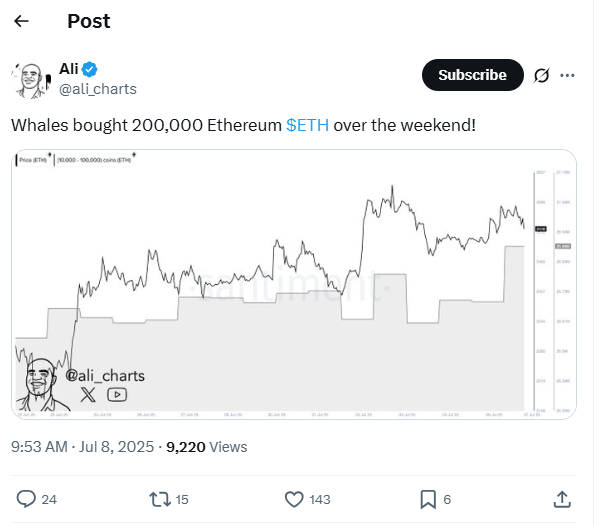
Large wallet holders buying aggressively during low volatility periods often reflects long-term conviction. Martinez didn’t disclose specific addresses, but the move follows weeks of muted exchange inflows. On-chain tracking platforms like CryptoQuant and Glassnode have reported multi-year lows in ETH balances held on major exchanges.
The timing aligns with broader Ethereum ecosystem developments, including institutional fund launches and the approval of ETH spot ETFs in the United States and Hong Kong. These catalysts have yet to fully reflect in market flows, which could amplify demand once new products go live.
Q2 2025: ETH Posts Better Returns Than Bitcoin
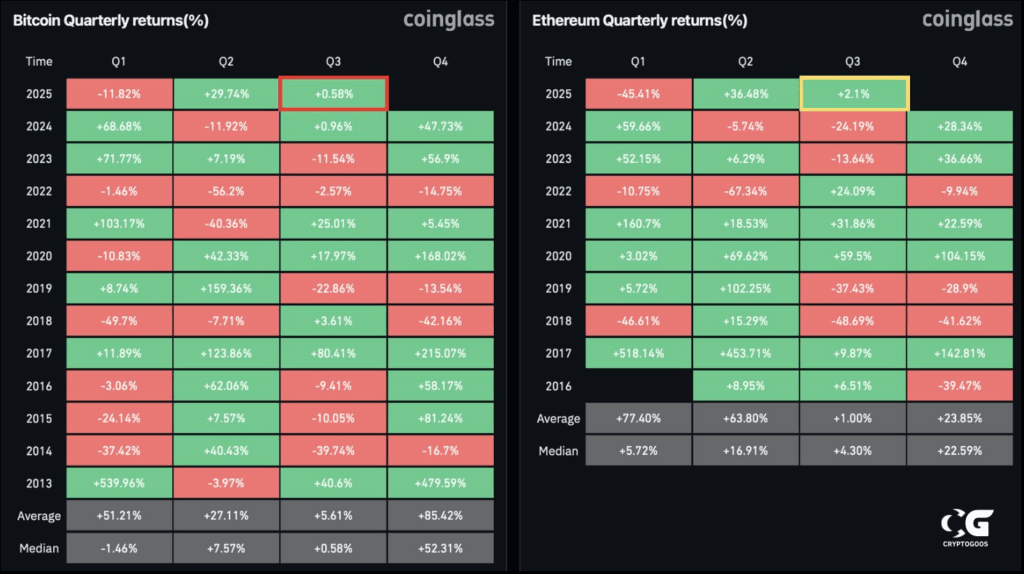
According to CryptoGoos and data from Coinglass, Ethereum outperformed Bitcoin in Q2 2025, posting a +6.84% return versus Bitcoin’s -11.29%. Historical quarterly charts shared on X show ETH has outpaced BTC in three of the last five Q2s. Q3 data is pending but already leans positive for Ethereum, with a modest +2.11% return so far.
The pattern echoes the 2021 cycle when Ethereum consistently posted stronger quarterly gains. Coinglass data shows Ethereum’s average Q3 return since 2016 stands at +22.59%, compared to Bitcoin’s +9.23%. The relative strength reinforces institutional narratives that ETH could outperform during the current cycle, particularly with a shrinking liquid supply.
Ethereum Foundation Launches $10K Ecosystem Push
Adding momentum, the newly formed Ethereum Community Foundation announced a funding initiative aimed at driving long-term growth.
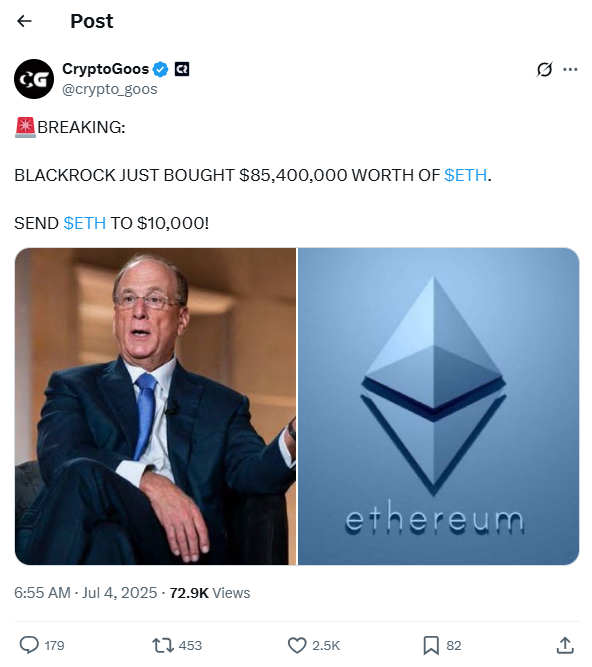
In a post shared on X, the foundation revealed plans to push Ethereum to $10,000 through strategic funding of core infrastructure, community engagement, and ecosystem burns. The timing of the announcement coincides with falling exchange supply and rising on-chain accumulation—both of which are historically bullish signals.
The foundation didn’t disclose specific burn mechanics or timelines but emphasized efforts to support projects contributing to deflationary pressure on the network. Since the London hard fork and EIP-1559, Ethereum has already burned over 4 million ETH from base transaction fees.
Market Liquidity Squeeze Meets Demand Surge
The convergence of factors whale accumulation, lower exchange balances, improved quarterly returns, and institutional ecosystem investment has begun to reshape Ethereum’s near-term outlook.
While ETH traded near $3,065 at the time of writing, according to Coinglass, bulls now look toward reclaiming key technical levels. A breach above $3,250 would place ETH back in the territory seen during April’s rally, when expectations for the spot ETF approval triggered inflows from retail and institutional participants.
Sentiment across the Ethereum derivatives market remains neutral, with open interest and funding rates showing little speculative excess. However, a continued supply squeeze could force short positions to unwind, fueling upside momentum.
As supply exits exchanges and long-term holders consolidate positions, the question remains: how long can ETH stay this quiet?
Disclaimer
This article is for informational purposes only and provides no financial, investment, or other advice. The author or any people mentioned in this article are not responsible for any financial loss that may occur from investing in or trading. Please do your research before making any financial decisions.