
 Doge Pepe
 Zylo Ecosystem
 Pearl
Pearl Optimism
 Bitway
 NEAR Protocol
 Pons
Pons

Key Insights:
- El Salvador moved its Bitcoin reserves into several wallets for stronger security.
- Monero developers proposed new rules to fight selfish mining.
- Both steps focused on reducing risks from future quantum threats.
El Salvador has spread its Bitcoin reserve across several wallets, while Monero developers are working on new defenses against selfish network mining.
Both moves were aimed at reducing risks, including possible threats from future quantum computers and attempts to exploit blockchain networks.
El Salvador Shifts Bitcoin for Safer Storage
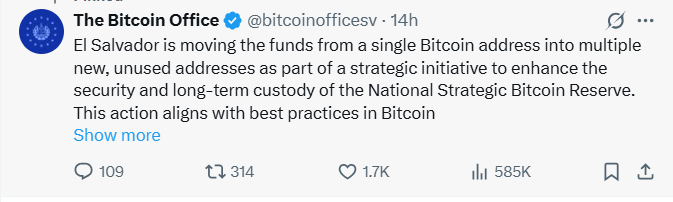
El Salvador’s Bitcoin Office said it moved national reserve funds from one wallet into several new ones.
Each wallet now holds up to 500 Bitcoin. The office described the move as a step toward better security and long-term storage.
The decision was tied to concerns about future advances in quantum computing.
Quantum computers, if developed far enough, could use a method called Shor’s algorithm to break the cryptography behind Bitcoin.
That would allow attackers to discover private keys from public ones and take control of funds.
Unused Bitcoin addresses are considered safer because their public keys are hidden. Once money is spent, the public key becomes visible on the blockchain.
This visibility could give a quantum computer time to guess the private key and move the funds before the transaction is complete.
By spreading funds across wallets, the country reduced the amount at risk if one address were attacked.
Officials also ended the practice of reusing the same address, which had left public keys exposed for long periods.
A public dashboard was created so people could still track the reserve without the need to reuse addresses.
The change followed widely accepted practices in Bitcoin management.
It was presented as preparation for future challenges while maintaining open reporting on the reserve.
Monero Developers Confront Selfish Mining
In another development, researchers in the Monero community looked at how to limit selfish mining.
This is a strategy where a pool with more than 25% of the network’s power can delay block releases to gain higher rewards.
Unlike a 51% attack, it does not require full control of the network but can still disrupt it.
Developer Tevador proposed a system called “Publish or Perish,” also known as PoP.
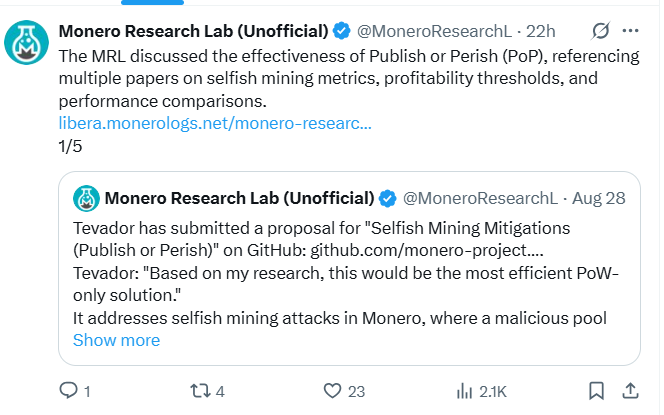
The plan included a soft fork to make selfish mining less profitable by adjusting how blocks are weighed and allowing uncle blocks.
A second step involved a hard fork with “Reward Splitting,” which would divide rewards in ways that reduce incentives for attackers.
It is worth noting that other community members debated whether PoP was the best option.
Some pointed to research showing it performed well compared with other methods. Others raised doubts based on later papers that showed limits in its effectiveness.
Another idea came from researchers who suggested learning systems that adjust miner choices in real time to block selfish strategies.
That proposal did not require a fork but relied on timestamps, which some said could be manipulated.
In addition, the discussions also touched on advanced models, such as Markov Decision Processes, to test how different mining rules would perform.
The aim was to confirm how much power an attacker would need before selfish mining became profitable.
Focus on Custody and Long-Term Safety from Quantum Computers
It is important to add that both cases showed how cryptocurrency groups are looking at long-term risks.
For El Salvador, the focus was on protecting a national reserve that holds thousands of Bitcoin.
Additionally, for Monero, the focus was on keeping its network fair and preventing miners from gaining more than their share of rewards.
Furthermore, advocates repeated the call for self-custody, noting that holding private keys directly remained the most reliable way for individuals to protect their funds.
Governments and developers are working on wider protections, but at the personal level, control of keys is still central to security.
These steps showed broader efforts to prepare for possible advances in quantum technology and new forms of network attack.
While no quantum computer has yet shown the ability to break Bitcoin’s cryptography, planning was seen as necessary.
Splitting funds into smaller parts and changing mining rules remain two ways different communities are trying to stay ready for future risks.
Disclaimer
This article is for informational purposes only and provides no financial, investment, or other advice. The author or any people mentioned in this article are not responsible for any financial loss that may occur from investing in or trading. Please do your research before making any financial decisions.





