
 Wisp
Wisp Doge Pepe
 Crawlerpad
 Zylo Ecosystem
 Pearl
Pearl Basic Attention
 Quantus

As the market crashed, activity on the blockchain surged, with some platforms seeing downtime and stress. Some traders were exiting positions to minimize losses. Others saw the dip as a buying opportunity and went long.
Most cryptocurrencies made their yearly lows during the crash. However, the decentralized finance (DeFi) category has proven resilient in the face of its competitors. Thus, this market crash triggered the DeFi vs. centralized exchanges (CEXs) debate again.
Major platforms, such as Binance, experienced downtime and transaction delays. On the contrary, Hyperliquid (HYPE), Uniswap (UNI), and Aave Protocol (AAVE) remained operational without disruptions, with record activity.
Uniswap and Aave Founders on DeFi, CZ Calls Out Binance
Uniswap co-founder Hayden Adams seconded that this sell-off showed that DeFi worked differently. Adams pointed out that Uniswap processed around $9 Billion in transactions smoothly. This volume was slightly above the usual levels. This indicated strong liquidity.
In the meantime, Stani Kulechov, the founder of Aave, stated that DeFi had successfully passed its most significant stress test. The $75 Billion lending protocol succeeded in automatically selling collateral to the tune of $180 Million in under an hour.
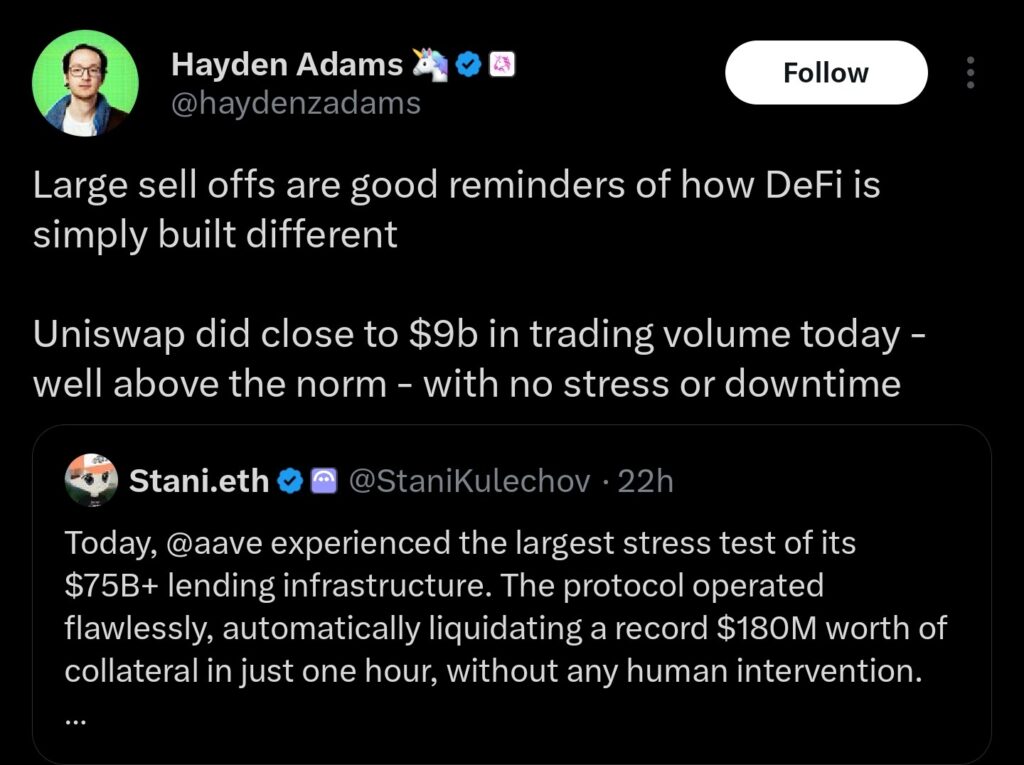
Both founders highlighted DeFi’s automation and transparency. They believed it handled extreme market pressure more effectively than CEXs. This validated its consistency and increasing prevalence in the crypto space.
On the other hand, CZ Binance called out CEXs on X to protect users as allegations of manipulation escalated. However, Binance clarified that it would handle compensation for all those liquidated due to platform issues.
The debate did not end at volume and resilience. DeFi protocols were also highly active. By singling out Hyperliquid DEX, the activity also indicated another hint.
Is DeFi Toppling CeFi? Activity on DeFi Protocols vs. CEXs
Activity on DeFi ecosystems spiked. This was reflected in the large losses seen across multiple addresses, with some being wiped out completely.
Traders took advantage of price dips on DeFi platforms. Unlike CEXs, these platforms allowed quicker access during the crypto market crash.
For context, more than 1,000 wallets were wiped out on Hyperliquid DEX. Additionally, an excess of 6,300 wallets resulted in more than $1.23 Billion in losses. Out of these, 205 wallets lost more than $1 million, and 1,070 of them lost over $100,000.

On CEXs like Binance, complaints were made about buy orders failing to fill and wrongful liquidations due to system issues.
Tokens were dumping harder on Binance than on protocols like Jupiter. Pump.fun (PUMP) price action, along with other cryptocurrencies, was an example.

DeFi continued to demonstrate strong transparency. It also shows sufficient liquidity and resilience to process large transactions more efficiently than CEXs.
The volume traded on HYPE, UNI, and AAVE was a testament, but did not give certainty. However, DEXs still had considerable work to do.
How Did DeFi Tokens Perform?
In terms of price movement, the category faced a similar fate as the broader market. On the second day of the crash, DeFi tokens extended their fall, with HYPE losing 26%, trading at $36.
UNI dropped 28.0% to $5.83, and AAVE dropped 20.0% to $226.50. Ethena (ENA) fell 38.4% to $0.3676, while Aster (ASTER) crashed 44.1% to $1.21.
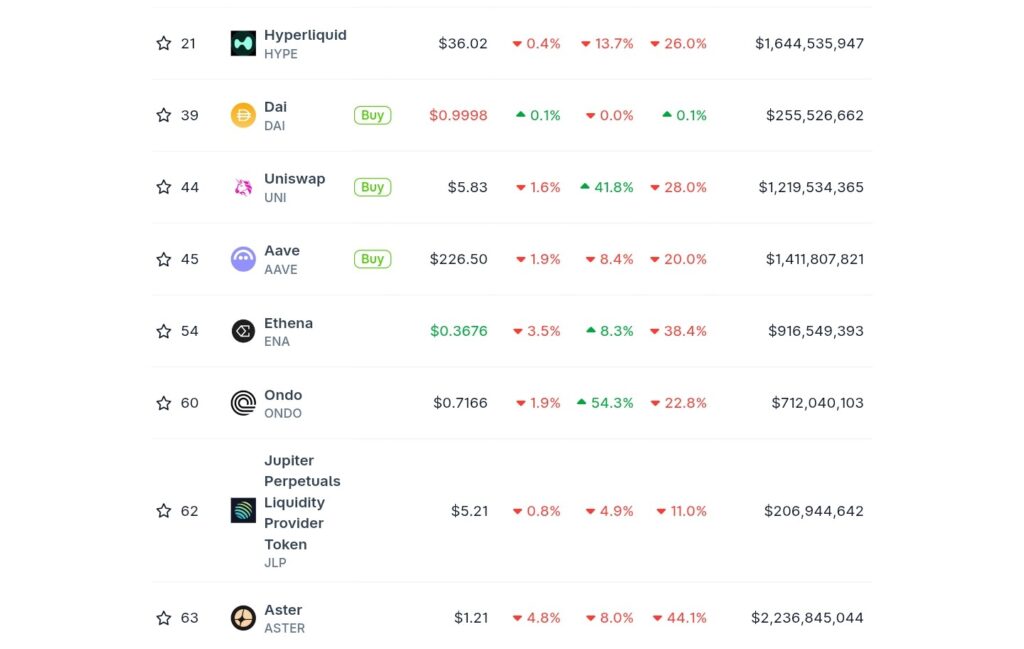
Conversely, USD-pegged Dai (DAI) showed no growth or loss, unlike Ethena’s USDe on Binance. Jupiter Perpetuals (JLP) fell 11.0%. These pointed to severe declines in most DeFi assets, with the one exception of the stable DAI.





