
 NEAR Protocol
 Bitcoin
 Puffer
 Hyperliquid
 ZKsync
 Pudgy Penguins
 Pearl
Pearl

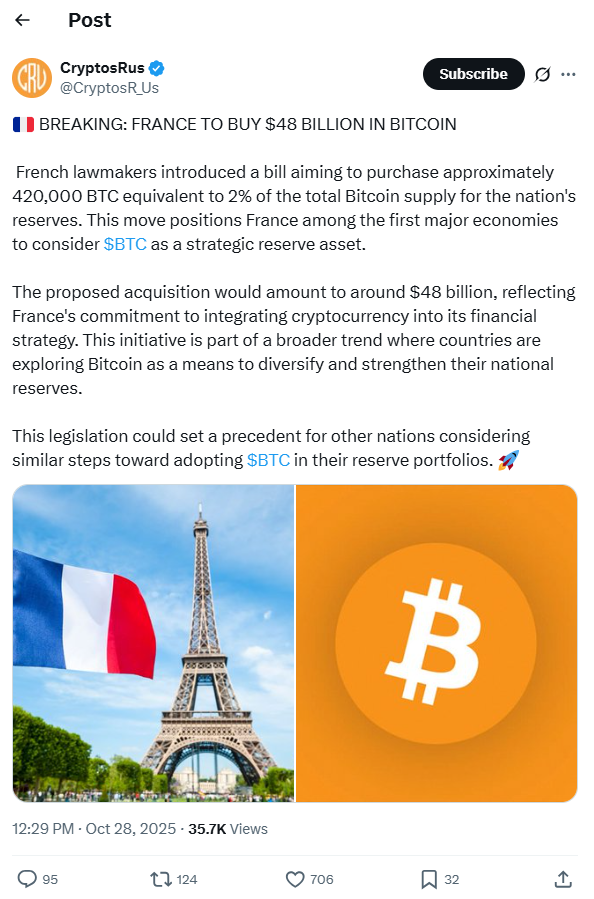
French lawmakers are debating legislation that would position France as the first European nation to establish a Bitcoin strategic reserve.
The proposed bill, introduced by the Union of the Right and Center Party and led by Éric Ciotti, aims to acquire approximately 420,000 BTC over the next seven to eight years.
This is roughly 2% of Bitcoin’s fixed 21 million coin supply, with an estimated value of $48 billion at current market prices.
France proposes historic Bitcoin reserve acquisition
The proposed bill establishes a public administrative institution dedicated to holding and managing the Bitcoin reserve.
The stated objectives include diversifying France’s foreign exchange reserves, strengthening financial sovereignty, and positioning the country as a leader in digital asset adoption. Achieving the 420,000 BTC target would make it one of the largest government-held cryptocurrency reserves globally.
The acquisition timeline spans seven to eight years, allowing for a gradual accumulation through multiple channels.
France’s proposal arrives at a time when several nations are exploring cryptocurrency as a means to strengthen national reserves.
Funding mechanisms for Bitcoin accumulation
The bill shares several funding sources for building the Bitcoin reserve. Public Bitcoin mining using France’s surplus nuclear and hydroelectric energy is the first major component.
France generates over 70% of its electricity from nuclear power, often producing more capacity than domestic demand requires.
Systematic retention of seized Bitcoin from judicial procedures forms another funding pillar. Currently, France auctions confiscated cryptocurrency.
The new approach would direct these assets into the strategic reserve instead.
The most important funding source involves allocating approximately one-quarter of funds from Livret A and LDDS savings accounts for daily Bitcoin purchases.
These popular savings vehicles would contribute roughly €15 million per day toward secondary market purchases. This alone would account for over 130,000 BTC during the initial three-year period.
The bill also explores allowing tax payments in Bitcoin, though this provision requires constitutional approval.
Broader cryptocurrency policy reforms
Beyond the Bitcoin reserve, the legislation includes several pro-cryptocurrency provisions affecting France’s digital asset ecosystem.
The bill proposes recognizing euro-backed stablecoins as legitimate payment methods nationwide. This would expand cryptocurrency usage beyond speculative investment into everyday transactions.
Tax exemptions for small stablecoin transactions up to €200 per day aim to encourage adoption for routine payments.
The bill calls for loosening European Union MiCA regulations on stablecoin issuance, arguing current restrictions limit innovation.
Political challenges facing France’s Bitcoin bill
The proposal faces significant political obstacles that could hinder its passage in its current form.
The Union of the Right and Center Party currently holds only 16 seats in the National Assembly, providing limited power to advance major legislation.
The proposal’s €15 million daily spending from savings accounts could face opposition from those questioning the appropriateness of directing retail savings toward cryptocurrency markets.
The proposed legislation represents a complete reversal of France’s earlier stance on cryptocurrencies. In 2016, political leader Marine Le Pen called for a complete ban on Bitcoin.
She argued cryptocurrencies served “Wall Street investment banking lobby” interests rather than French citizens.
France’s transition accelerated with the 2019 PACTE Law, which established a comprehensive regulatory framework for digital assets.
The legislation introduced the concept of Digital Asset Service Providers and brought most cryptocurrency activities under regulatory oversight. Over 100 companies registered under this regime.
By March 2025, Le Pen publicly supported using surplus electricity to mine Bitcoin and even called it “a secure and extremely profitable solution.”



