
 Pearl
Pearl ZKsync
 Bitcoin
 Starknet
 Quantus
 Puffer
 Lighter

According to Argentine national daily La Nacion (”The Nation” in Spanish), the Latin American country’s central bank announced that it would consider allowing banks to offer crypto trading services. According to La Nación, the Banco Central de la República Argentina (BCRA), Argentina’s central bank, was drafting a relevant regulation but did not provide any further details.
La Nacion reported that, according to an Argentine crypto exchange, the approval is likely to materialize in April next year. Argentine banks are prohibited from offering crypto services due to a BCRA decree passed in 2022.
Meanwhile, President Javier Milei’s administration announced a new bond called ‘Bonar’ last Friday, aiming to rebuild international investor confidence, according to Reuters. Argentina faces significant debt obligations on its national balance sheet.
Could BCRA Reverse Its 2022 Prohibition on Banks?
Presently, a BCRA resolution prohibits banks from facilitating trade in digital assets. The resolution — BCRA 7506 — restricts banks to financial intermediation services. It was passed in May 2022, days after a few private banks launched crypto services.
The latest development would mean the central bank will reverse or significantly modify its earlier resolution.
In 2022, major national banks in Argentina, including Banco Galicia, Brubank, and Ualá, launched limited forms of crypto custody and transaction services, according to La Nacion. Galicia’s services covered Bitcoin (BTC), Ethereum (ETH), USDC, and XRP at the time, according to the national daily.
BCRA’s ban on banks’ crypto services came amid rising debt restructuring pressure from the International Monetary Fund (IMF) and defaults. However, the new Milei administration is expected to execute major economic reforms. Additionally, crypto volatility was a key discouraging factor for the financial regulator.
Reuters reported that Bonar, the new government bond announced on December 5th, is part of the Milei administration’s push to rebuild global investor confidence in the South American nation. Its first auction will take place on December 10th. This month, Argentina is scheduled to repay $27.68 million in maturities, and in January 2026, it is set to repay $4.5 billion, according to Reuters.
La Nacion consulted multiple major crypto exchanges operating in the country, including Lemon and Bitso. Public affairs representatives from these exchanges told the news agency that they welcomed the move. However, they noted that commensurate regulatory changes would also be required.
Reportedly, the Fernandez administration repealed a tax exemption provided to cryptocurrency service providers. A Bitso representative that La Nacion consulted noted that the exemption must be reinstated to level the playing field.
Approval Could Boost Crypto Mass Adoption in Argentina
The Bitso representative added that if BCRA were to permit banks to offer crypto services, banks would have to choose from major options. Either they offer the crypto services themselves, but for they will have to register as digital asset service providers.
Alternatively, they could partner with existing registered entities like crypto exchanges, according to Bitso’s statement to La Nacion. Partnering with existing digital asset services providers could significantly cut technological upgradation and custody costs.
The exchanges La Nación consulted said that the approval could spur the mass adoption of cryptocurrencies in the country. Familiarity with existing financial institutions would encourage people to accept cryptos and the exchanges.
However, centralized exchanges are already playing a key role in driving cryptocurrency adoption in Argentina and the broader Latin American region.
According to the Chainalysis Crypto Geographies Report 2025, centralized exchanges account for an estimated 64% of crypto activity in Latin America (Latam), second only to the Middle East and North Africa (MENA) region (66%).
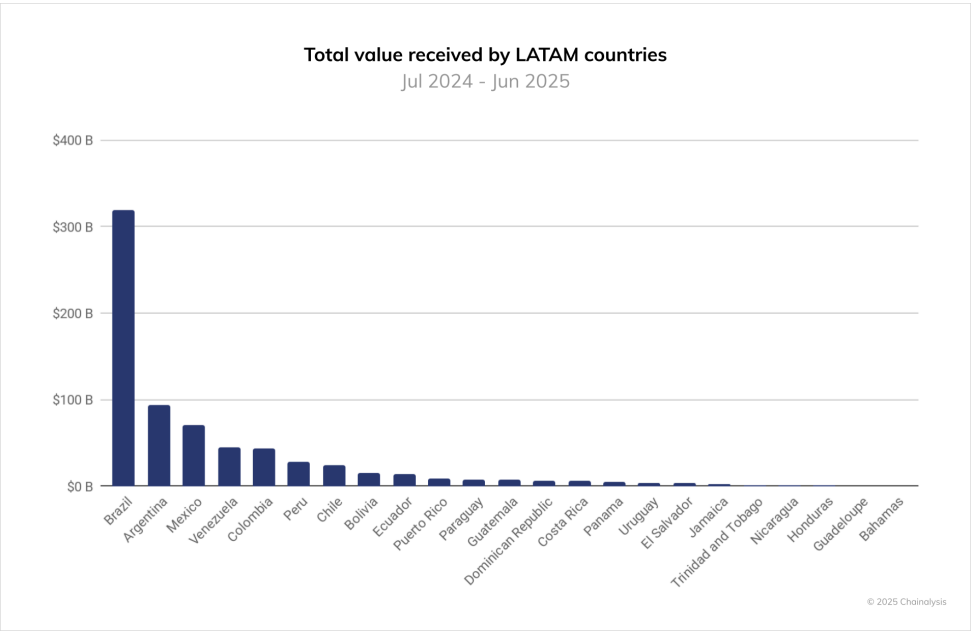
Argentina places second in terms of total crypto value added ($93.9 billion) from July 2024 to June 2025. It was second only to Brazil ($318.8 billion).
Citing orderbook data, Chainalysis noted that over half of exchange activity in Argentine Pesos, like some other Latam currencies, was stablecoin purchases.
Stablecoins are popular in the region, particularly in Argentina, due to high inflation and currency instability. Remittances are one of the major use cases of stablecoins in the region.



