
 Pearl
Pearl Bitway
 Walrus
 Optimism
 Pons
Pons Quantus
 NEAR Protocol

Tether’s USDT stablecoin has reached a new milestone in Abu Dhabi and potentially in the overall Middle East and North Africa (MENA) region. On December 8, 2025, the Financial Services Regulatory Authority (FSRA) of the Abu Dhabi Global Market (ADGM) recognized USDT as an Accepted Fiat-Referenced Token (AFRT). Tether shared the official approval decision in a Monday press release.
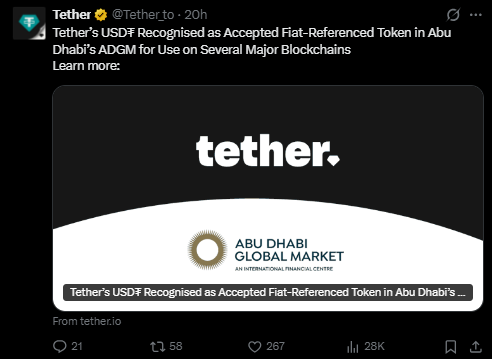
This approval expands its earlier recognition from October 2024. Licensed institutions can now use USDT across twelve blockchains.
The decision strengthens Tether’s legal status in the Middle East. USDT’s market cap now stands at about $185.7 billion, showing its global dominance.
Expansion Across Multiple Blockchains
The new approval allows USDT to operate on nine additional networks. These include Aptos, Celo, Cosmos, Kaia, Near, Polkadot, Tezos, TON, and TRON.
This builds on the earlier approval in October 2024. That recognition covered Ethereum, Solana, and Avalanche. With this expansion, USDT is now supported on twelve blockchains. This makes it a versatile tool for cross-chain operations.
ADGM-licensed firms such as banks, exchanges, custodians, and payment providers can now legally custody, transfer, and use USDT. They can integrate the stablecoin into regulated financial activities.
Paolo Ardoino, CEO of Tether, said the decision shows both entities’ commitment to financial inclusion and innovation. He emphasized that the approval aligns with Tether’s efforts to improve transparency and compliance.
Abu Dhabi’s Regulatory Framework
The ADGM was established in 2015 on Al Maryah Island. It has quickly become a blockchain-friendly jurisdiction. In 2024, ADGM introduced a comprehensive stablecoin regulatory framework.
This framework requires issuers to maintain full reserves. It also mandates regular audits and strict compliance with anti-money laundering (AML) and know-your-customer (KYC) standards.
USDT now joins other approved stablecoins in the ADGM registry. These include Circle’s USDC, PayPal’s PYUSD, and USD1. This recognition underscores the UAE’s ambition to become the “crypto capital” of the Middle East.
The UAE has invested heavily in digital assets. With its oil wealth and strategic location, the country aims to diversify its economy.
ADGM’s progressive policies have attracted major players such as Binance and Kraken. Plans for an AED-pegged stablecoin also show the intent to connect blockchain with traditional finance.
Impact on Tether and the Region
For Tether, the approval could accelerate USDT’s integration into sectors like real estate and traditional finance. Earlier partnerships, such as with Reelly Tech for property transactions in the UAE, highlight the potential of stablecoins in high-value deals.
Industry experts see this as a strategic win for Tether. The company has faced scrutiny over reserves and transparency. It settled with the New York Attorney General in 2021 and continues to face debates about its backing.
Despite controversies, Tether remains dominant in the stablecoin market. The ADGM endorsement adds legitimacy. It may ease concerns for institutional users and regulators worldwide.
On the social media platform X, the news sparked excitement. Some pointed to the role of regulated adoption in Abu Dhabi.
Analysts predict increased USDT usage in the Middle East and North Africa. Remittances and trade in the region rely on efficient payment rails. With global stablecoin transaction volumes surpassing $10 trillion annually, ADGM’s framework positions the UAE to capture growth.
Challenges remain. Geopolitical tensions and evolving regulations, such as the EU’s MiCA framework, will shape the industry’s future.
Still, Tether’s multi-chain recognition in ADGM strengthens its edge against rivals like USDC. It also reinforces the UAE’s role as a global hub for digital finance innovation.




