
 Doge Pepe
 Bitway
 Optimism
 Pearl
Pearl Pons
Pons Quantus
 Starknet

In its response to MSCI during the designated consultation period, Strategy (MSTR) emphasized that Bitcoin treasury companies represented a novel business model, an innovation that must not be stifled.
Concerns about volatility and spillover effects on other assets have raised concerns among institutions regarding adopting and accepting cryptocurrencies.
MSCI is consulting for a proposal to remove from its global investable indices those companies whose net assets include 50% or more in digital assets. Strategy and 38 similar companies that fit that criteria face potential exclusion from MSCI’s global investable indices. Globally, publicly traded companies held around 1.06 million BTC as per Bitcoin Treasuries(dot)net as of November 30th.
Bitwise Calls Out MSCI
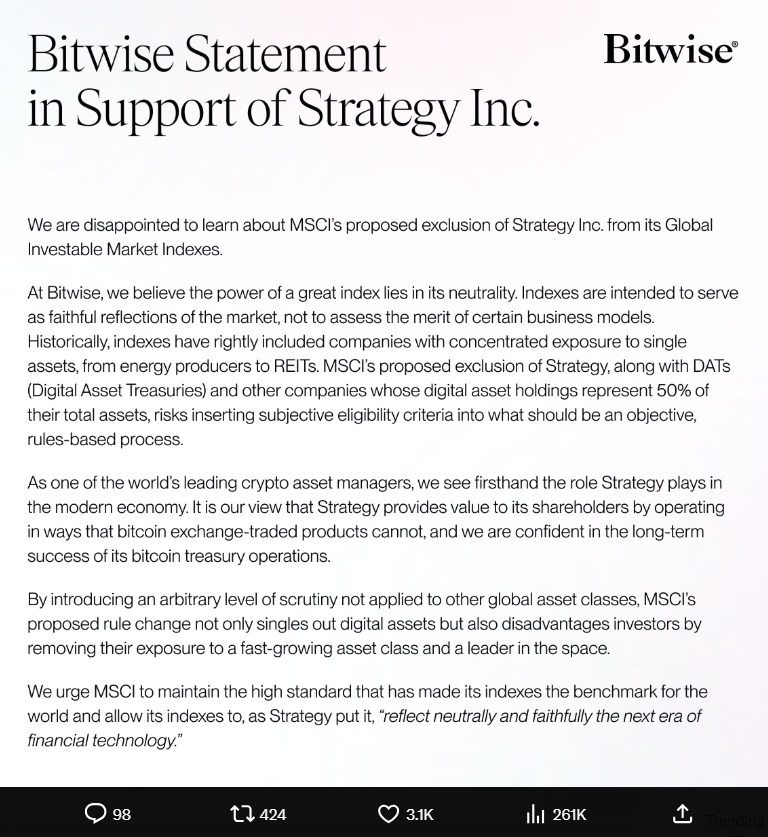
American asset management giant and leading ETF sponsor, Bitwise, in a support statement for Strategy, urged MSCI to remain neutral, echoing Strategy’s letter.
The leading asset manager pointed out that MSCI’s proposal would insert a ‘subjective eligibility criteria’ for digital assets. It emphasized that MSCI did not apply similar screening rules for other assets. It added that if the proposal were to be cleared, investors would lose the opportunity to gain exposure to a rapidly growing asset class.
Bitwise sponsors multiple cryptocurrency spot Exchange-Traded Funds (ETFs). As of December 12th, 2025, collectively, Bitwise crypto spot ETFs hold around $4.9 billion in net assets.
In the US, crypto spot ETFs were cleared for trading in January 2024, marking a significant regulatory and evolutionary milestone in the history of the crypto market. As of today, US BTC Spot ETFs hold aroud 1.5 million BTC. Vanguard, the world’s second-largest asset manager, which is often considered to represent the most conservative and long-term focused investors, has opened up to crypto ETF investments.
Notably, US altcoin spot ETFs were accumulating steadily, seemingly unfettered by delisting concerns. MSCI’s October 10 proposal allegedly spooked institutions. Market commentators attributed the October 10 ‘flash-crash’ that set off over $19 billion in liquidations, to MSCI’s proposal.
In an elaborate response to MSCI, Strategy co-founder Michael Saylor and CEO Phong Le urged the index provider to reject the proposal. Among several discussion points presented in their December 11th letter, Saylor and Le argued that the 50% threshold was ‘discriminatory, arbitrary, and unworkable’.

A signature campaign by Bitcoin for Corporations had recorded 619 signs at the time of writing.
39 Companies Face Potential Exclusion From MSCI Indices, Including 24 US Cos
24 of the 39 companies that could be affected by the proposal are based in the USA. The list also includes four Chinese companies and three Japanese countries. Tokyo-registered Metaplanet (TYO: 3350), the second-largest BTC Treasury company is part of the list.
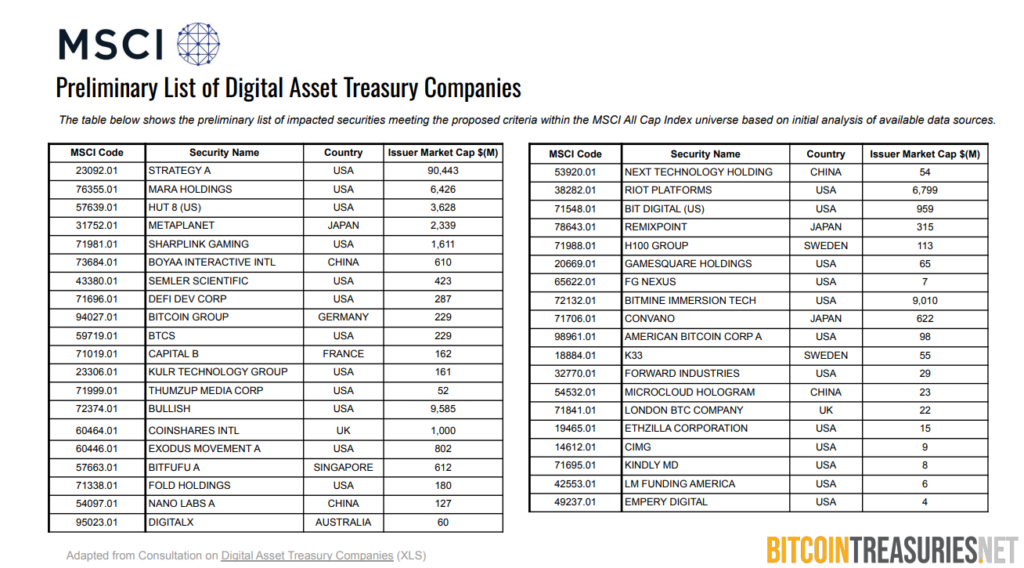
The world’s largest Ethereum (ETH) treasury company, BitMine Immersion Technologies Inc. could also be affected by the proposal. Other notable names on the list include Bitcoin miners Riot Platforms and Hut 8.
MSCI isn’t the only global financial institution that has expressed concerns regarding DATs. Japanese Exchange Group (JPX), the Australian Stock Exchange (ASX), and even Nasdaq are considering special screening criteria for these companies.
While concerns regarding investor protection are justified and understandable, the growth of DATs can’t be ignored. Bitcoin Treasuries(dot)net tracks 195 public companies globally that hold Bitcoin. Of these, the data aggregator noted, they began tracking 130 in 2025 alone. Moreover, they estimate roughly 5000 BTC to be accumulated by DATs by December end.
Delisting fears remain for now; however, they are unlikely to affect the long-term growth of these companies. Meanwhile, a favourable decision from MSCI would catalyse their growth and expand global financial markets.




