
 Pearl
Pearl Puffer
 NEAR Protocol
 ZKsync
 Bitcoin
 Solana
 Starknet

Stablecoins are gradually outperforming banking institutions due to their numerous advantages. This has been evident as nations and states continue to embrace the technology.
After launching the first U.S. state-backed stablecoin, FRNT, the token is now expanding into other chains. This development became the new norm worldwide. Here are some of the details that illustrate why this is the case.
FRNT Launches on Solana, Impact on Stablecoin Supply on Solana
The Wyoming Stable Token Commission, which issued the first U.S. state-backed stablecoin, FRNT, has expanded its user base.
The stablecoin became available on the Solana blockchain through the Kraken exchange. Thus, people in Wyoming can buy FRNT on exchanges. This made it easy and cheap to send and receive money.
This was a one-of-a-kind addition to the over $310 billion stablecoin market. These reserves would help Wyoming’s school programs.
This move focused on two objectives: one was lowering counterparty risk. The other was making it easy for both retail and institutional users to audit transactions right away.

Following FRNT’s launch, the supply of Solana’s stablecoin increased by more than $900 million in just 24 hours, according to the Kobeissi Letter on X. This indicated that a significant amount of money was flowing into the crypto market.
This rise was in line with other events. For instance, the launch of Jupiter‘s on-chain stablecoin and Morgan Stanley’s filing for a spot Solana ETF were in line with this rise.
The expansion showed that Solana was becoming more liquid. That way, more traders would use the network. However, the long-term effects on market dynamics were still unknown as regulations were often changing.
Institutions Stay Bullish on Stablecoin Rails, Volume Hits $3T Surpassing Visa and Mastercard Combined
Again, institutions were wary of the crypto volatility but welcomed the infrastructure of stablecoins. This was evident from monthly transaction volumes of $3 trillion. This amount was more than what Visa and Mastercard could handle together.
The difference showed that stablecoins were outpacing traditional card networks in payments and yield. Stablecoin rails handle fewer transactions, charge lower fees, and settle faster. This procedure differs from traditional banking systems, which often require intermediaries and can take several days to clear.
Again, these dollar-pegged stablecoins let you send money across borders. They eliminate the risks that come with volatile assets like Bitcoin.
Banking institutions like JP Morgan launched their JPM Coin in 2019, aligning with stablecoin rails. Now, institutional tokenized payments are available.
Stablecoins could change the way money moves around by combining traditional oversight with blockchain efficiency. This would make them more widely used as more banks come up with similar solutions.
Stablecoin Market Cap
Meanwhile, the stablecoin market cap stood at $310 billion at the time of writing. The crypto sector grew steadily from almost nothing in 2017 to surpass $50 billion by the end of 2020. It then shot up to $150 billion by 2021 and peaked at $250 billion in 2022. The cap then fell to around $150 billion in 2023 and then rose again to $310+ billion by the end of 2025.
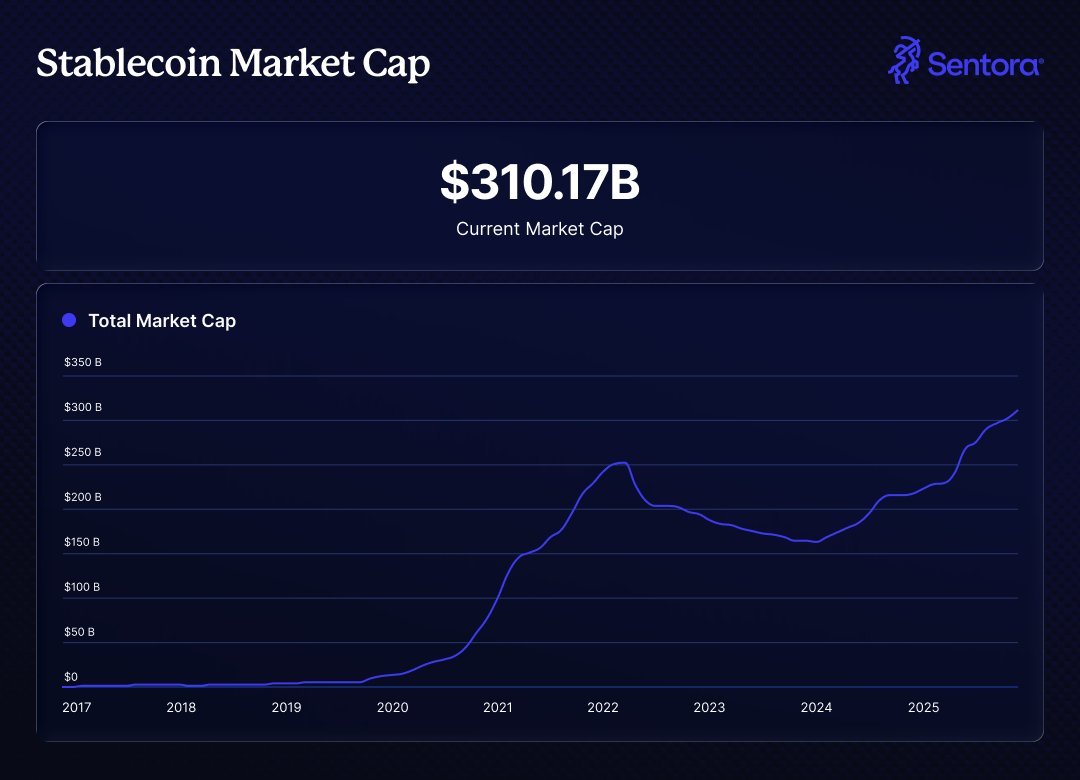
This path indicated that growth was strong even when the market was weak, especially at the end of 2025. This suggested that growth could continue through 2026. That would make stablecoins necessary for global on-chain payments.
The 158% rise from the lows of 2023 demonstrated the importance of stablecoins. They made transactions that were quick and stable as more people continued to embrace crypto.



