
 Puffer
 Bitcoin
 ZKsync
 NEAR Protocol
 Walrus
 Pearl
Pearl Ondo
Ondo
Key Insights:
- The SEC has approved the first yield-bearing stablecoin, issued by Figure Certificate Co.
- YLDs will offer holders interest by investing reserves in U.S. Treasuries and securities.
- This marks the first time stablecoin holders can receive direct returns on their assets.
The U.S. Securities and Exchange Commission’s (SEC) Division of Corporation Finance has released detailed guidance addressing the legal framework applicable to specific types of stablecoins. These stablecoins, now defined under a new term—“Covered Stablecoins”—refer exclusively to digital assets designed to maintain a one-to-one value with the United States Dollar.
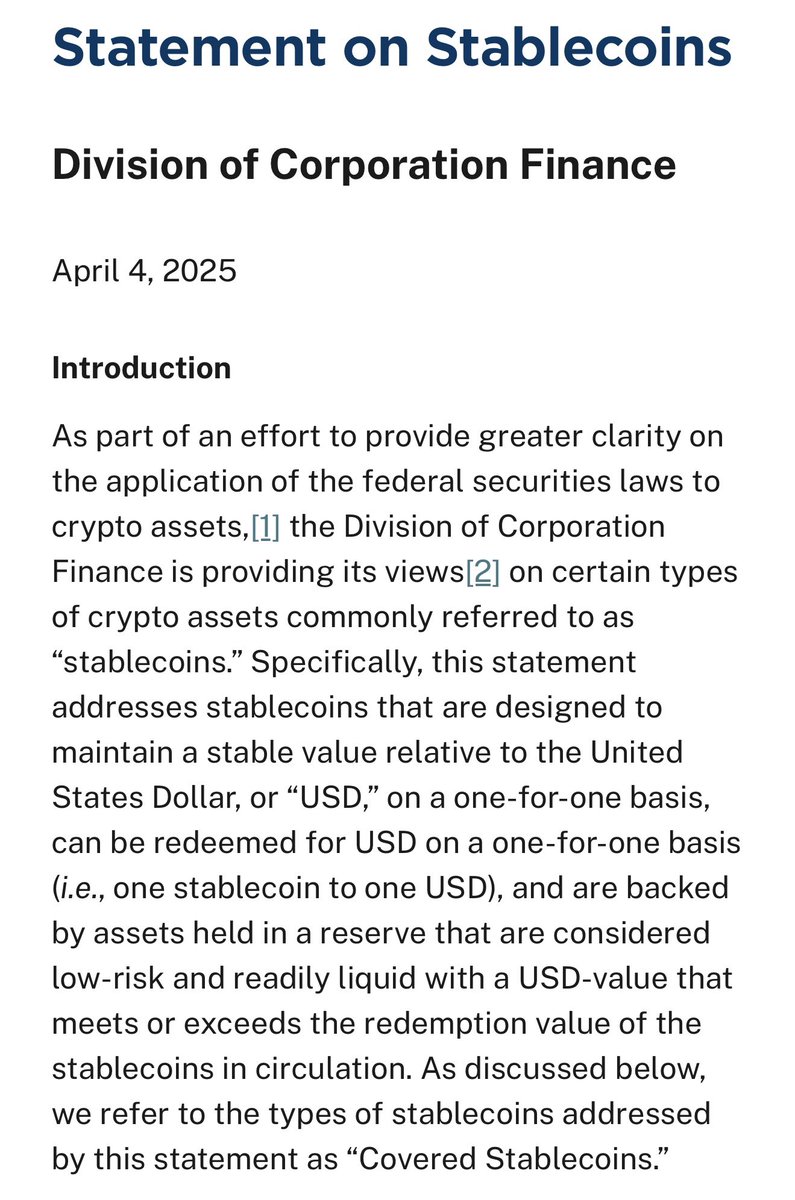
The Division’s position indicates that these particular stablecoins, when structured and operated as described, do not meet the definition of a “security” under federal law and, consequently, fall outside the SEC’s registration requirements. This stance draws a clear line separating Covered Stablecoins from other crypto assets such as algorithmic and yield-generating stablecoins, which are not covered by this guidance as of now.
Definition and Structure of Covered Stablecoins
Covered Stablecoins, in the Division’s words, are crypto assets which have a one-for-one peg to the U.S. Dollar. These are USD-redeemable, low-risk, liquid instrument-backed assets. The size of such reserves must be enough to cover or exceed the sum of the total redemption value of the stablecoins in circulation.
Covered Stablecoins may be minted and redeemed either directly by holders or through designated intermediaries. In some cases, only authorized intermediaries can handle minting and redemption. In others, all holders may do so. Regardless of the setup, issuers maintain a fixed-price redemption mechanism, stabilizing market prices.
This design allows entities to exploit arbitrage when market prices deviate from the pegged value. If the price rises above $1.00, new coins can be minted and sold to increase supply and correct the price. If the price drops below $1.00, coins can be bought and redeemed, reducing supply and restoring the peg.
Regulatory Analysis Under Securities Laws
In determining whether Covered Stablecoins fall under the definition of “security,” the Division applied the Reves v. Ernst & Young and SEC v. W.J. Howey Co. legal tests. These frameworks analyze the economic realities of financial instruments to evaluate if they should be regulated as securities.
Under the Reves “family resemblance” test, the Division considered four key factors. First, the motivations of both issuer and buyer indicated a commercial rather than investment purpose. Buyers use stablecoins for payment and storage, not profit. Second, although the coins are broadly distributed, the design does not promote speculative trading due to price stability mechanisms. Third, based on marketing and use, a reasonable purchaser would not expect investment returns. Fourth, the structure includes risk-reducing features such as robust reserves and clear redemption policies. Taken together, these factors support the view that Covered Stablecoins are not securities.
First Yield-Generating Stablecoin
This news comes amid a change in stance towards the crypto sector by the federal government, particularly stablecoins. Recall, in a separate regulatory development in February, the SEC approved the first yield-bearing stablecoin, signaling a significant change in the evolution of digital assets.
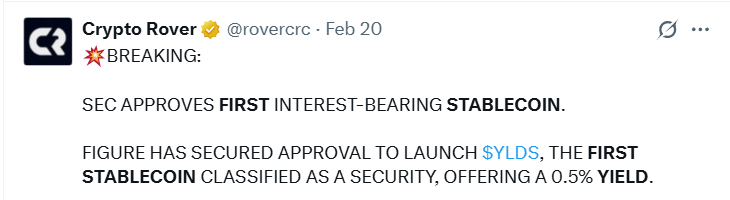
The approval was granted to Figure Certificate Co., allowing the company to issue a new class of stablecoin called YLDs. These coins will pay interest to holders—differentiating them from traditional stablecoins, which maintain price stability but do not generate returns.
YLDs mark a shift in the stablecoin market. Traditionally, any yield from reserves has gone to issuers. Under the SEC’s new framework, those earnings can now be distributed to token holders, subject to compliance with applicable rules.
Disclaimer
In this article, the views and opinions stated by the author or any people named are for informational purposes only, and they don’t establish the investment, financial, or any other advice. Trading or investing in cryptocurrency assets comes with a risk of financial loss.



