Dacity Coin
 astronaut
 streamoors
 Celestia
 NeoSoul
 Sui
Sui Injective

Key Insights:
- Bitcoin must hold $102K to avoid deeper trend exhaustion, Bitfinex analysts warn.
- ETF inflows remain strong despite geopolitical risk and flat monthly performance.
- On-chain cycle metrics point to a possible $205K top if historical trend holds.
Bitcoin risks further downside if it fails to hold the $102,000 level, Bitfinex analysts warn. ETF inflows and long-term cycles support upside, but geopolitical pressure and trend fatigue weigh on market sentiment.
Bitcoin (BTC) traded at $105,232 on Tuesday, but downside pressure remained as analysts flagged a critical level around $102,000. Bitfinex researchers said that holding above this zone was essential to sustain the current recovery structure.
“If Bitcoin can hold above the $102,000–$103,000 region for a sustained period,” the firm stated in a market report, “it would suggest that the market is absorbing the selling pressure effectively.”
Tensions, Trend Fatigue Stall Breakout Momentum
The market’s optimism around a potential retest of Bitcoin’s $111,940 all-time high faded last week. That sentiment shift followed escalating military actions between Israel and Iran. Dozens of Israeli airstrikes on Thursday night triggered a 2.8% drop in Bitcoin’s price within 90 minutes—from $106,042 to $103,053. It later stabilized at $104,790, according to CoinMarketCap.
Macro volatility continues to weigh on confidence. Bitfinex analysts highlighted that the situation now mirrors “a high-risk, high-reward opportunity,” citing global tensions and uncertain Federal Reserve policy.
Despite the turbulence, Matthew Hyland noted that Bitcoin remains in an uptrend. “Choppy price action but still in an uptrend for BTC,” the crypto trader posted on X.
EY strategist Danny Marques added a bullish twist. “The current move has significant room to expand structurally, momentum-wise, and psychologically,” he wrote. He claimed Bitcoin had not yet entered a euphoric phase.
ETF Flows Support Price Despite Headwinds
Despite the selling pressure, institutional inflows remained consistent. Bitcoin spot exchange-traded funds (ETFs) recorded six straight days of net inflows through June 16, with $412.2 million entering during the period, Farside data showed.
That trend suggests long-term confidence among institutional buyers. The flows came even as Bitcoin marked a flat 0.25% return over the past 30 days.
Bitfinex said even if the price dips, it won’t mimic the steep corrections of previous years. The firm cited Aug. 2023, when Bitcoin dropped 20% in 10 days to $53,991, as an outlier. “The current structure resembles prior capitulation-driven setups,” the analysts wrote, “which usually result in Bitcoin reversing course shortly after aggressive selling.”
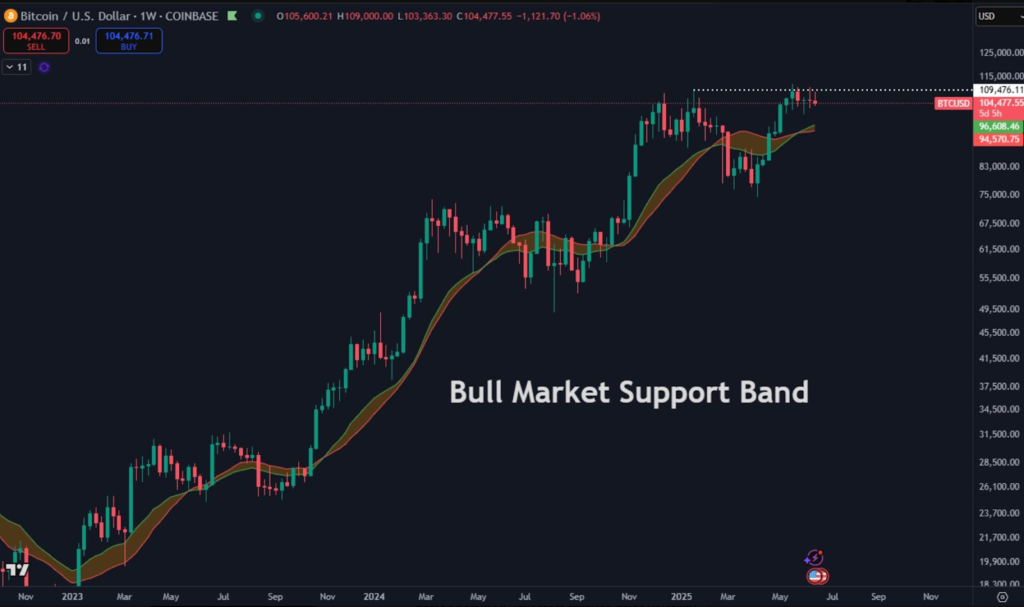
Still, caution remains among some market participants. Crypto trader Daan Crypto Trades said Bitcoin “has stalled out for now” and continues to face resistance near its peak zone.
Daan pointed to the bull market support band—a technical indicator made of moving averages—as the next key level to watch. “Holding on to the bull market support band will be critical,” he added, saying that failure to do so could sap momentum from the cycle.
On-Chain Data Reinforces the Bigger Picture
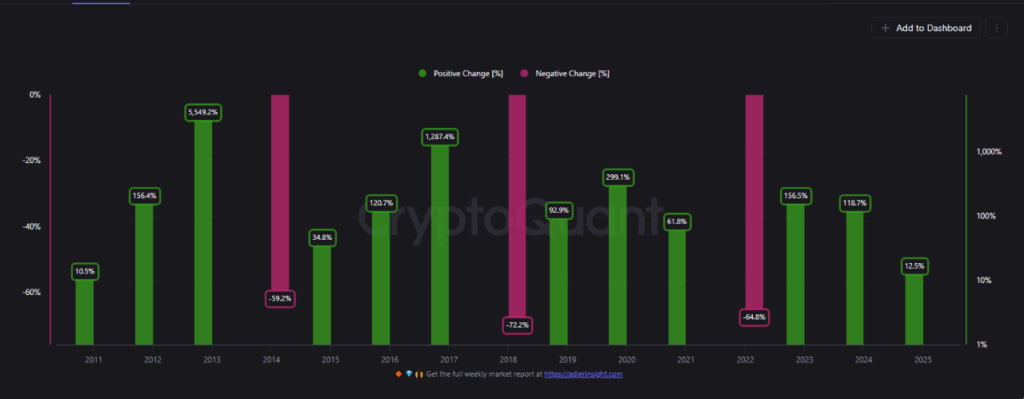
Long-term metrics continue to show that Bitcoin may be entering the final phase of its cyclical uptrend. One such tool, the Bitcoin Yearly Percentage Trend, suggests Bitcoin’s current trajectory mirrors the third year of its historic four-year cycle: three years of growth followed by one year of compression.
If Bitcoin follows its 2025 trend path, the metric shows a possible 120% gain from the starting point of $93,226—implying a cycle top near $205,097.
This pattern fits with other macro metrics like Realized Cap, which reached new highs this year. The growth points to capital entering the network despite temporary price stalls.
On-chain analyst platforms like CryptoQuant and Glassnode have also shown that exchange reserves continue to decline, suggesting investors are withdrawing assets to cold storage rather than preparing to sell.
Meanwhile, Super฿ro pointed out that Bitcoin remains above its rising 50-day moving average, keeping short-term bullish setups intact. “No reason to be bearish above a rising 50 MA,” the analyst posted.
Q3 Caution as Halving Euphoria Fades
As July nears, attention shifts to Bitcoin’s historical Q3 performance. According to CoinGlass data, the third quarter has produced the weakest average returns for Bitcoin since 2013.
That seasonal trend, coupled with geopolitical instability and slowing momentum, could test Bitcoin’s resilience. Yet analysts remain divided over whether the bull run has topped.
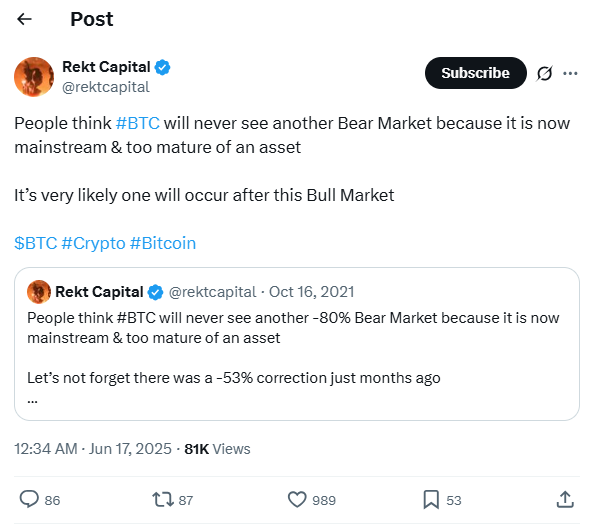
Rekt Capital warned that a crypto winter remains a possibility. “It’s very likely one will occur after this Bull Market,” the trader said, pushing back against more optimistic voices like Michael Saylor, who dismissed any notion of a deep post-cycle drop.
The next key test will be whether Bitcoin can hold above $102,000 heading into July. If it does, it may reignite the cycle’s final leg toward a new high. If not, the market could face deeper exhaustion before any recovery attempt begins.
Disclaimer
This article is for informational purposes only and provides no financial, investment, or other advice. The author or any people mentioned in this article are not responsible for any financial loss that may occur from investing in or trading. Please do your research before making any financial decisions.