Altai the Tiger
 Sword Inu
 streamoors
 IGNITION
 NEAR Protocol
 Pearl
Pearl Injective

U.S. crypto ETFs recorded approximately $391 million in combined net withdrawals on Oct. 14, reversing the previous session’s recovery. Spot Bitcoin ETFs lost $261.46 million, while Ethereum funds recorded $129.51 million in outflows, according to SoSoValue.
The withdrawals followed $200.46 million in combined inflows on Oct. 13. Fidelity and BlackRock accounted for most of the latest Bitcoin ETF redemptions.
Meanwhile, Bitcoin price remained under pressure after falling below $81,000. The decline brought BTC closer to the psychological $80,000 support level.
Bitcoin ETFs Record $261M in Outflows as Crypto ETFs Weaken
The October 14 outflow more than erased the $175.62 million that Bitcoin ETFs pulled in a day earlier. Inflows were thin across the board.
Bitwise’s BITB posted the largest inflow of the day at just $2.22 million, a small figure next to the total that left the products.
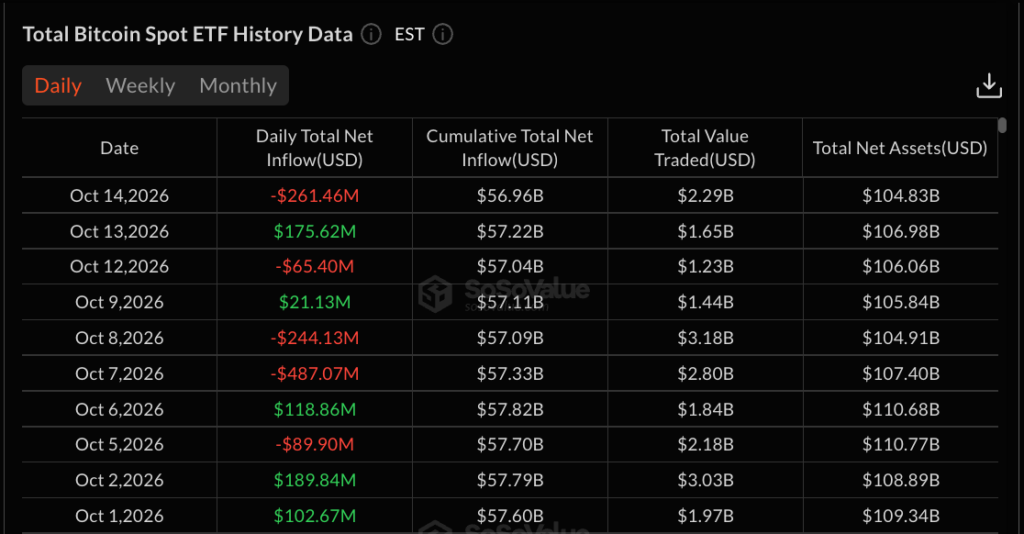
The weekly numbers look heavy too. Bitcoin ETFs have recorded $151.25 million in net outflows so far this week, after losing $681.10 million in the week ending October 9.
That earlier week included a $487.07 million exit on October 7, the biggest single-day outflow so far this month.
Cumulative net inflows for Bitcoin ETFs now stand at $56.96 billion, down from $57.82 billion on October 6. Total net assets fell to $104.83 billion, compared with $110.77 billion on October 5.
For crypto ETFs as a group, October has been a back-and-forth month. Bitcoin funds have swung between inflow and outflow days with no clear run in either direction.
Ethereum ETFs See $130M in Outflows Led by BlackRock’s ETHA
Spot Ethereum ETFs had a weaker day in relative terms. Net outflows hit $129.51 million, and BlackRock’s ETHA made up $110 million of that, about 85% of the total.
Ethereum funds have been under steady pressure for weeks. October 13 was the only inflow day after September 28, and it brought in just $24.84 million.
The weekly flows also show that ETH ETFs lost $138.02 million in the week ending October 2, $542.07 million in the week ending October 9 and $190.07 million so far this week.
Total net assets for Ethereum ETFs dropped to $15.20 billion, down from $17.71 billion on October 1. Cumulative net inflows slid to $13.07 billion.
BTC Price Analysis: Can Bitcoin Recover After Breaking Below $81,000?
On the 1-hour chart, BTC continues to print lower highs and lower lows, indicating sellers are in control of the short-term trend.
The price fell from the $83,000 to $84,000 region and recently touched a low of $80,226. It now trades close to that level, in line with the weak flows into crypto ETFs this week.
The 6-period RSI sits at 35.02. That puts it close to oversold territory below 30, though an oversold reading on its own does not guarantee a bounce.
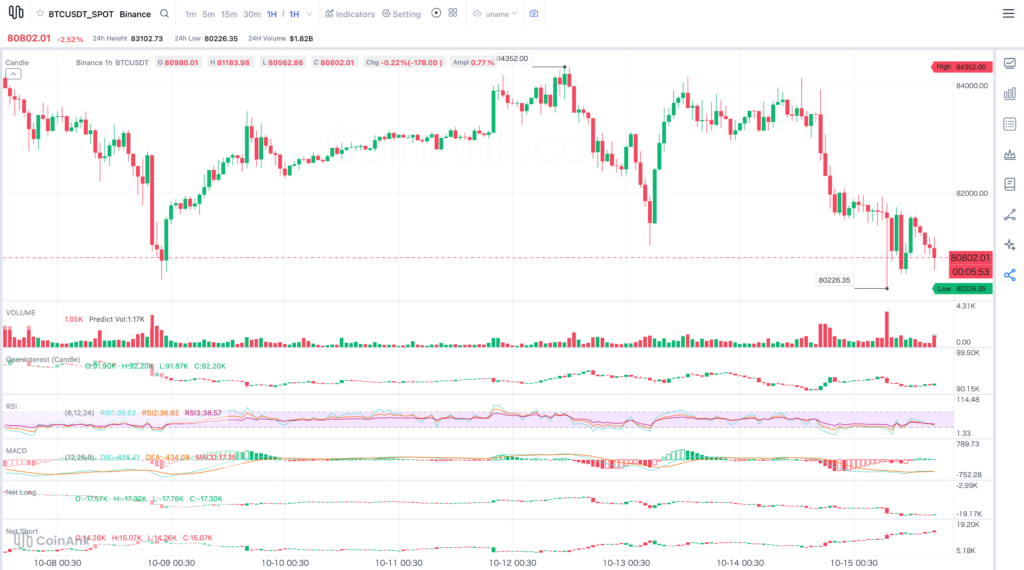
The MACD histogram is slightly positive at around 17, but the two MACD lines remain close together. Selling pressure may be easing a little.
There is no strong bullish reversal on the chart yet, and BTC would need a sustained price recovery to improve the short-term outlook.
Immediate support sits at $80,226, the recent low, with $80,000 below it as psychological support. On the upside, $81,000 to $81,500 is the near-term resistance zone and $82,000 is the level that would confirm a recovery.
Above that, $83,000 to $84,000 is the major overhead resistance zone. These are approximate zones based on the visible chart, not confirmed price targets.
Bitcoin Price Prediction: Could Outflows From Crypto ETFs Trigger Further Downside?
ETF flows and price have moved together this month. Across October 7 and 8, the two heaviest outflow days, total net assets in Bitcoin ETFs fell by more than $5 billion.
Bearish scenario. If BTC breaks below $80,226 and fails to reclaim it, the price could test $80,000 next.
Bullish scenario. If BTC holds above $80,226 and reclaims the $81,000 to $81,500 zone, a relief bounce toward $82,000 could follow. A move above $82,000 would improve the short-term structure, with $83,000 to $84,000 as the major resistance overhead.
This article is for informational purposes only and does not constitute financial or investment advice.