
 Pearl
Pearl NEAR Protocol
 Bitway
 Starknet
 Walrus
 Pudgy Penguins
 Hyperliquid

Key Insights:
- Ethereum proposes a 16.77M gas limit to prevent DoS attacks and stabilize transaction processing.
- The cap supports zkVMs and may require developers to optimize smart contract efficiency.
- Technical charts and user activity signal growing momentum toward Ethereum‘s next major price leg.
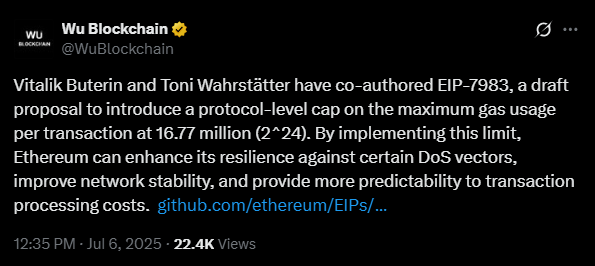
Ethereum developers have proposed a new gas ceiling for individual transactions to improve scalability and reduce attack vectors. The proposal, EIP-7983, would introduce a 16.77 million gas cap per transaction, enforcing a hard upper limit regardless of the block’s remaining space.
This move follows a series of protocol upgrades targeting Ethereum’s long-term viability, including its transition toward zero-knowledge virtual machines (zkVMs).
Ethereum Gas Cap Targets Security and Network Stability
Ethereum’s current architecture allows individual transactions to consume an entire block’s gas limit, which can lead to congestion and DoS vulnerabilities. To address this, developers propose a hard-coded cap of 16.77 million gas per transaction through EIP-7983. This threshold ensures no single transaction can dominate block space, allowing for more balanced and stable block production.
Although the block gas limit itself will remain unchanged, this cap will act as a ceiling at the transaction level and will be enforced during both block validation and mempool inclusion. Consequently, high-cost transactions above this threshold would be rejected, even if the block has room. Ethereum aims to maintain smooth operations under high network load by enforcing this structure.
This change also supports Ethereum’s long-term shift toward zero-knowledge virtual machines (zkVMs), encouraging developers to split complex operations into smaller chunks. Moreover, it reduces the chances of computational bottlenecks and makes Ethereum more compatible with multithreaded execution models.
Developers Face New Constraints, but Efficiency Gains Follow
The new rule could pressure developers to write more efficient smart contracts, as operations requiring more than 16.77 million gas will no longer be permitted. However, disruption is expected to be minimal because most existing contracts fall well within this range. This shift may also reduce long-term technical debt by discouraging bloated or inefficient on-chain logic.
Despite these issues that some developers have with a lack of flexibility, the predictability of the costs structure can be advantageous to dApp teams that want stability. Although it might slow experimental features in the short run, the net effect might be a leaner, faster and cheaper contract execution. Also, decreased transaction size variability helps estimate fees and allocate resources more effectively.
The proposal builds on previous efforts, such as EIP-7825, and ties into Vitalik Buterin’s broader goal to simplify Ethereum’s protocol. These simplification efforts aim to improve performance, lower security risks, and reduce development complexity over time.
Ethereum Technical Setup Shows Bullish Momentum Building
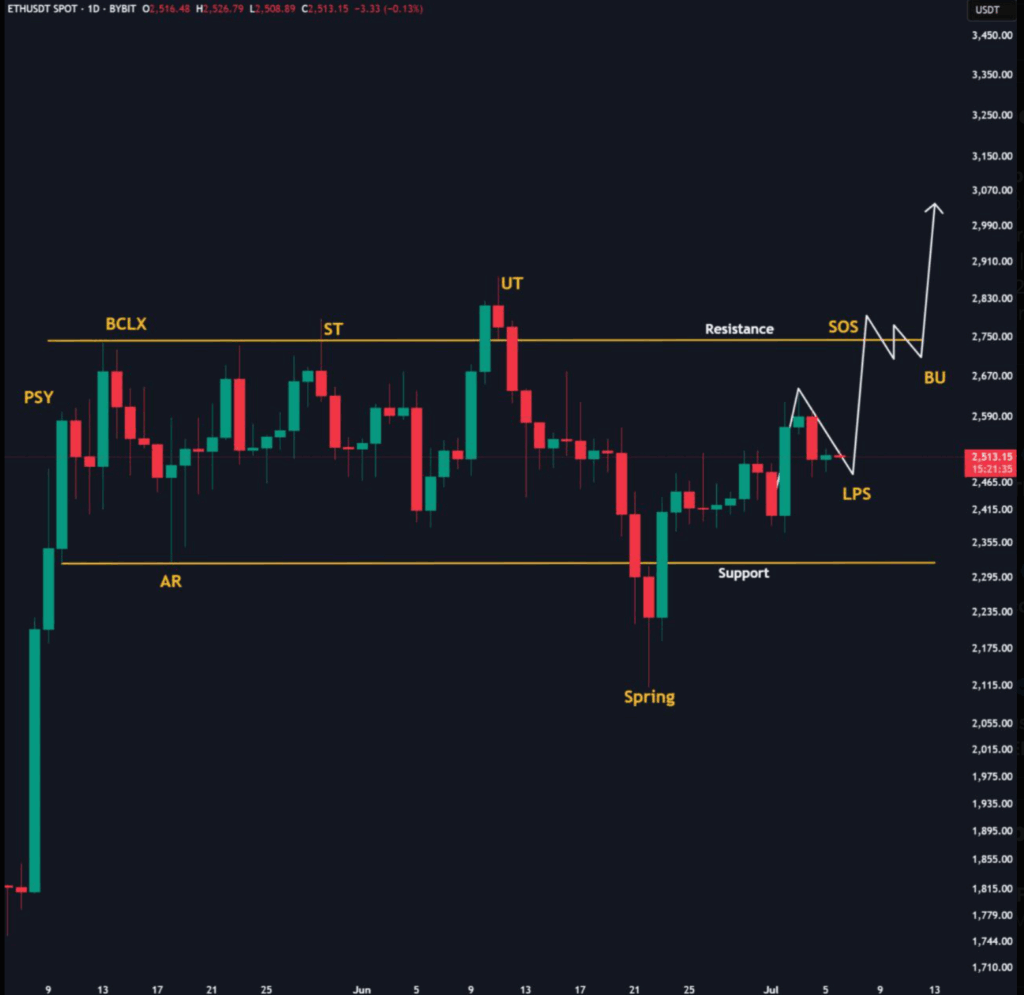
ETH is perfectly following its Wyckoff accumulation pattern. A local top at $2.9K happened exactly along with a capitulation below $2,100. The token is moving up again, and the short-term target is $2,800. If ETH manages a daily close above $2.8K, $3.5K will happen within weeks.
To back this momentum, the on-chain activity remains on the increase. The number of addresses engaged weekly has exceeded 20 million, which is a 52% growth in one week. In the meantime, Layer-2 scaling solutions are also running at an 8.8x usage multiplier, highlighting the wider usage of the Ethereum ecosystem.
Additionally, Ethereum’s unique addresses have surpassed 326 million, and the average daily increase is almost 200,000. Moreover, institutional interest seems to be increasing, with statistics indicating that 95% of the reported crypto portfolio of Donald Trump, worth more than $173 million, is stored in Ethereum.





