
 Pearl
Pearl Walrus
 Bitway
 Bitcoin
 Quantus
 Quant
Quant Pudgy Penguins
Key Insights:
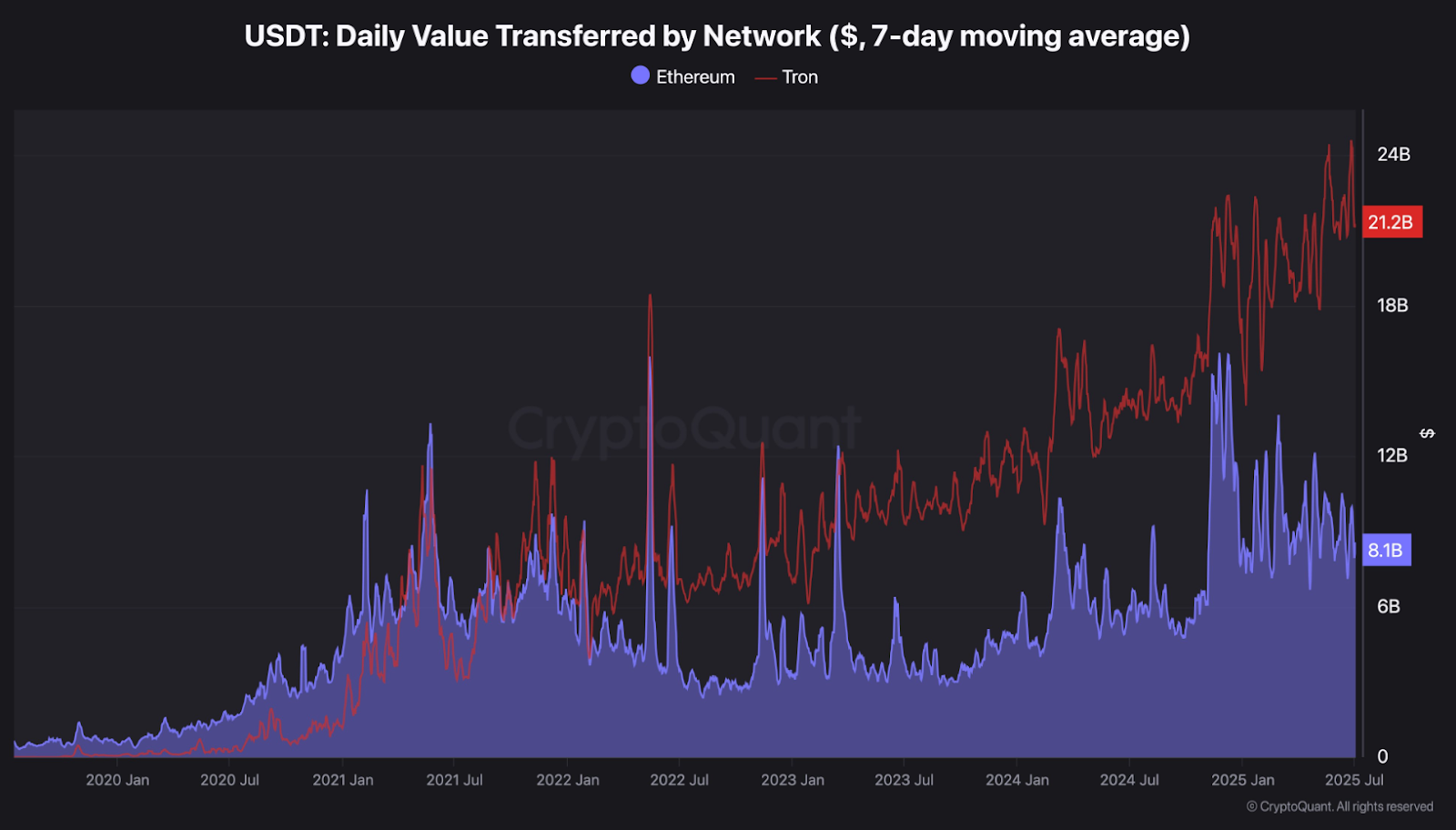
- Tron processes over $21 billion in weekly USDT transfers, more than double Ethereum’s
- Bitget Wallet slashes TRON USDT transfer fees by 50%, increasing access in emerging markets
- Kraken joins Tron as Super Representative, strengthening the network’s security and institutional reach
Tron has crossed 13 billion total transactions, marking a major milestone in blockchain history. This growth is largely fueled by its leadership in stablecoin usage, particularly USDT, across developing markets.
As global demand for fast, low-cost payments rises, Tron’s network is becoming a preferred channel for real-world digital finance.
Tron Surpasses 13 Billion Transactions as USDT Dominates On-Chain Payments
Tron has officially surpassed 13 billion total transactions, cementing its role as a leading blockchain for real-world stablecoin transfers. This rise is powered by growing demand for USDT payments, especially in regions where low-cost, fast digital finance is most needed.
As stablecoin usage accelerates globally, Tron stands out as a practical and scalable infrastructure for everyday economic activity.
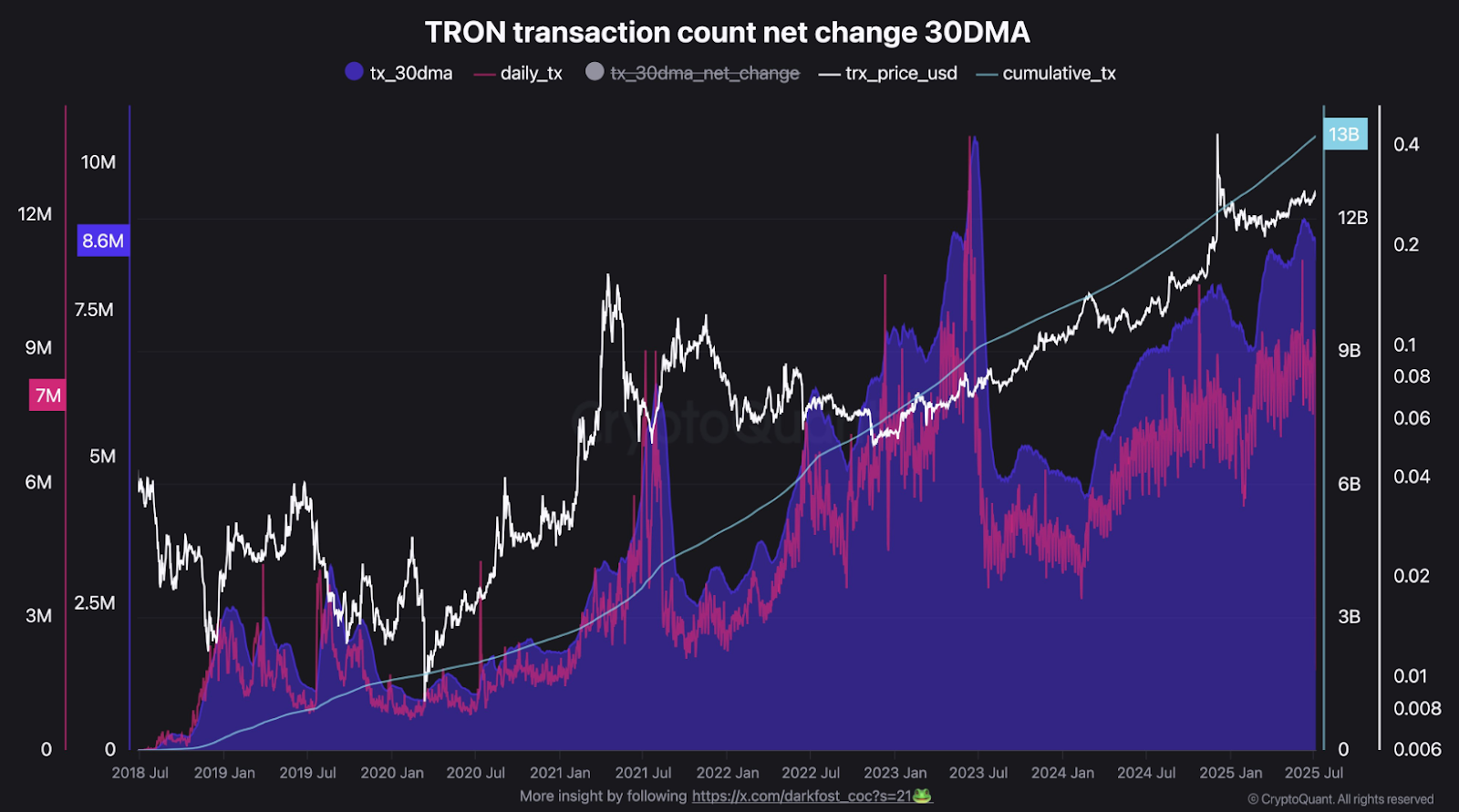
Data from CryptoQuant shows Tron now handles more than 8 million transactions daily. Moreover, its weekly USDT transfer volume has exceeded $21 billion, far surpassing Ethereum’s $8 billion. That reflects a shift in blockchain utility from speculative DeFi to stable, payment-driven use.
In countries like Argentina, users rely on Tron for daily purchases, remittances, and savings, bypassing fiat volatility.
While Ethereum still dominates NFTs and high-value DeFi, the token has carved its niche in micro-transactions. And with its low fees and speed, it increasingly resembles a decentralized payment network.
Wallet Innovations are Fueling Broader Access
To support this surge in real-world use, Bitget Wallet has introduced key upgrades to reduce friction in stablecoin transactions. It slashed USDT gas fees on Tron by 50%, while its GetGas feature now allows users to pay gas directly from USDT or USDC balances. Thus, holding TRX is no longer necessary just to send funds.
Furthermore, Bitget offers users a gas-free first transfer and auto-subsidies for future ones, making it the most cost-efficient wallet for Tron-based USDT transfers. With 80 million users and support for over 130 blockchains, Bitget has simplified stablecoin transactions for a global audience.
Since GetGas automates Tron’s complex energy model, users can send, swap, or interact with dApps without staking TRX or managing energy manually. Therefore, it offers a seamless experience that rivals centralized platforms while maintaining full self-custody control.
Institutional Participation Reinforces Network Strength
While retail adoption rises, institutional backing is also gaining momentum. On July 1, Kraken joined the Tron network as a Super Representative (SR), bringing enterprise-grade security and infrastructure to its governance.
Kraken now helps validate transactions, produce blocks, and shape protocol upgrades. This move strengthens Tron’s decentralization and reliability, especially as it scales.
With over 226 million accounts and $22 billion in total value locked, Tron remains among the busiest Layer-1 chains globally. Kraken’s involvement reflects growing institutional confidence in Tron’s long-term stability.
Moreover, as a Super Representative, Kraken operates secure and redundant infrastructure that ensures uptime and governance participation. Its entry may also inspire further institutional support. It could reinforce Tron’s credibility across both technical and financial sectors.
DeFi Momentum and Sovereign Integration Expand Utility
Beyond wallets and governance, the DeFi work of Tron continues to be going on vigorously through the use of such platforms as SunSwap and JustLend.
SunSwap has recorded swap volume of up to $3.8 billion in May alone, with WTRX/USDT clocking 62% of total trading pairs. This strength carried on through July, in spite of wider market movements.
In the meantime, the lending activity of JustLend is also on the rise. In June, it got deposits of 900 million of USDT and 358 million of USDD, and borrowing often surpassed $10 million daily. These numbers emphasize the continuous liquidity need and consumer interaction in Tron’s decentralized finance.
On a sovereign level, the role of the network is growing even more. Rostec, a Russian state-owned company, is introducing a ruble-pegged stablecoin called RUBx, which is a Tron-based stablecoin.
This token will be used to execute domestic and cross-border payments through RT-Pay. It will be completely incorporated into the banking system of the country and will be able to work with smart contracts.
Even as the regulation of international stablecoins is still in its early stages, with a bill in the U.S. Senate even proposing to legalize new issuers, not every entrant will be able to make it.
According to Moody’s analysts, sustainability will be a challenge to many because banks might opt to use tokenized deposits. However, Tron is already in the lead in terms of volume and adoption, as well as in terms of efficiency. That means it is in a good position to stay ahead.
Disclaimer
This article is for informational purposes only and provides no financial, investment, or other advice. The author or any people mentioned in this article are not responsible for any financial loss that may occur from investing in or trading. Please do your research before making any financial decisions.



