
 astronaut
 Walrus
 Pearl
Pearl Bitcoin
 NEAR Protocol
 Zcash
Zcash Hyperliquid

Key Insights:
- BitMine has raised its Ethereum holdings to 1,585,461 ETH worth $7.5 billion
- 200,000 ETH was withdrawn from exchanges in 48 hours in a show of whale push.
- The ETH/BTC breakout after 8 years sparks talk of a new price rally.
Tom Lee’s BitMine Immersion has increased its Ethereum holdings to 1,585,461 ETH worth $7.5 billion after fresh purchases.
In light of this, analyst Ali Martinez also revealed that 200,000 ETH left exchanges in just two days.
Alongside this, an ETH/BTC breakout drew attention and raised talk of whether Ethereum may be eyeing another rally.
BitMine’s Growing Ethereum Holdings
BitMine, a major cryptocurrency investor, has continued to expand its Ethereum position.
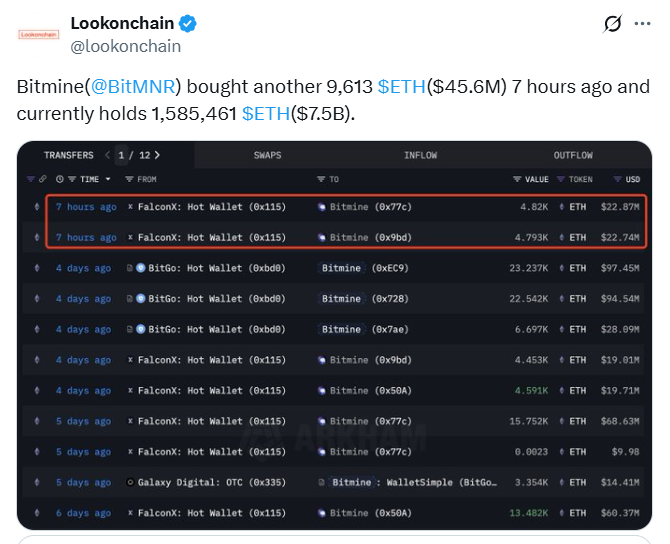
According to data shared by Lookonchain, the company bought another 9,613 ETH worth $45.6 million just seven hours earlier.
This raised its total balance to 1,585,461 ETH, a holding valued at about $7.5 billion.
This was not the first large move in recent weeks. On August 19, BitMine purchased 52,475 ETH worth $220 million.
At that time, its total Ethereum holdings stood at 1,575,848 ETH, valued at $6.6 billion.
The repeated buying showed that BitMine had been adding to its portfolio consistently.
Notably, the acquisitions are tied to known platforms, as the records showed transfers from FalconX hot wallets and from BitGo.
These were moved directly into BitMine addresses. The steady inflow of large amounts of ETH underlined the role of whales in shaping supply.
Each transfer decreased the amount of Ethereum available in the open market.
The size of the holdings placed BitMine among the largest known Ethereum holders. Observers in the market often describe wallets of this scale as whales and may influence ETH price significantly.
While it is not clear how long BitMine will keep accumulating, its moves drew attention as other investors watched the flow of funds on-chain.
Exchange Withdrawals and Market Supply
Alongside whale accumulation, analysts noted a sharp ETH change on cryptocurrency exchanges.
Ali Martinez, a popular market analyst, reported that 200,000 ETH were withdrawn from exchanges in just 48 hours.
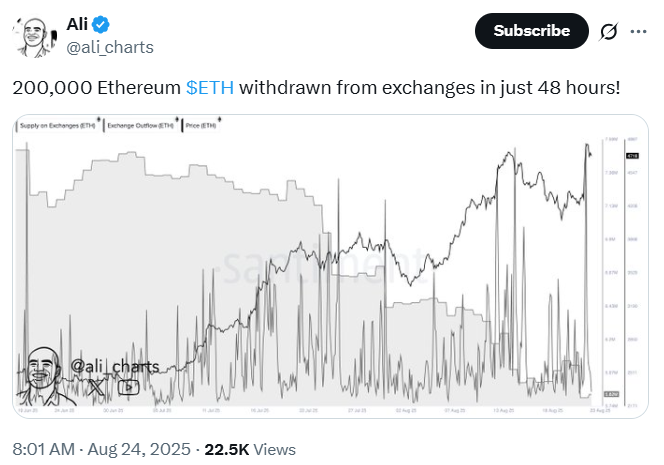
The withdrawals were seen as a sign that traders and investors moved funds into private wallets.
When coins leave exchanges, they are less likely to be sold immediately. This can lower selling pressure and reduce available supply for buyers.
If demand increases at the same time, this may support higher prices. Market watchers often see such withdrawals as a signal of confidence among holders.
However, it is important to note that these withdrawals do not always mean prices will rise.
They may suggest that investors want to hold their coins, but the outcome is not certain.
Again, some investors move assets for other reasons, including security or staking. The withdrawal of 200,000 ETH marked a notable move that many traders noticed.
Market participants believe that the shift may influence Ethereum’s price in the short term.
ETH/BTC Breakout and Outlook
More importantly, another development came from the trading chart of Ethereum against Bitcoin.
Ted Pillows, a market analyst, said that the ETH/BTC chart had broken a trend line that lasted almost eight years.
In his post on X, he noted the move could give Ethereum an advantage over Bitcoin.
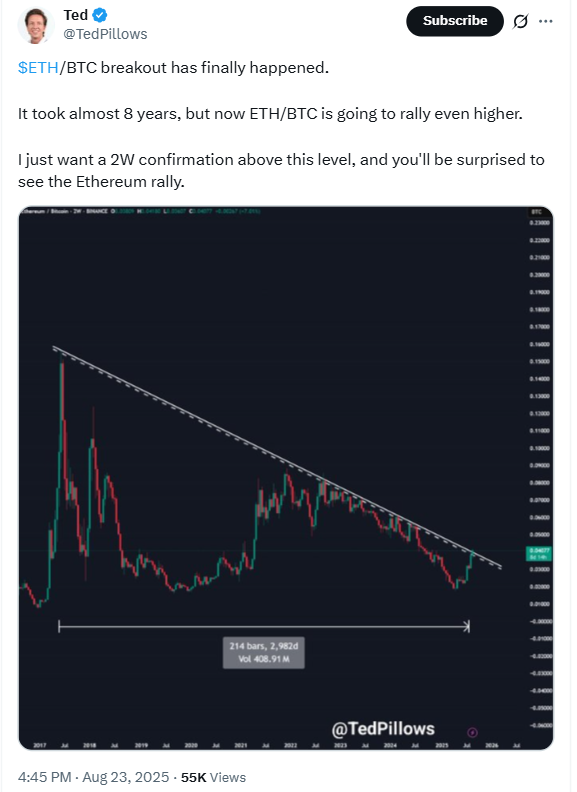
Ted added that a two-week close above the line would confirm the breakout. Ethereum was trading at $4,753.78, up 0.7% in 24 hours, with potential for more upside.
The combination of whale accumulation, exchange withdrawals, and the ETH/BTC breakout has created a mix of signals.
Whether this would result in a new all-time high remained to be seen, but the market is watching closely.
The recent moves show how large investors, exchange balances, and technical patterns all shaped the outlook.
Disclaimer
This article is for informational purposes only and provides no financial, investment, or other advice. The author or any people mentioned in this article are not responsible for any financial loss that may occur from investing in or trading. Please do your research before making any financial decisions.




