
 Zerebro
 Bitcoin
 Quantus
 Pearl
Pearl Starknet
 ZKsync
 NEAR Protocol
Key Insights:
- XRP Ledger (XRPL) has overtaken Ethereum in daily transaction count.
- Webus International partners with Air China for XRP payment integration, boosting the ecosystem.
- XRPL has activated Credentials amendments, which have led to massive institutional adoption.
The XRP Ledger (XRPL) has dethroned its strong competitor, Ethereum (ETH), in daily transaction counts. This marks a huge milestone as it is the first time XRPL is overtaking ETH in daily transaction count.
This move coincides with the launch of Credentials and a partnership between Ripple Labs, Webus, and Air China.
XRP Ledger Surpasses Ethereum in Transaction Count
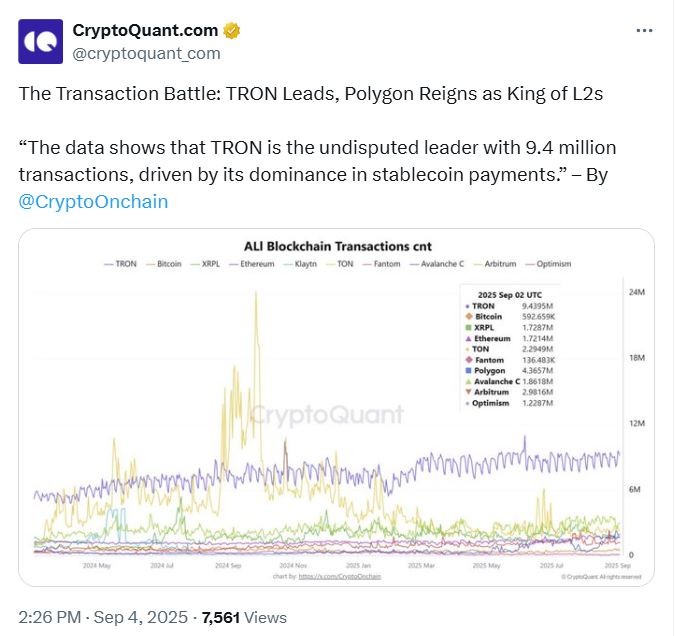
According to analytics data provider CryptoQuant, the Tron (TRX) blockchain leads daily transaction counts across ten major blockchains.
TRON leads with 9.4 million daily transactions, primarily due to its heavy use in stablecoin payments. Stablecoins, like USDT, are widely used on TRON for fast, low-cost transactions, making it a regular chain for daily transfers.
Polygon comes second with 4.36 million transactions, standing out as the top Ethereum Layer 2 (L2) scaling solution. Arbitrum and TON came next with transaction counts of 2.98 million and 2.29 million, respectively.
Despite its focus on high-value activities, like DeFi and NFT trades, Ethereum had transactions of 1.72 million.
As a result, XRP Ledger surpassed Ethereum with transactions of 1.728 million. The milestone in transaction volume indicates steady growth and progress in the XRPL ecosystem.
It also reflects user engagement and trust in the platform. This increased engagement has the potential to impact the values of XRPL in the long term positively.
It is important to note that real competition for scalability is within the Ethereum ecosystem, even though Tron excels in raw transaction volume.
Webus Taps Partnership with Air China for XRP Integration
The XRPL milestone coincided with a partnership between Webus International and Air China. Webus International and Air China have agreed to integrate blockchain technology into the airline’s PhoenixMiles loyalty program.
This partnership unlocks access for Webus to Air China’s massive user base of over 60 million PhoenixMiles members. Consequently, it enables new services like tokenized rewards, faster settlements, and enhanced travel perks.
Leveraging the partnership, both entities plan to intr XRP as a payment option for global travel services. This would permit customers of Air China to use XRP for transactions such as booking flights, redeeming miles, or other airline-related payments.
The integration aims to utilize XRP’s core strength as a fast and low-cost blockchain. This is seen as a bullish development for XRP adoption, especially in real-world utilities like payments.
It is also in line with ongoing efforts from Ripple to promote XRP for enterprise use cases, like remittances and settlements.
In July, Ripple partnered with the Swiss-based AMINA Bank to offer custody and trading services for the RLUSD stablecoin.
New era with Credentials Launch
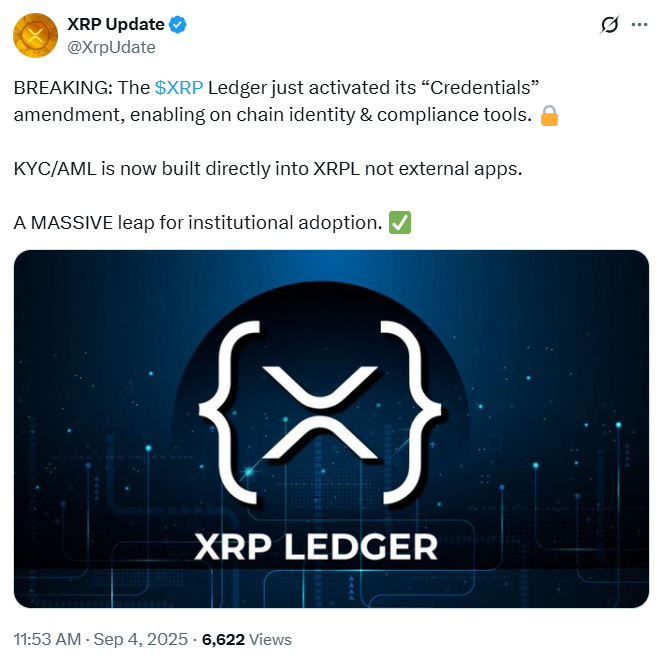
Another key development in the Ripple ecosystem is activating the Credentials amendment on XRPL.
The amendment introduces a set of on-chain features designed to handle authorization. Other features include identity management and compliance requirements.
With the new amendment, KYC and AML are built directly into XRPL, not external applications. This allows issuers to attest to facts about an account, without storing sensitive personal data on the blockchain.
XRPL uses a decentralized governance model where amendments require an 80% supermajority for two weeks.
This Credential Amendment achieved 82.86% support, triggering an “EnableAmendment” event that permanently activates it across the network.
It follows three recent amendments, fixAMMv1_3, fixEnforceNFTokenTrustlineV2, and fixPayChanCancelAfter that improved AMM functionality, NFT trustlines, and payment channels.
Credential Amendments is a game-changer for enterprises wary of crypto regulatory risks. Banks, fintechs, and payment providers can now build compliant apps natively on XRPL.
It positions XRPL as a bridge between traditional finance and blockchain, potentially unlocking trillions in tokenized real-world assets.
Disclaimer
This article is for informational purposes only and provides no financial, investment, or other advice. The author or any people mentioned in this article are not responsible for any financial loss that may occur from investing in or trading. Please do your research before making any financial decisions.




