
 no crying in the casino
 NEAR Protocol
 Starknet
 Pyth Network
 Pearl
Pearl Quantus
 Pudgy Penguins

Spot Bitcoin and Ethereum ETFs have seen consistent inflows. They’ve remained net positive for eight straight days. Ether ETF inflows were positive on October 8.
The boost came from BlackRock’s iShares Ethereum (ETHA). It recorded $147 Million in net inflows. This comes despite the ETH price experiencing a sharp 8% pullback after being rejected at the $4,700 level.
BlackRock Ethereum ETF Leads Most Inflows
Inflows into spot Ethereum ETF from US issuers have stayed in the positive territory for eight consecutive trading sessions. During this period, the BlackRock iShares Ethereum Trust (ETHA) has been leading most of the inflows.
On Wednesday, October 8, the net inflows into BlackRock’s ETHA were at $148.9 Million. The world’s largest asset manager acquired an additional 32,968 ETH. This pushed its total Ethereum holdings beyond 4 million. The update comes from the official iShares website.
The fund also experienced robust trading activity, with a total volume of $1.4 Billion traded. This indicated continued institutional demand for Ethereum.
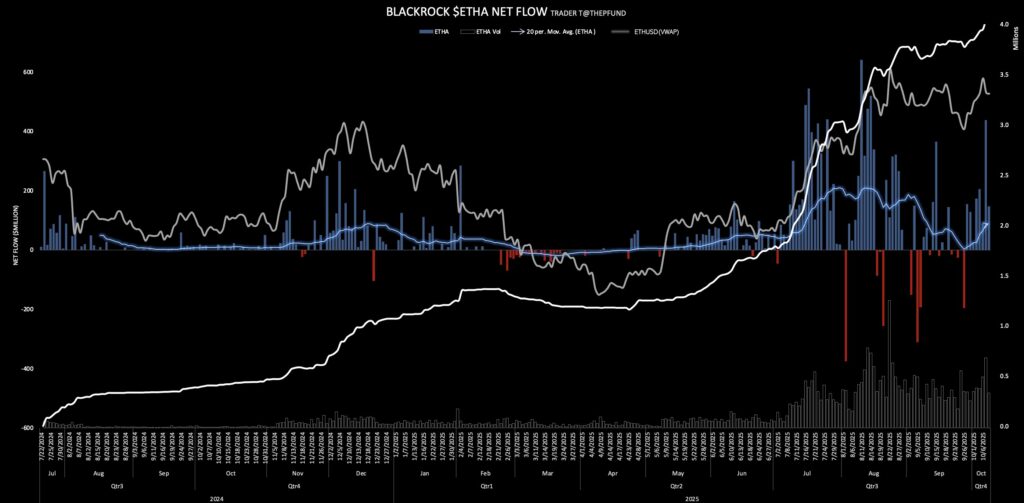
BlackRock’s Ethereum ETF (ETHA) has seen massive inflows. Since launch, net inflows have surpassed $14.5 Billion.
It also ranks among the top ETFs in 2025 in terms of inflows. As a result, the ETHA share price has experienced substantial upside, gaining 175% over the past six months.
Grayscale Staking Ethereum ETF On Investors’ Radar
Grayscale has staked $5.2 Billion worth of Ethereum over the past two days. This caused the staking entry queue wait time to surge to 24 days, according to crypto analyst Tom Wan.
On Tuesday, the daily staking inflow reached 946,000 ETH, marking a new all-time high, twice the previous record. Grayscale holds $8.1 Billion in ETH through its two spot Ethereum ETFs. This indicates a staking utilization rate of roughly 60%.
Wan shared a forward-looking view on ETH staking. If half of the ETH in U.S. spot ETFs, approximately $18 Billion, is staked, it could have a significant impact. This move would add nearly 4.1 million ETH to the staking entry queue. The shift could happen in the near future.
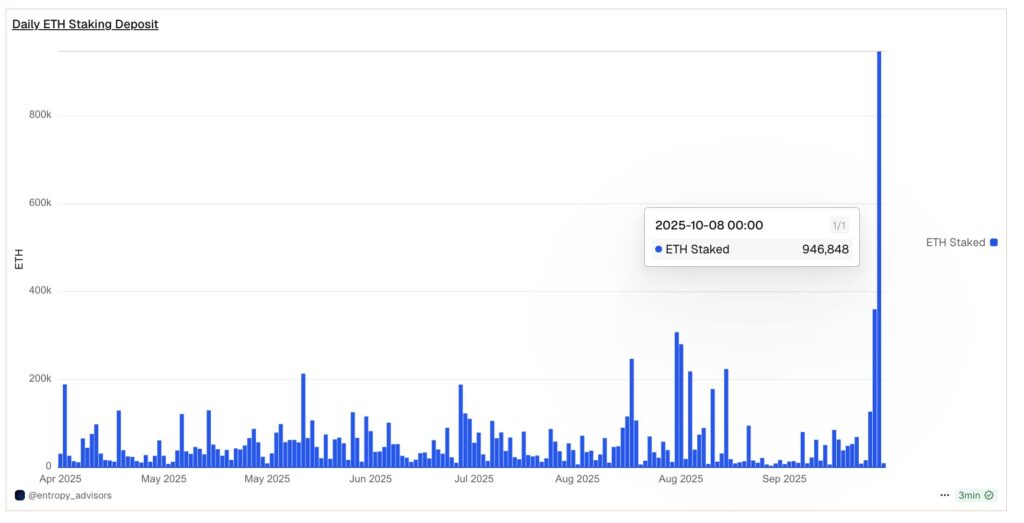
Grayscale introduced the staking facility to its Ethereum ETFs, ETHE and ETH, earlier this week. This made them the first of their kind ETFs in this category. At the same time, other Ether ETF issuers have been waiting for the SEC’s green light.
Grayscale clarified that its Ethereum products, ETHE and ETH, are not registered under the Investment Company Act of 1940. They don’t fall under the same regulatory oversight as registered ETFs and mutual funds. As a result, they lack the investor protections provided by the Act.
Bitcoin ETFs Also Lead With Strong Inflows
Apart from spot Ethereum ETFs, inflows into Bitcoin ETFs have also surged in recent times. On October 8, the net inflows across all U.S. Bitcoin ETF issuers totaled $440 million. BlackRock’s iShares Bitcoin Trust (IBIT) alone contributed $426 Million from this.
On Wednesday, BlackRock’s IBIT reported net inflows of 3,451 BTC. Besides, the fund also recorded a daily trading volume of $3.8 billion. This reflects continued strong investor demand and institutional participation in Bitcoin exposure through regulated ETF products.
Last week, the BlackRock Bitcoin ETF ranked first among all U.S. ETFs in terms of positive weekly inflows. This underscores its market dominance. With $3.5 Billion in weekly inflows, IBIT managed to beat top S&P 500 ETFs like SPLG and VOO.
The fund also continues to hold the title of the fastest-growing ETF in history. This reflects a surge in institutional demand for Bitcoin exposure through regulated investment products.



