
 Zerebro
 Bitcoin
 Quantus
 Pearl
Pearl Starknet
 ZKsync
 NEAR Protocol

Binance news surfaced on October 14 as the exchange issued a strong denial of allegations regarding its listing process.
The exchange called its claims “false and defamatory” in an official customer support statement. The response followed X user CJ’s publication of alleged Binance listing terms, including a 1% day-one airdrop, 3% further airdrops within six months, and more.
Binance News: Exchange Issues Formal Denial of Listing Profit Claims
Binance customer support issued a formal statement on X addressing allegations by user CJ posted on October 14, 2025.
The exchange characterized the claims as “false and defamatory” and stated they were “clearly designed to mislead the community and attack the integrity of Binance’s listing process.”
The exchange denied profiting from its listing process, stating “token allocations are for Binance users.”
The statement clarified that Binance does not charge listing fees while the security deposit exists “for the protection of users.”
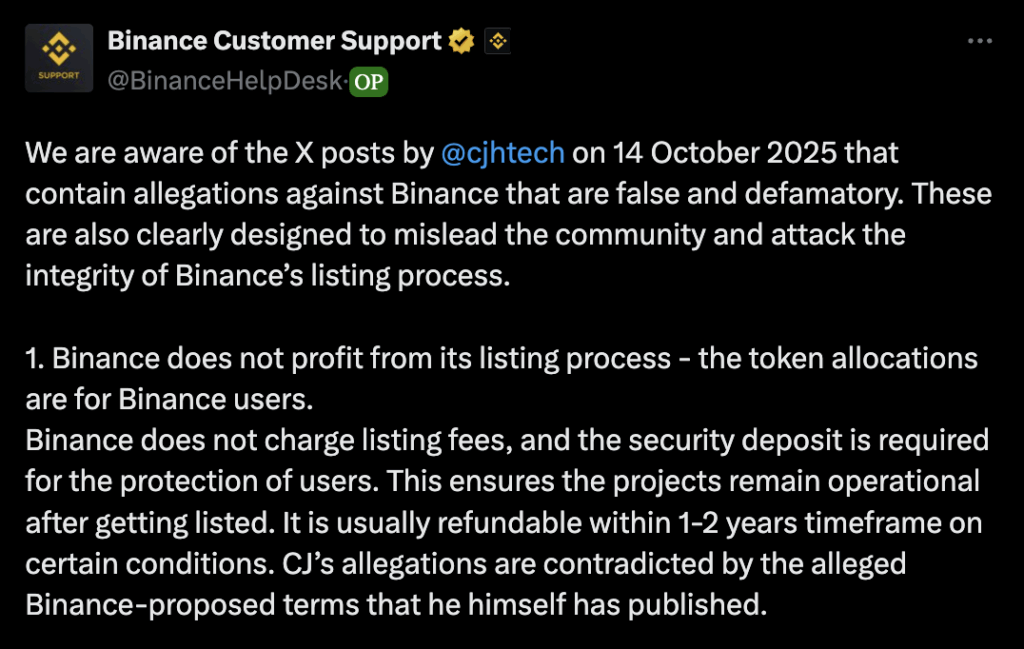
The deposit structure aims to ensure projects remain operational after getting listed. The refund terms specify deposits are “usually refundable within a 1-2 year timeframe on certain conditions.”
Binance noted that CJ’s allegations are contradicted by the alleged Binance-proposed terms he himself published. The internal inconsistency in the claims undermined their credibility according to the exchange’s analysis.
The exchange denied allegations that Binance and its founders have been dumping tokens, calling these claims “entirely untrue and unsubstantiated.”
Binance expressed surprise at “CJ’s illegal and unauthorized disclosure of confidential communications with Binance.”
The Binance news statement warned that given the severity of CJ’s actions, the exchange “expressly reserve all of our rights, including taking legal action to protect our interests.”
CJ Alleges Extensive Token Allocations and Security Deposits
X user CJ posted detailed alleged listing terms from Binance, contrasting them with Coinbase’s approach.
The Binance terms included a 1% airdrop on day one with an alpha listing, 3% further airdrops within six months, and a 1% allocation for “marketing” at Binance’s full discretion. The structure represented over 5% total token allocation before security deposits.
The alleged terms required providing 100% of the total value locked for the token pool on PancakeSwap, exceeding $1 million.
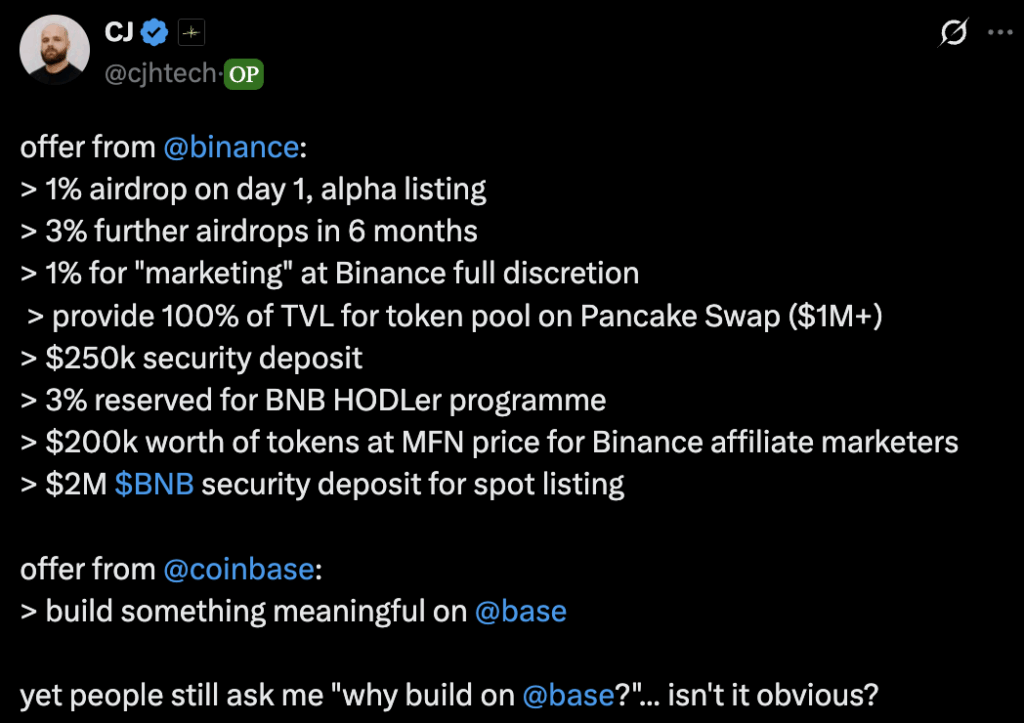
The $250,000 security deposit would be combined with 3% reserved for the BNB HODLer program. The proposal included $200,000 worth of tokens at the most favored nation price for Binance affiliate marketers.
The spot listing required an additional $2 million BNB security deposit, in addition to other allocations.
CJ compared these terms with Coinbase’s approach, stating the competing exchange required projects to “build something meaningful on Base.”
CZ Defends Exchange Listing Models in Lengthy Post
Former Binance CEO Changpeng Zhao posted extensive commentary defending various exchange listing approaches following the controversy.
CZ characterized his perspective as “unpopular opinion” and addressed the recent complaints about listing fees. The Binance news cycle sparked broader discussions about industry practices.
CZ stated that projects complaining about listing airdrops or fees should “don’t pay it” if their project is strong.
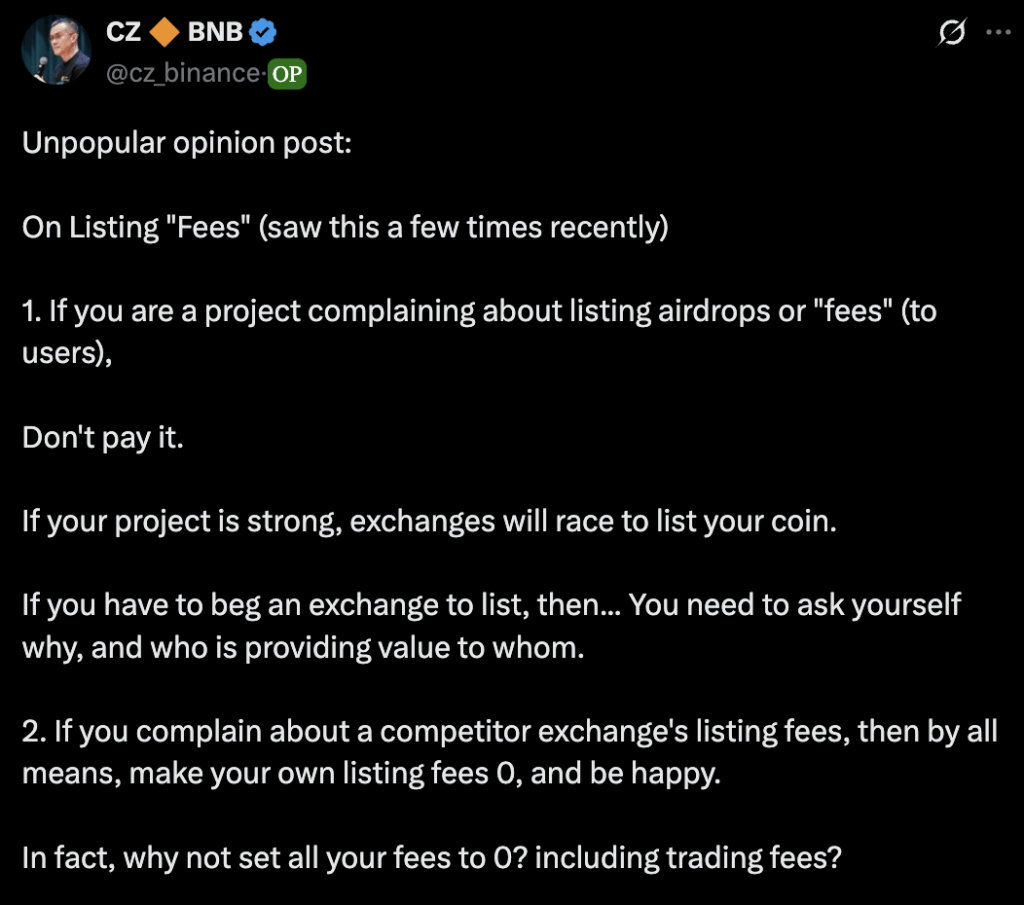
He argued that “exchanges will race to list your coin” for genuinely compelling projects. The statement implied that weak projects, which paid for listings, were the ones complaining.
CZ questioned “if you have to beg an exchange to list, then… You need to ask yourself why, and who is providing value to whom.”
The former CEO addressed competitors complaining about Binance’s listing fees and suggested they should make their own listing fees 0, and be happy.
He extended the logic, questioning, “Why not set all your fees to 0, including trading fees?”
Three Exchange Listing Models Outlined by Former CEO
CZ outlined three primary approaches to exchange listing in his Binance news commentary.
The first model involves listing “everything on every blockchain,” acknowledging that “most tokens are scams” and most legitimate projects fail, with only a few succeeding.
The second model selectively lists while making the “listing fee a revenue source.” CZ characterized this as a “fine business model if you can attractive enough projects to list.” He noted many small exchanges adopt this approach lacking sufficient trading fee revenue.
The third model selectively lists while requesting airdrops to users and security deposits, making scams and failed projects more expensive to execute. The structure aims to “protect users” by creating financial barriers that deter low-quality projects.
The Binance news statement and CZ’s defense positioned the exchange’s practices as industry-standard user protection rather than exploitative rent-seeking.




