
 Doge Pepe
 Optimism
 Pearl
Pearl Quantus
 Bitway
 Pons
Pons NEAR Protocol
The Ethereum Foundation has introduced a new portal to support institutions building on the network.
The launch comes as the Ethereum price holds steady at around $4,000, awaiting the Federal Reserve’s rate decision.
Traders are watching key support levels while some analysts expect higher prices this cycle.
Ethereum Foundation Introduces Institutional Portal
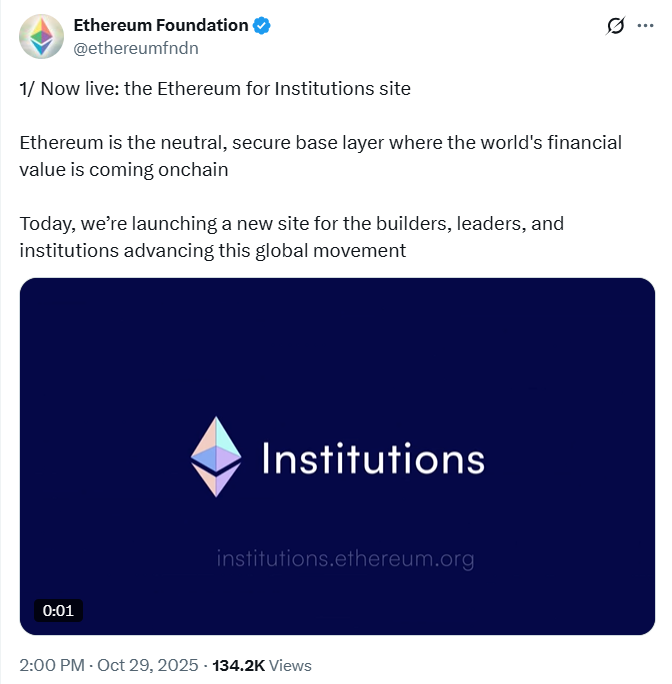
The Ethereum Foundation has launched a website designed for companies and organizations seeking to develop financial products on Ethereum.
The portal explains the various ways firms already utilize the network and highlights tools that enhance security, privacy, and scalability.
As detailed, the goal is to guide decision makers who plan to move more financial activity onchain.
Ethereum has run for more than 10 years with notable validator support. The Foundation noted that over one million validators help secure the network.
Major businesses already operate services on Ethereum. These include well-known financial groups such as BlackRock, Visa, Coinbase, and eToro.
According to the update, their products manage large amounts of assets and process high trading volumes.
Additionally, privacy remains important for regulated institutions. The information on the portal highlights methods that maintain business activity privacy while still enabling proper oversight.
These methods include zero-knowledge proofs, fully homomorphic encryption, and trusted execution environments.
Several teams focus on this work, including Chainlink, Railgun, Aztec, and Zama provide privacy tools in active use today.
Likewise, a section of the portal focuses on scaling. The Foundation states that Layer 2 networks have more than $50 billion in value secured on top of Ethereum.
Users pay low transaction fees, often less than one cent. Teams such as Linea, Starknet, Base, Inco, Unichain, and Scroll build rollups that support large transaction demand.
Frameworks from Arbitrum, Optimism, Polygon, and zkSync enable businesses to launch their own chains more quickly.
This development process could help more institutions join the network with systems that fit their needs.
The portal also points to growing activity in tokenization. More than 75% of tokenized real-world assets run on Ethereum.
More than 60% of stablecoins also operate on the network—stablecoins from Tether, Circle, Ethena, Sky, PayPal, and First Digital support fast settlement.
Staking Advances Aim To Strengthen The Network
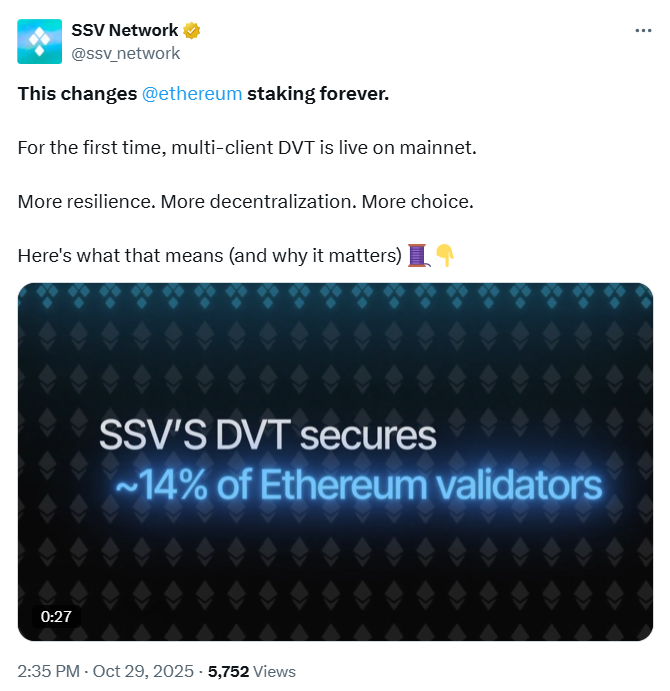
In addition to the Ethereum Foundation news, SSV Network has announced a change to Ethereum staking through distributed validator technology.
In a recent post on X, the protocol mentioned that this update improves reliability for validators on the network.
The idea follows the same approach that helped Ethereum become more stable at the consensus layer.
When more than one client is in use, no single system holds control. That reduces the likelihood of a single issue affecting everyone.
The new client is named Anchor, it is built in Rust and is open source. The developers behind Ethereum’s Lighthouse client created it. Anchor is now live on mainnet as the second SSV Network client.
Additionally, SSV Network explains that Anchor reduces the likelihood of single-client failure.
It provides operators with more options and enhances the network’s ability to handle problems. The upgrade could also support new forms of validator infrastructure.
Price Outlook Shows Traders Watching Support Levels
As of writing, CoinMarketCap data shows that the Ethereum price was trading at $3,964.10.
However, the market is awaiting the Federal Reserve’s announcement of an interest rate change.
This is because proponents believe it could have some influence on the price of ETH. Many expect a 25-basis-point cut.
Lower rates can lead to more interest in assets that involve higher risk.
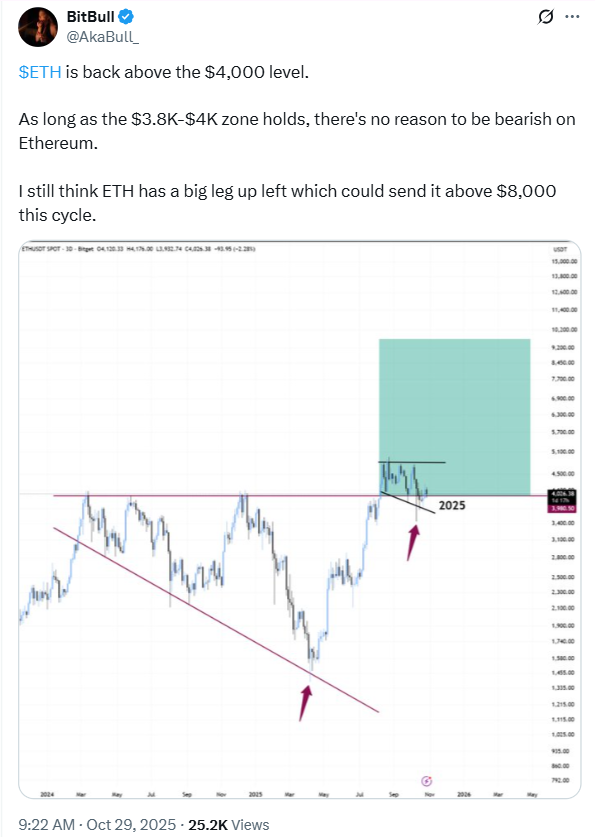
Chart data shows support around the $3,800 to $4,000 zone. A market observer known as BitBull says that if this range holds, there is no reason to expect a negative outlook.
The analyst believes the price could rise further and reach above $8,000 before the end of the cycle.
Technical traders also watch the 100-day exponential moving average, which is currently near $3,971.
If buyers keep prices above that level, momentum could continue toward the 50-day average near $4,116 and resistance close to $4,253.





