
 Pearl
Pearl ZKsync
 Bitcoin
 Starknet
 Quantus
 Puffer
 Lighter

U.S. Vice President JD Vance recently made a significant prediction, noting that 100 million Americans will own Bitcoin. BTC adoption has been gaining traction once again!
But this time, in addition to retail and institutional players, top US lawmakers are warming up to it. His comments came as the world marked 17 years since the release of the Bitcoin whitepaper. The anniversary fell on October 31, 2025.
JD Vance Bets On Bitcoin Adoption With Clarity Act
U.S. Vice President JD Vance projected a significant surge in Bitcoin ownership nationwide. He stated that “around 50 million Americans own Bitcoin today, and that number is going to double before too long.”
Vance described Bitcoin and other digital assets as mainstream, innovative, and a hedge against inflation and regulatory overreach. His comments come as the U.S. banking sector awaits the implementation of the Clarity Act, expected to take effect in early 2026.
The legislation aims to provide long-awaited regulatory clarity for financial institutions. Additionally, the introduction of the Clarity Act may accelerate the integration of blockchain and Bitcoin into everyday banking operations.
According to Bitwise, there is now an 80% chance that the Clarity Act will pass by early 2026. This landmark bill will resolve years of regulatory confusion. It settles the jurisdictional dispute between the SEC and CFTC over digital assets.
If enacted, the Clarity Act would clearly distinguish which crypto assets qualify as securities or commodities. Besides, it will also provide legal clarity for exchanges and blockchain projects to operate within U.S. law.
Furthermore, the Clarity Act will unlock institutional confidence and capital inflows into the sector. With crypto ETF approvals and Wall Street’s growing participation already transforming the market, regulatory clarity could further accelerate adoption and innovation.
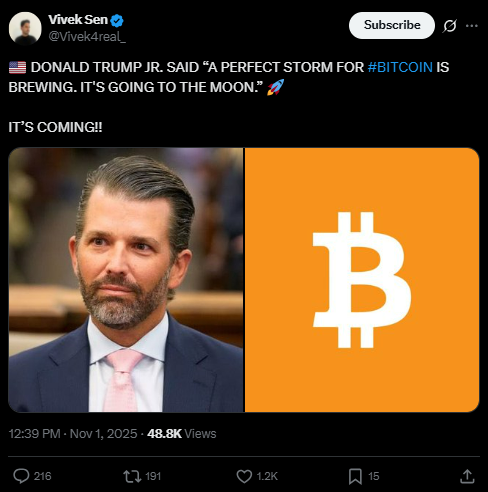
The overall Trump administration has been supportive of Bitcoin and other cryptocurrencies. Donald Trump Jr. recently said a “perfect storm for Bitcoin is brewing.” He added that the cryptocurrency “is going to the moon.”
Bitcoin Adoption To Rise Among US Banks
MicroStrategy Executive Chairman Michael Saylor said that major U.S. banks are preparing to enter the Bitcoin market. He noted that traditional banking players will plan to buy, sell, custody, and lend against Bitcoin by the first half of 2026.
“That’ll be great for them, great for Bitcoin, great for us,” Saylor said. He added that the next phase of adoption will involve traditional financial institutions directly handling Bitcoin, not just ETFs. Bitcoin ETFs have already proved to be an extremely successful investment product in the market.
Michael Saylor’s Strategy just delivered stellar Q3 results earlier this week. The MSTR stock price shows a healthy recovery on Friday, with plans for S&P 500 inclusion moving ahead.
Echoing this sentiment, Galaxy Digital CEO Mike Novogratz described the incoming wave of institutional involvement as a “monster pool of capital.” He emphasized that more access points will draw new participants into the digital asset ecosystem.
Novogratz observed that the expanding global M2 money supply may boost Bitcoin and other digital assets. He believes a sizable portion of new liquidity could flow into these markets. This will fuel the next phase of mass BTC adoption, said Novogratz.
US Treasury Secretary Praises BTC
On October 31, the BTC community marked the 17th anniversary of Satoshi Nakamoto’s publication of the BTC Whitepaper. U.S. Treasury Secretary Scott Bessent acknowledged the milestone in a post on X.
He commended Bitcoin’s enduring reliability and resilience over the years. In his message on X, while slamming the Democrats, Treasury Secretary Bessent wrote:
Cardano founder Charles Hoskinson responded to the post, calling it “profoundly magical” to see the U.S. Treasury Secretary publicly acknowledge Bitcoin’s reliability.
He noted that the gesture marks a significant shift from the country’s previously critical stance toward Bitcoin. Hoskinson credited the pro-crypto policies of President Donald Trump’s administration for driving this change.




