
 Bitcoin
 ZKsync
 Pudgy Penguins
 Pearl
Pearl Quantus
 Starknet
 NEAR Protocol
zkSync, a Layer 2 network is dominating the current Ethereum news outlook, has launched the Atlas upgrade.
The update delivers 15,000 transactions per second, one-second finality, and very low fees.
It also connects Ethereum’s liquidity directly to Layer 2 networks for faster and smoother capital movement.
Ethereum News: Atlas Opens Faster Access to Liquidity
In a major development, zkSync has rolled out its Atlas upgrade to boost Ethereum’s speed and liquidity usage.
The update brings major improvements, reaching over 15,000 transactions per second.
Per the development, it also offers one-second zero-knowledge finality, meaning transactions are confirmed almost instantly.
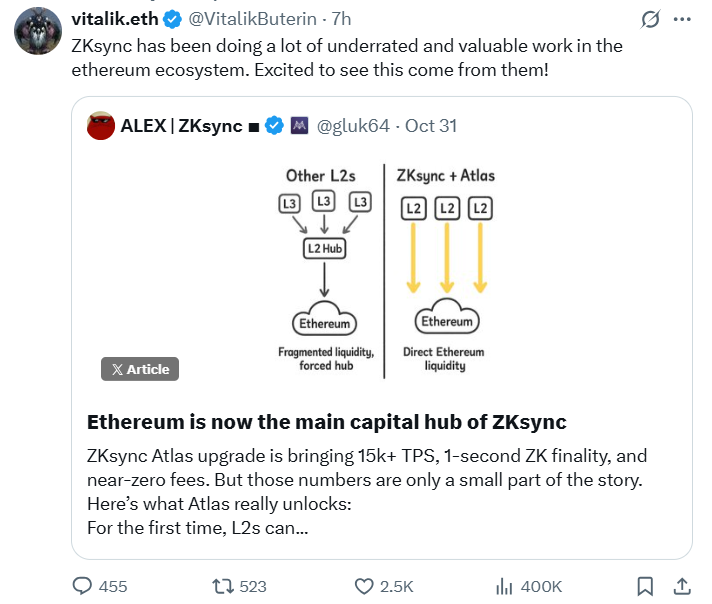
Atlas connects Ethereum’s main network with zkSync-based chains in real time. This allows funds to move quickly between layers without delays.
Before this upgrade, each Layer 2 network, such as zkSync Era, Base, or Arbitrum One, had to build its own liquidity pool.
Per the Ethereum news, these separate systems slowed down transfers and increased costs. With Atlas, that setup is no longer needed. zkSync chains can now draw liquidity straight from Ethereum.
Developers can still build special hubs or app-specific chains, but these will serve as add-ons instead of core requirements.
This change makes Ethereum the main capital center for assets and tokens across zkSync networks.
More importantly, the upgrade aims to make Ethereum more efficient for institutional investors and real-world assets.
Transactions between the main network and Layer 2 chains can now settle faster, improving how large funds and asset flows operate.
zkSync’s goal is to act as a true extension of Ethereum’s financial layer, rather than a separate system.
Vitalik Buterin Supports zkSync’s Work
Commenting on the Ethereum news, co-founder Vitalik Buterin has shown support for zkSync’s latest progress.
In a post on X, he said zkSync has been doing valuable work for the Ethereum ecosystem.
His comments on social media reflect trust in the project’s approach and its use of zero-knowledge technology.
It is important to add that Buterin has often spoken about the need for zero-knowledge systems in Ethereum’s long-term plan.
Essentially, these technologies enable faster transactions while maintaining security and decentralization.
The Atlas upgrade aligns with this vision by enhancing performance without altering Ethereum’s core structure.
By integrating Ethereum and zkSync more closely, the upgrade could help the network better handle higher demand.
It could also make it easier for developers and financial projects to build faster applications that remain connected to Ethereum’s base layer.
Analysts Watch Ethereum’s Price and Network Growth
In a separate Ethereum news, market analysts are watching Ethereum closely as the network continues to grow.
Crypto analyst Michaël van de Poppe said Ethereum remains one of the best ecosystems for developers and investors.
He expects the Ethereum price to move toward a new high above $5,000 if momentum continues.
He pointed to strong developer activity, new products, and growing network use as key drivers.
However, he also noted that the market is still showing mixed signs. Ethereum’s price has slipped below the 50-day and 100-day moving averages, suggesting weaker short-term strength.
If the price drops under $3,800, it could find support near $3,500. The next major level sits around $3,200, near the 200-day moving average.
To regain positive movement, the Ethereum price would need to break above $4,000, then test the $4,150 to $4,200 range.
The current chart shows price pressure at the top of the trading range, with buyers defending the lower side.
A range between $3,730 and $3,880 marks the near-term zone that traders are watching.
As zkSync and other Layer 2 projects expand, Ethereum’s role as a settlement and liquidity hub continues to grow.
The Atlas upgrade could strengthen that position by linking faster chains directly to Ethereum’s core network, giving both developers and investors new tools to work with.



