
 Zylo Ecosystem
 astronaut
 Pearl
Pearl Walrus
 Starknet
 Pudgy Penguins
 Bitcoin

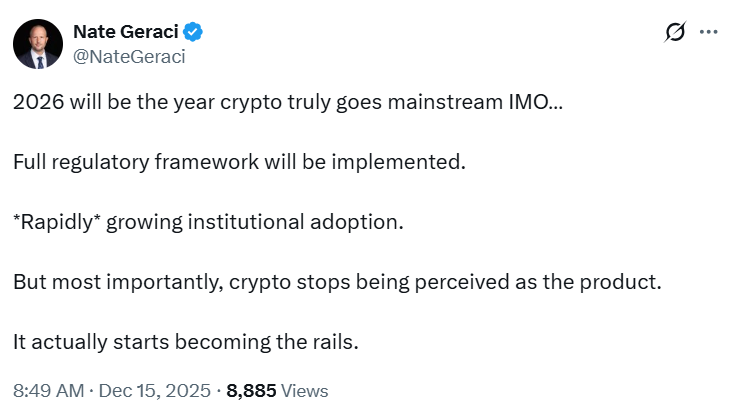
Bitcoin spot Exchange-Traded Funds (ETFs) hold approximately 7.8% of the 21 million BTC supply. In a recent X post, ETF analyst Nate Geraci pointed out that trends suggested that crypto could go ‘mainstream’ in 2026.
The number of BTC treasury companies (digital asset treasuries or DATs) went from 44 to 190 between January 2025 and November 2025, in the wake of Strategy’s aggressive BTC accumulation, according to BitcoinTreasuries(dot)Net. BTC Digital Asset Treasuries (DATs) also accumulated a significant amount of BTC in 2025, led by Strategy Inc.
Concerns about volatility and risks remain among the general public, echoed by a recent letter by the American Federation of Teachers (AFT).
Bitcoin Spot ETFs – Crypto Accumulation Machines
Bitcoin spot ETFs have rapidly accumulated Bitcoin (BTC) since their approval by the Securities and Exchange Commission (SEC) in January 2024. They have accumulated at least 1.5 million Bitcoins (BTC) as of November 2025, BitcoinTreasuries(dot)net data shows.
US BTC Spot ETFs suggest a strong institutional interest in Bitcoin, the largest cryptocurrency by market cap. However, since January 2024, ETFs for other major cryptocurrencies, such as Ethereum (ETH), XRP, and Solana (SOL), have gained momentum rapidly, and that trend is continuing to grow.
Additionally, US Spot ETFs for Dogecoin (DOGE) and Chainlink (LINK) were launched between October and December.
SEC’s greenlight for crypto ETFs was a bellwether for the evolution of the regulatory structure across the world. European regulators had cleared crypto ETFs even before the US SEC.
Cryptocurrency exchanges dominated the BTC share pie chart, but US crypto Spot ETFs are rapidly gaining on exchanges. BTC spot ETFs control roughly 6.57% of the maximum BTC supply. BTC’s maximum supply is 21 million bitcoins.
Distribution is concentrated in the United States; however, ETFs don’t own the Lion’s share of BTCs. Publicly listed companies collectively hold the biggest share of BTC in the US, and their numbers are growing fast.
Public Companies Are Increasingly Emulating Strategy
Ever since Strategy Inc. (NASDAQ: MSTR) shifted its primary focus to BTC accumulation in 2020, other public companies have adopted a similar model. Bitcoin Treasuries(dot)Net data shows that the number of similar DATs went from 44 to 190 between January and November 2025.
Strategy is the biggest BTC DAT in the global crypto market, and its lead is massive. As of December 15, Strategy’s last reported BTC holdings stood at 660,624 ($50.307 billion), which is 3.14% of the maximum BTC supply. The second largest BTC DAT, Mara Holdings Inc. (NASDAQ: MARA), holds 53,250 BTC, according to BitcoinTreasuries(dot)Net. Both MARA and MSTR are US-based companies.
The largest non-US BTC Treasury, Metaplanet Inc. (OTCQX: MTPLF), listed on the Tokyo Stock Exchange, held 30,823 BTC ($2.76B) as of the time this report was written.
Globally, public companies’ net BTC additions in November 2025 were 10,761 BTC (added 12,644 BTC; sold 1,883 BTC) according to BitcoinTreasuries(dot)Net November Adoption Report. However, that number is small compared to other months of 2025.
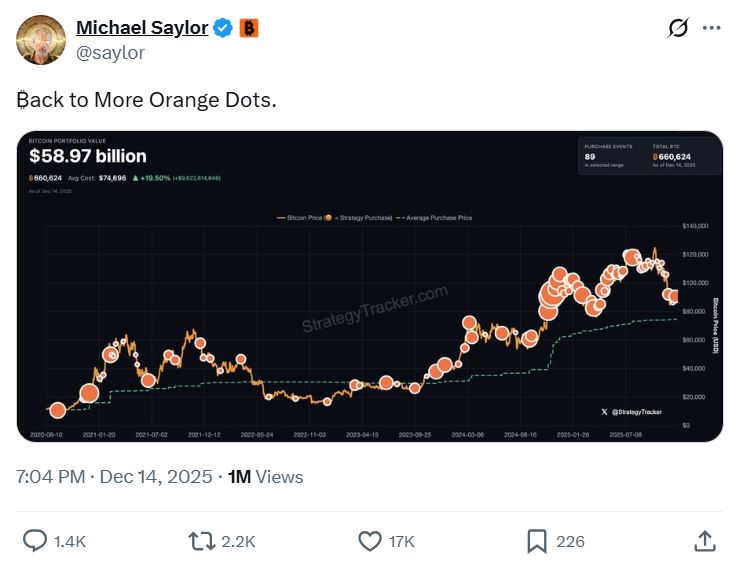
Bitcoin Treasuries projects that public companies might accumulate around 40,000 BTC in Q4, 2025. Saylor teased another purchase announcement yesterday morning; Strategy purchased 10,624 BTC in early December.
‘Full Regulatory Framework’ in 2026
Geraci noted that ‘full regulatory framework will be implemented’ in 2026. Also, he likely referred to tokenization in his post when he said crypto would become ‘rails’. Tokenization is one part of the broad process of integration into the mainstream.
As 2025 comes to a close, ETFs and DATs maintain net positive Bitcoin positions overall, reflecting strong and growing interest in the cryptocurrency market. The regulatory framework around digital assets in the US is not fully established. A case in point is a recent letter by the American Federation of Teachers, a labor union, to two US senators.
A letter by the American Federation of Teachers (AFT), a labor union with 1.8 million members, was written to Senators Tim Scott and Elizabeth Warren, calling the Responsible Financial Innovation Act (RFIA) ‘irresponsible’ and ‘reckless’.
Senator Tim Scott is the head of the Senate Committee on Banking and Housing Affairs, and Senator Warren is a ranking member.
The Union noted that Americans depend on pensions and other similar financial plans and that exposing those to crypto risks would be dangerous. They pointed out that tokenized stocks would mean that existing pension funds, which do not directly invest in crypto, could be exposed to crypto risks.
Key pieces of legislation have been passed or are under discussion in the US Legislature. The GENIUS Act provides a framework for stablecoins in the US. It was passed in July 2025. The CLARITY Act aims to clearly demarcate the jurisdictions of regulators, such as the SEC and the Commodity Futures Trading Commission (CFTC); it has been approved by the House.



