
 astronaut
 Pearl
Pearl NEAR Protocol
 Walrus
 Zylo Ecosystem
 Bitcoin
 Hyperliquid

Pi Network price continued its strong downward trend this week as demand weakened and supply rose. It also retreated as a top analyst blasted the Pi Core Team for its slow progress on rolling out the Protocol 23 update. It plunged to a low of $0.171, its lowest level since January 19.
Top Analyst Blasts Pi Network Core Team for the Protocol 23 Update Delay
Dr Altcoin, a popular analyst, blasted the Pi Core Team for the ongoing sell-off of the token. It has crashed by over 90% from its all-time high in February last year.
He blamed the team for making no meaningful progress since the mainnet launch in 2025. He gave the example of Protocol Version 23, which the upgrade started last year.
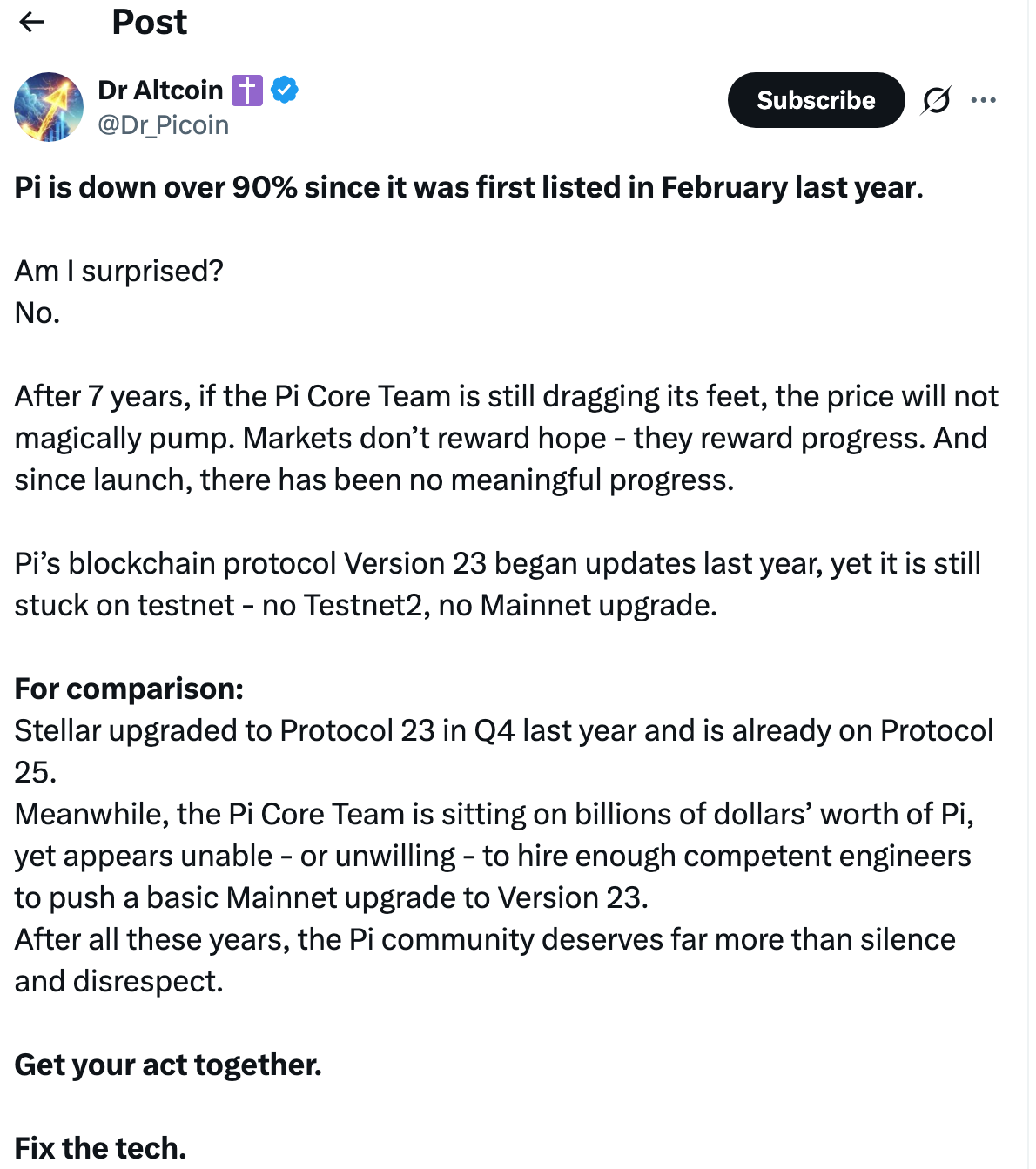
The upgrade was important because Pi Network’s mainnet exists on top of Stellar’s protocol. Stellar upgraded its network from Protocol 22 to Protocol 23 in late 2025. The team activated Protocol 25 this year.
In contrast, Pi Network is still stuck in the Protocol 23 testnet. Its testnet 2 has not been launched. Also, it is unclear when the mainnet will be launched.
An upgrade from Protocol 19 to Protocol 23 would be a big milestone for Pi Network. This would enable smart contract features in the network. It would also bring more scalability, transition it to a more mature blockchain, and introduce better security and decentralization.
Pi Network’s Team Has Faced More Criticism
Pi Network’s team has faced more criticism in the past few months as its price has continued crashing. First, the team has faced the criticism of the slow pace of the Know Your Customer (KYC) verification.
Nearly a year after the mainnet launch, millions of pioneers have never been verified. The team has launched an AI feature for KYC verification. However, the process is still slow, and many people on X complain that their details were not captured.
Second, the team is blamed for centralization. There, the obscure Pi Foundation holds over 90 billion tokens in hundreds of wallets.
Unlike other chains like Ethereum, Solana, and Uniswap, Pi Network’s pioneers still don’t have a say in how it is run. There is no way to submit or vote for any proposals.
Instead, the team follows a top-down approach. They make decisions and post them directly on their blog and social media platforms. This explains why some of their initiatives, including the upcoming DEX and AMM features, have not become popular.
Third, nearly a year after the mainnet launch, no other tier-1 exchange has listed it. It is not listed on popular exchanges like Binance, Coinbase, and Upbit. This means that millions of customers who use these companies have no access to the coin.
Additionally, Pi Network has not achieved its utility goal. Its ecosystem is a ghost chain, and no retailer is accepting the coin today. This is a sharp contrast to what users were promised before the mainnet launch.
Most importantly, the team has not worked to reduce the supply influx through a token burn or reduced unlocks.
Pi Network Price Technical Analysis
The daily chart shows that the Pi Coin price has been in a strong bearish downward trend since its mainnet launch. Most recently, it dropped in the last nine consecutive days.
The coin has moved below the important support level at $0.1941, its lowest level in October and December last year. It has remained below all moving averages and the Ichimoku cloud indicator. The Relative Strength Index (RSI) and the MACD have continued falling.
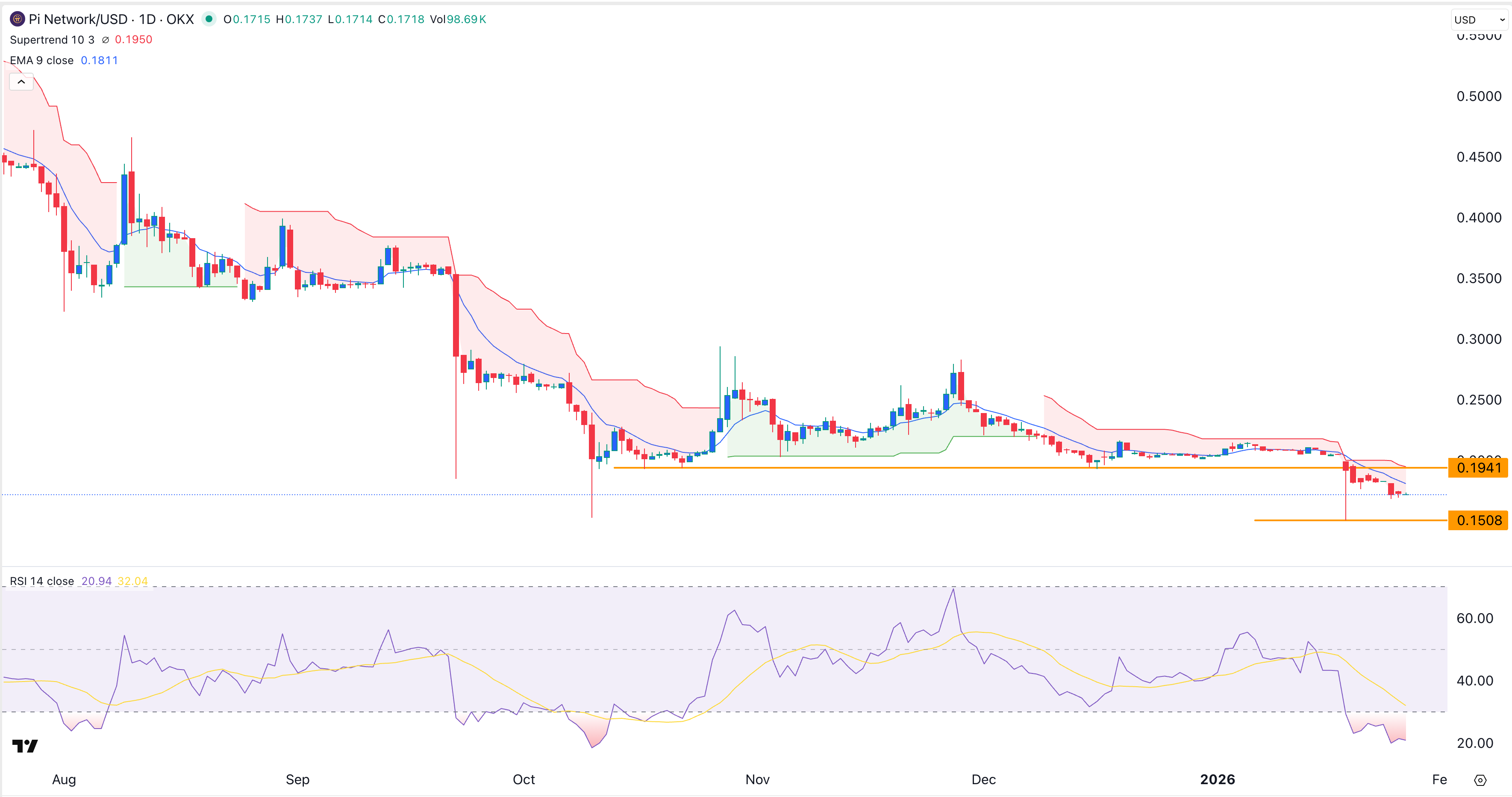
Therefore, the most likely Pi Coin price forecast is bearish, with the next key target to watch being at $0.1500, its all-time low. A move below that level will point to more downside in the coming weeks.



