
 Bitcoin
 Starknet
 Pearl
Pearl ZKsync
 NEAR Protocol
 Quantus
 Zerebro
World Liberty Financial has proposed a new governance plan that would place 62.28 billion WLFI tokens under new multi-year vesting terms. The plan would also introduce a potential burn to the founder, team, and allocation to advisors and partners. The move comes as the Trump-linked DeFi platform faces rising pressure from holders, growing governance scrutiny, and renewed questions around token control.
World Liberty Financial Introduces New Vesting Structure for Locked WLFI
The new proposal outlines different vesting schedules for separate groups of token holders. Early supporters would face a two-year cliff, followed by a two-year linear vest. That means their locked WLFI tokens would remain inaccessible at first and then unlock gradually over time.
The allocation of founders, teams, advisers, and partners would take a more rigid approach if such holders agree to the new terms. Under the proposal, these groups would encounter a two-year cliff and a three-year linear vest. This would spread token release over a longer period and avoid a sharp rise in circulating supply.
The proposal also includes a penalty for those who do not accept the new structure. Holders who do not accept the new vesting terms will be permanently locked in. That condition adds pressure on insiders and affiliated groups to opt into the revised framework.
In effect, the plan formalizes a phased unlock structure that the project had signaled before. It also tries to present the release schedule as controlled and orderly rather than immediate. In the meantime, this proposal is making vesting a supply-management tool available during a tense period for the platform.
Burn Option Targets Insider-Linked Token Allocations
Alongside vesting, the proposal also introduces a token burn. The platform said it may burn up to 4.52 billion WLFI tokens. That amount represents 10% of the founder, team, adviser, and partner allocation.
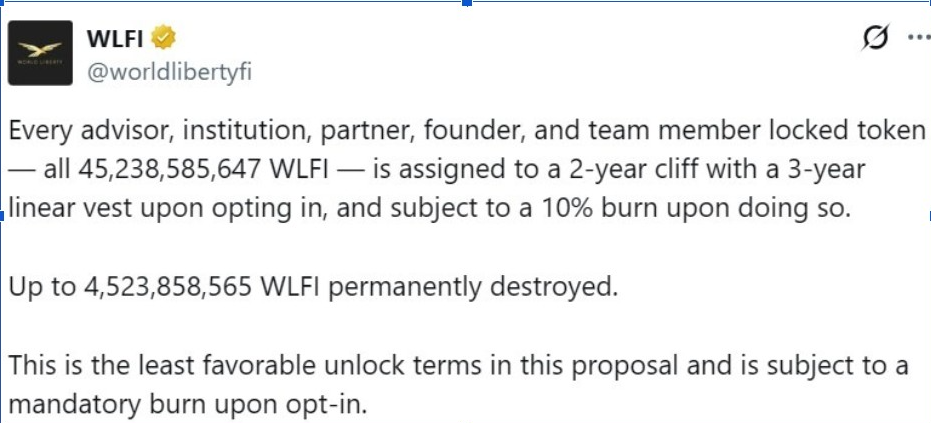
This feature appears designed to show restraint at the insider level. A burn would permanently remove a portion of those tokens from supply. In turn, that could help address concerns from holders worried about future dilution once locked tokens begin to unlock.
The burn is interesting because it does not apply to all token classes. Rather, it targets the populations that tend to attract the most criticism when it comes to the idea of token governance. That includes founders, internal teams, advisers, and external partners tied to the platform.
Holder Backlash and Governance Concerns
The proposal comes after increased backlash from early WLFI purchasers. The project announced on April 10 that it would proceed with a governance proposal after some of its holders threatened to sue. The frustrations focused much on lengthy lockups and liquidity shortages.
Also, that tension was compounded by governance concerns. Critics questioned how much influence ordinary holders actually had over platform decisions. The issue drew more attention after a public dispute with Tron founder Justin Sun.
On Monday, Sun, who already invested 30 million in WLFI, denounced the platform due to its lack of transparency and involvement in governance. He insisted that the previous votes were controlled by fewer wallets, and they did not have any meaningful participation with the rest of the holder base.
In reaction, WLFI threatened to sue Sun. The conflict brought governance issues into sharper focus and raised broader questions about how decisions are made behind the scenes.
Treasury Activity and Token Control Concerns
Furthermore, the governance debate also comes just after fresh questions around treasury activity. On Saturday, WLFI fell to a new all-time low. That decline came only days after wallets linked to the project used billions of tokens as collateral to borrow around $75 million in stablecoins.
That sequence highlighted how treasury-linked wallets are being used and the extent of influence key entities may have over the token. Sun urged the platform to reveal who owns significant wallets attached to the smart contracts as well. He cautioned that such control might have the power to freeze tokens.



