
 Wisp
Wisp Doge Pepe
 Zylo Ecosystem
 Crawlerpad
 Pudgy Penguins
 Pearl
Pearl Basic Attention
The CLARITY Act delay could push the Securities and Exchange Commission to advance its own digital asset market rules.
SEC Chair Paul Atkins said the agency and Commodity Futures Trading Commission could address regulatory gaps if Congress fails to complete the legislation.
However, Atkins continued supporting a federal law because legislation would provide greater long-term certainty than agency rules.
The Senate had not scheduled full floor consideration as lawmakers approached the August state work period.
CLARITY Act News: Senate Delay Leaves Bill Without a Floor Vote
The House approved the CLARITY Act in July 2025 by a 294-134 vote. The Senate Banking Committee advanced the bill in May 2026 by a 15-9 vote. However, Senate leaders have not scheduled a floor vote. The measure would need at least 60 votes to pass the chamber.
The bill would divide oversight between the SEC and the Commodity Futures Trading Commission. It would give the CFTC authority over spot markets for digital commodities. That structure could place many crypto assets outside the SEC’s direct market jurisdiction.
Senate Democrats have raised concerns about ethics provisions linked to government officials and digital asset activity. Lawmakers also remain divided over whether stablecoins should offer yield. These issues have slowed negotiations and reduced the chance of passage before the August recess.
Senate Majority Leader John Thune said the chamber likely would not complete the bill before the break. The Senate later set the proposal aside while lawmakers focused on other priorities. The delay leaves the bill without a clear date for a final vote.
Lawmakers must also settle how the bill treats decentralized networks, token sales, and customer protections. According to prediction market Polymarket, the CLARITY Act has a 29% chance of becoming law in 2026.
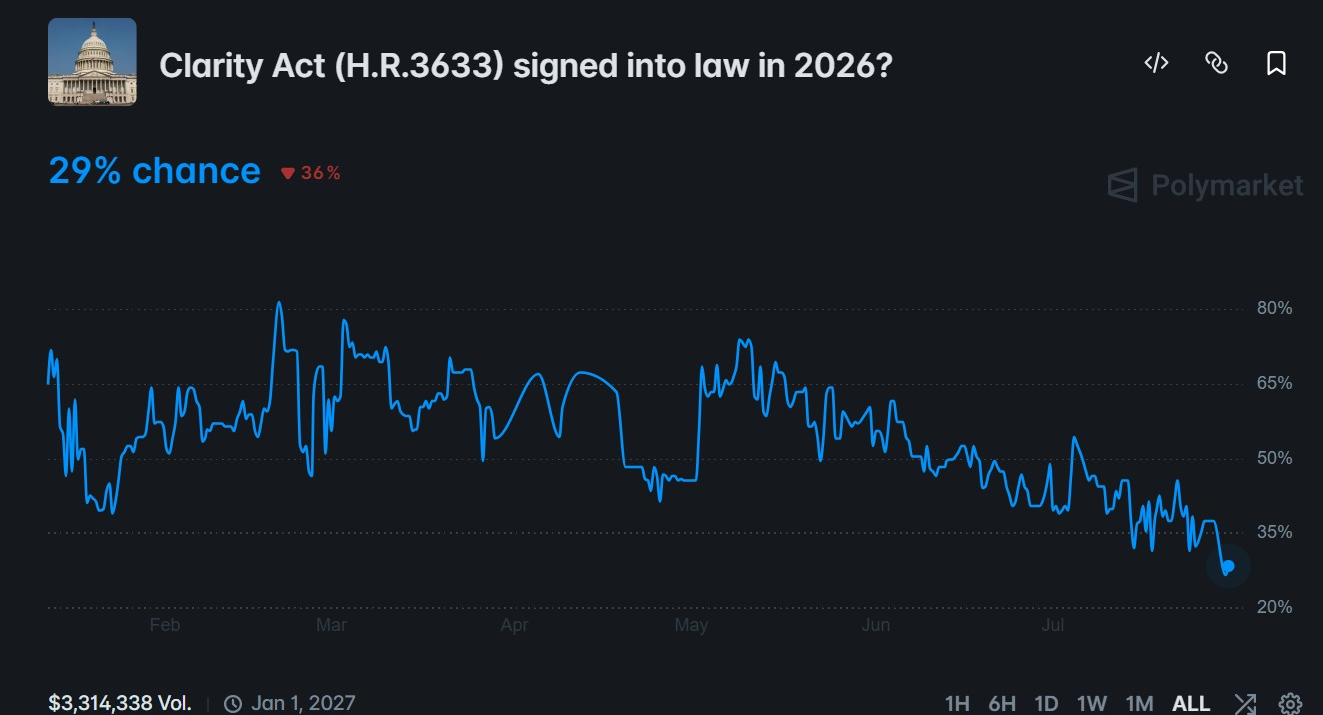
Polymarket probability has fallen 36% as the Senate floor vote remains pending.
SEC Prepares Alternative Crypto Rules
Atkins said the SEC stands ready to create rules covering many issues that the CLARITY Act addresses. The agency could use its existing authority to address token registration, custody, trading platforms, and broker-dealer requirements. It could also create exemptions for some crypto projects.
The SEC has already placed a crypto rulemaking package on its 2026 agenda. The plan includes registration exemptions and a possible safe harbor for decentralized projects. It also covers custody standards and rules for digital asset trading venues.
Atkins has described the agency’s work as a bridge to legislation. He said the SEC can provide rules if Congress does not act. However, he continues to support the bill and has offered technical assistance to lawmakers. Atkins said the agency wants standards for issuers, investors, and intermediaries. He argued that uncertain jurisdiction can leave businesses without consistent compliance requirements.
The agency has also worked with the CFTC on digital asset classification. March guidance identified 16 tokens as digital commodities, including Bitcoin and Ethereum. That guidance remains an administrative action rather than a federal law.
CLARITY Act Timing Remains Uncertain
The Senate Banking Committee’s vote demonstrated bipartisan support for a digital asset market structure framework.
However, committee approval did not guarantee the bill enough support to overcome procedural hurdles on the Senate floor.
The legislation still faces disagreements over ethics, stablecoin rewards, illicit finance and consumer safeguards.
It could return after lawmakers complete the August state work period. Senate leaders had not announced a firm date for floor consideration.
The SEC is therefore likely to continue preparing its own crypto rules while Congress debates the legislation.
Those rules could provide shorter-term guidance for issuers and intermediaries.
However, Atkins maintained that comprehensive legislation remained the stronger route toward a durable U.S. crypto market framework.




