astronaut
 Zylo Ecosystem
 Pearl
Pearl Bitcoin
 Quantus
 Pudgy Penguins
 Bitway
- The Solana founder pointed out that addressing bugs is a significant area where smart solutions are needed.
- Each protocol has its unique strengths and weaknesses.
- Solana and Ethereum continue to compete fiercely in the blockchain space.
Anatoly Yakovenko, Solana founder (SOL), recently highlighted key features that set it apart from Ethereum (ETH). He emphasized the divergence between the two platforms, particularly in how they manage network congestion.
In the cryptocurrency industry, comparisons between blockchains and digital assets are frequent. However, the rivalry between Ethereum and Solana has particularly captivated individual investors and piqued institutional interest.
As the blockchain landscape evolves, many platforms are evaluated against one another to identify the most advanced technology.
Among these, Solana and Ethereum are often the most scrutinized networks within the ecosystem.
Solana Founder on Solutions For Addressing Bugs
The Solana founder highlighted a key difference between Solana and Ethereum regarding price discovery during periods of high demand.
He pointed out that Solana’s hardware struggles to cope with surging demand, leading to poor price discovery when the network is saturated.
This limitation typically acts as a control mechanism for congestion issues. However, Solana’s founder argues that instead of raising transaction fees during peak times, the focus should be on scaling hardware to meet new demands.
Yakovenko identified software limitations as design flaws that prevent validators from upgrading their hardware to effectively manage traffic.
In a post on X, he stated,
“If the software doesn’t allow validators to add more hardware to deal with new demand, it’s a bug in the software. Local contention should be the only factor driving user fees.”
The Solana founder also shed light on the relationship between hardware and software. He claimed that the maximum additional bandwidth a system can achieve is roughly 10 times the cost of the hardware.
These insights underscore Solana’s commitment to leveraging hardware upgrades to enhance network performance and address congestion challenges.
Solana and Ethereum: An Insightful Comparison
While Solana focuses on addressing its bugs, it stands out in its competition with Ethereum in distinct ways. Solana is celebrated for its high throughput and low transaction fees, making it an attractive option for users.
In contrast, Ethereum network is recognized for its robust smart contract capabilities, positioning it as a leader in the Decentralized Finance (DeFi) space.
Despite Ethereum’s dominance, it has struggled with scalability issues for years, particularly as the popularity of Decentralized Applications (dApps) and DeFi protocols has led to significant network congestion.
Ethereum’s status as the preferred platform for smart contract development remains strong, largely due to the Solidity programming language, which facilitates the creation of diverse applications.
However, Solana still has work to do in this area to match Ethereum’s established capabilities.
Solana Price Outlook: Bullish Trends Ahead
Solana price (SOL) has seen a surge in positive sentiment recently, signaling a potential bullish rally. With a strong ecosystem backing it, some analysts argue that the coin is undervalued.
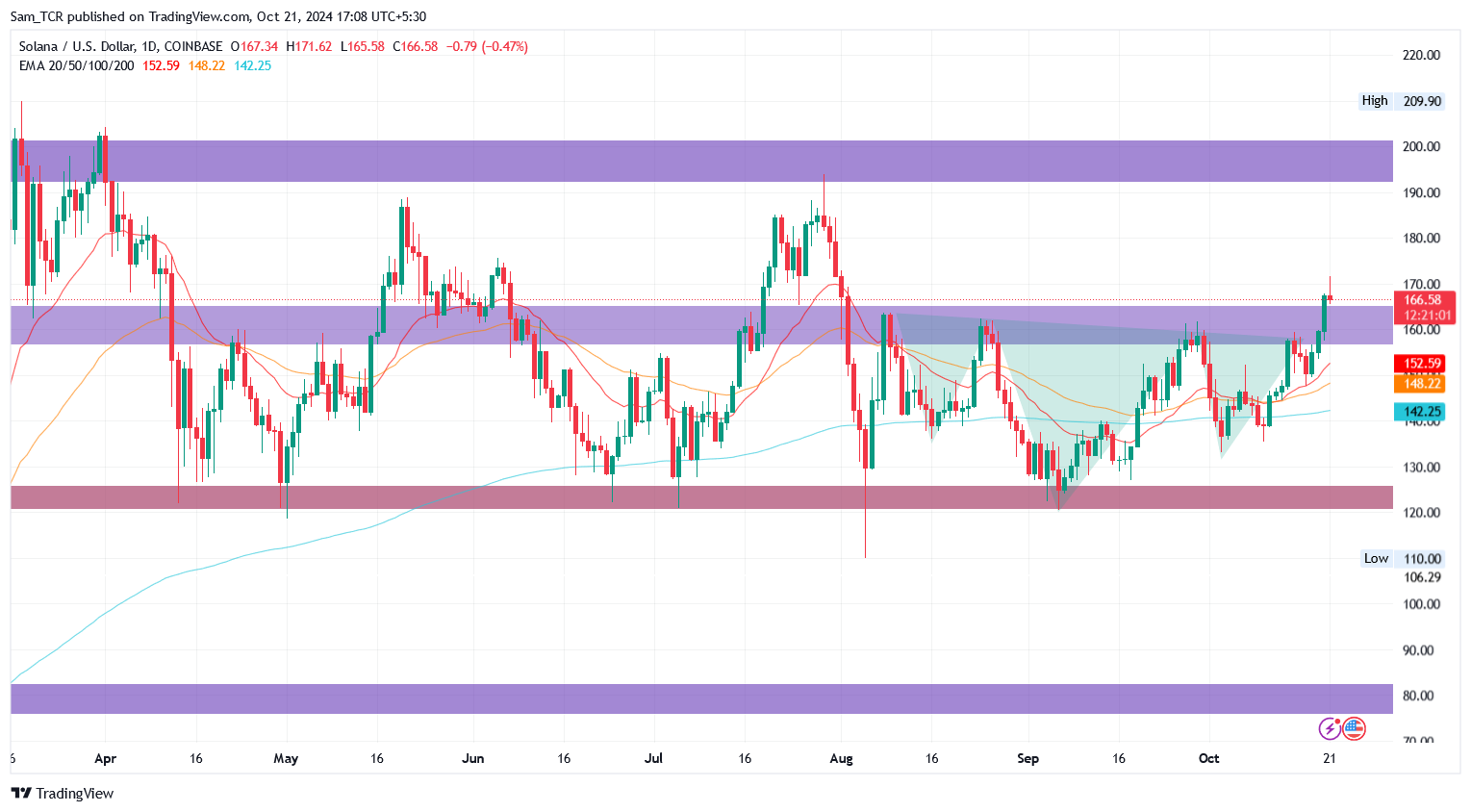
As the fifth-largest cryptocurrency, SOL boasts a market capitalization of $78.34 Billion and is currently priced at $166.73, up by 5% over the past 24 hours.
Many experts believe Solana could reach $200, especially if its DeFi sector continues to flourish. The ongoing memecoin excitement within the network could also push the Layer-1 platform to new highs. Given the typical trends in the crypto market, the expected “Uptober” effect may further fuel SOL’s price increases in the near future.
Disclaimer
In this article, the views, and opinions stated by the author, or any people named are for informational purposes only, and they don’t establish the investment, financial, or any other advice. Trading or investing in cryptocurrency assets comes with a risk of financial loss.