
 astronaut
 Pearl
Pearl NEAR Protocol
 Starknet
 Zcash
Zcash Pudgy Penguins
 Ethena
- Over the past week, Federal Reserve liquidity has dropped by approximately $80 billion.
- Meanwhile, the Bank Term Funding Program experienced its largest weekly decline since February. It has shredded to $30 Billion.
- In contrast, the People’s Bank of China has injected around $33 billion into the money markets on a net basis.
Liquidity in the global financial markets is shifting in unexpected ways, and it’s having a direct impact on cryptocurrencies. The Federal Reserve liquidity has plunged, draining funds from the market.
At the same time, the Treasury General Account (TGA) has seen a modest dip. However, it remains at a high level.
The Federal Reserve’s Bank Term Funding Program (BTFP) has also experienced its largest weekly decline since its inception. This signaled a further tightening of liquidity.
Meanwhile, in China, the People’s Bank of China (PBoC) injected billions into the money markets. The bank is taking a more cautious approach to liquidity easing.
What do all these shifts mean for the cryptocurrency market, which thrives on liquidity? Could these liquidity changes drive new volatility or opportunities in crypto? Continue reading.
Liquidity Drain: The Federal Reserve’s Liquidity Experiences $80 Billion Drop
The Federal Reserve liquidity has dropped by around $80 Billion, mainly due to a surge in reverse repo agreements. These transactions have pulled significant funds out of the market, affecting the financial system.
At the same time, the Treasury General Account (TGA) decreased by approximately $30 Billion. This brought its balance to $809 Billion. While this drop is significant, the TGA remains still well-funded.
Experts have anticipated the TGA could continue to decline in the coming weeks. This could potentially lead to an increase in overall Federal Reserve liquidity.
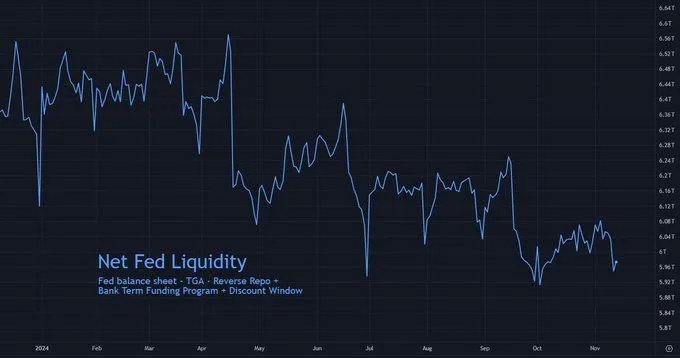
So, why does this matter for Bitcoin and other cryptocurrencies? Increased liquidity typically boosts market sentiment. It spurs more investor activity and potentially drives up crypto prices.
As liquidity conditions evolve, the next few weeks determine whether these changes reignite momentum in the crypto markets.
The $30 Billion Weekly Decline By BTFP and PBoC Liquidity Injections
As of the latest update, the Federal Reserve’s Bank Term Funding Program (BTFP) saw its largest weekly drop since its launch. It was around $30 Billion dip.
This reduction highlighted a tightening of financial conditions. More than 80% of the funds initially provided under the program have been repaid. Moreover, over $134 Billion was returned to the Federal Reserve.
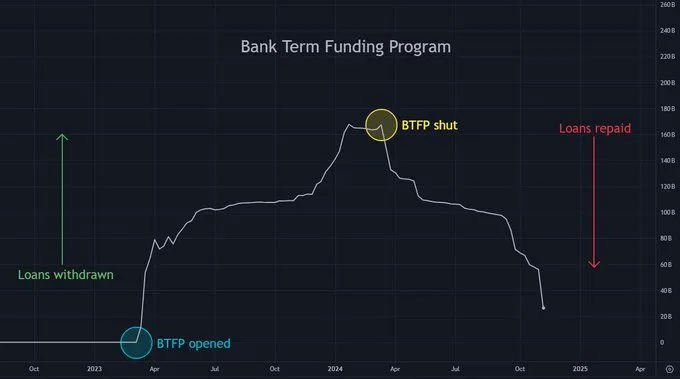
The large repayment of funds has resulted in a significant liquidity drain from the financial system. That could impact short-term economic conditions, including the cryptocurrency market.
Meanwhile, the People’s Bank of China (PBoC) took a different approach. It injected around $33 Billion into the money markets last week. This move is part of a broader strategy to provide short-term liquidity support and stabilize China’s economy amid global economic uncertainties.
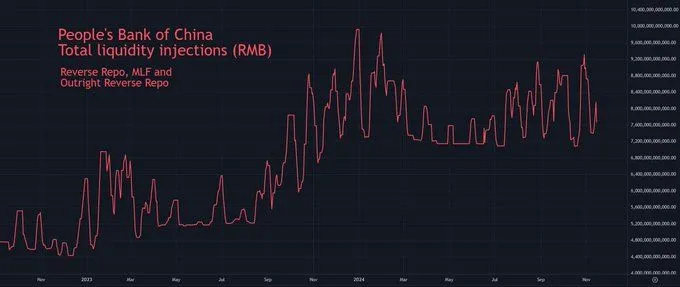
Experts debate whether these liquidity injections will ramp up toward 10 trillion RMB or stay within the typical 7 to 9 trillion RMB range. This will indicate a measured and cautious approach.
Analysts believe strengthening the U.S. dollar may drive the PBoC’s restrained strategy. That is limiting its capacity to implement more aggressive monetary measures.
Inflation and Fed Policy Impact on Crypto, & What’s Next for Crypto Investors?
The Federal Reserve’s shifting approach to inflation is pivotal in the current liquidity landscape. After initially labeling inflation as “transitory,” the Fed eventually acknowledged its persistence. This led to a series of policy adjustments.
Over time, the central bank has accepted that a recession might be necessary to curb inflation. It has aimed for a “soft landing” while projecting inflation to return to 2% by 2025.
The Fed has recently debated whether a 50 basis point rate cut is needed to avoid a recession. Despite this, it maintains that the economy is strong enough to withstand such moves.
This ongoing policy uncertainty, characterized by frequent shifts in strategy, has created volatility in both traditional financial and cryptocurrency markets. Investor sentiment can swing dramatically with each Fed decision, raising questions about the Fed’s reliability.
As central banks globally adjust liquidity, the impact on the cryptocurrency market could be significant. Cryptos like Bitcoin and Ethereum are especially sensitive to macroeconomic shifts, as changes in liquidity influence investor risk appetite.
The current divergence between U.S. and Chinese monetary policies could lead to heightened volatility in crypto markets. This is making them both more unpredictable and potentially more rewarding for investors.
These macroeconomic forces will likely continue to shape how cryptocurrencies are perceived and adopted worldwide in the coming months.
Disclaimer
In this article, the views, and opinions stated by the author, or any people named are for informational purposes only, and they don’t establish the investment, financial, or any other advice. Trading or investing in cryptocurrency assets comes with a risk of financial loss.





