
 Zerebro
 Bitcoin
 Quantus
 Pearl
Pearl Starknet
 ZKsync
 NEAR Protocol
- Peter Schiff criticizes Bitcoin, calling it a “national security threat” and urging Biden to sell off the U.S. government’s seized Bitcoin.
- Alex Kruger remains bullish, likening Bitcoin’s rise to gold’s post-Gold Standard boom in the 1970s.
- Bitcoin’s growing institutional adoption, including Bitcoin ETFs, contrasts with Schiff’s view of the asset as a speculative bubble.
Bitcoin USD, the dominant leader in the crypto space, continues to gain attention. Its popularity surged this year, especially after surpassing the $100K mark in December. This was driven by multi-factored reasons, such as retail and whale investments, alongside the rise of Bitcoin ETFs.
However, Bitcoin price’s recent intraday dip to $95K has reignited debates, despite its resurgence from the 20-day EMA band.
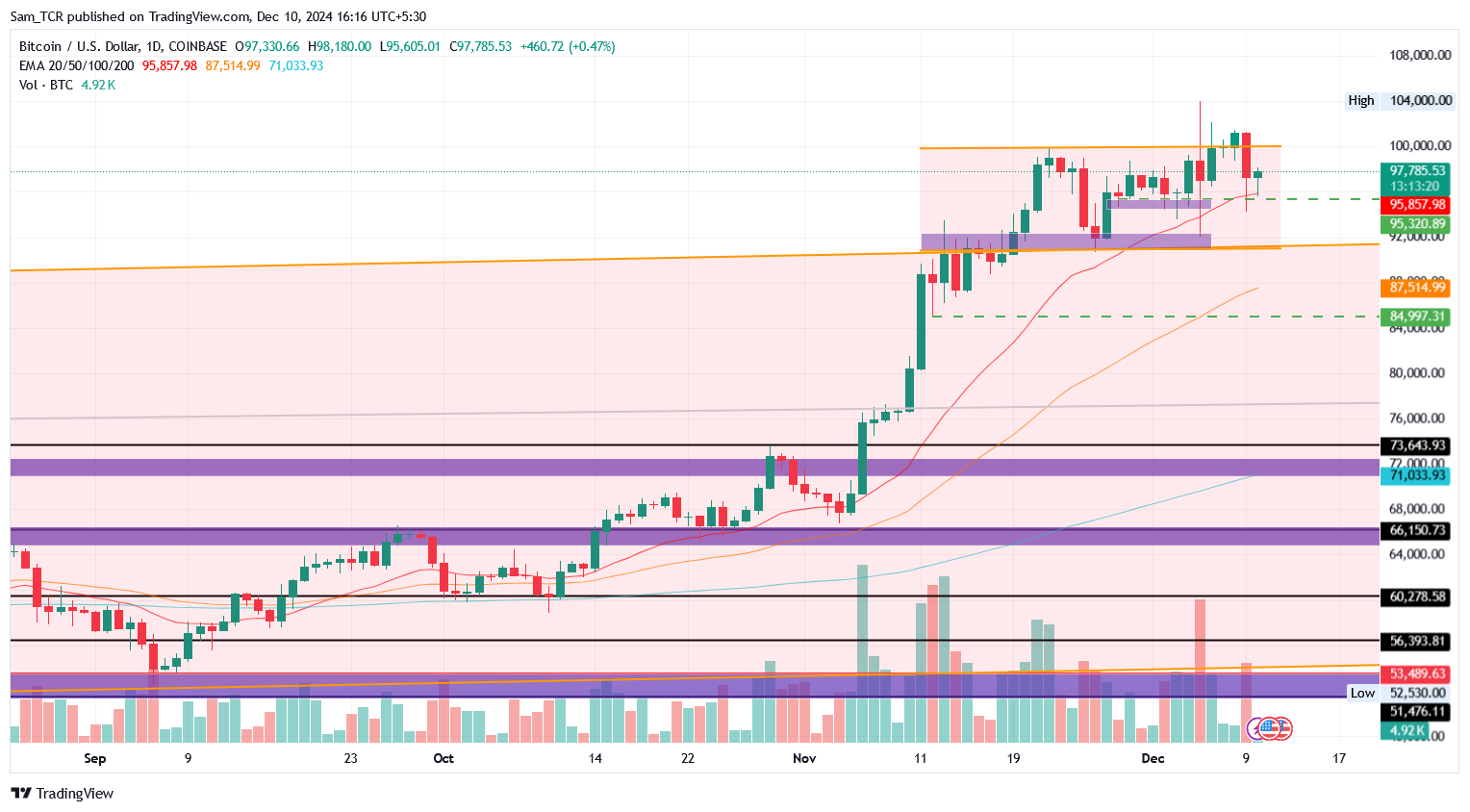
In 2024’s Q4, an array of several BTC news topics arose, and one more was added with one person’s criticism towards Bitcoin. Peter Schiff, a vocal Bitcoin critic, called the cryptocurrency a “national security threat”.
He argued that it misdirects resources and undermines economic productivity. He also criticized government involvement, claiming it misuses public funds.
In contrast, economist Alex Kruger views Bitcoin USD growth as part of a “supercycle,” likening it to gold’s rise in the 1970s. He highlights Bitcoin’s growing institutional adoption, which contrasts sharply with Schiff’s view of it as a speculative bubble.
Despite Schiff’s criticism, Bitcoin’s institutional adoption continues to grow, with Bitcoin ETFs holding more Bitcoin USD than the estimated 1.1 million BTC owned by Satoshi Nakamoto.
Continue reading for deeper insights to this article and surrounding Bitcoin.
Schiff’s Criticism at Peak: He Says Biden Still Has Time to Do a Good Job
Peter Schiff has escalated his criticism of Bitcoin. He asserted that the cryptocurrency could become a government-backed tool that harms the U.S. economy.
In a recent post on X, Schiff labeled Bitcoin as “public enemy number one,”. He even argued that while individuals are free to invest in Bitcoin, using public funds for its acquisition crosses a line. He warned that state involvement with Bitcoin could disrupt key economic sectors and threaten the stability of the U.S. dollar.
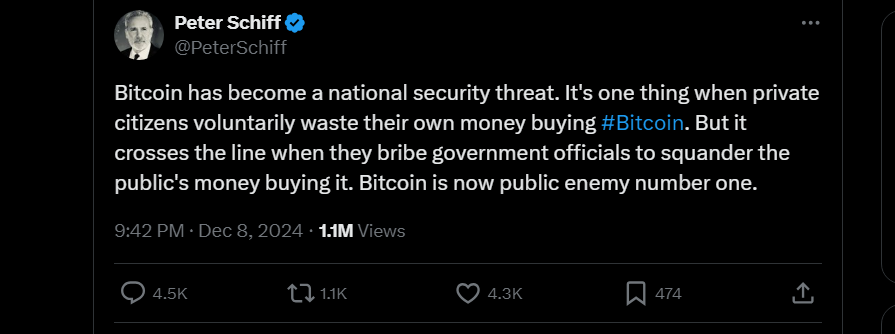
Schiff’s criticism also targets the proposed U.S. Strategic Bitcoin Reserve. He urged President Joe Biden to sell the government’s seized Bitcoin to help reduce the national deficit. He even warned that holding onto it could empower future administrations to use Bitcoin in ways that undermine the U.S. dollar.
While Peter Schiff remains one of Bitcoin’s most vocal critics, keeping aside Bitcoin USD growth this year, others, like economist Alex Kruger, hold a starkly different view.
Kruger and many other crypto advocates see Bitcoin USD rise as a positive, with its growing adoption and potential to transform global finance. While Schiff fiercely opposes Bitcoin, it continues to garner passionate support from enthusiasts like Kruger, who view its growth as part of a broader financial revolution.
Krüger’s Positive Outlook: Bitcoin Entering a Major Supercycle
In contrast to Peter Schiff’s warnings, Alex Kruger offers a more optimistic view of Bitcoin price future, suggesting it is entering a “supercycle” phase. On X, Kruger drew parallels between Bitcoin’s current trajectory and gold’s surge after President Nixon ended the Gold Standard in 1971.
Gold prices rose dramatically from $35 to $850 per ounce by 1981, a pattern Kruger sees in Bitcoin’s shift from being a fringe asset to gaining state support.
Kruger pointed out how the crypto industry has rapidly transitioned from being largely unregulated to receiving substantial government backing. He further thinks of Bitcoin’s growth and institutional adoption marking its maturation.
He also predicted a potential price peak in March 2025 but dismissed fears of a bear market. He even stated that the conditions for such a decline in Bitcoin price are absent.

Kruger remains confident in Bitcoin’s long-term prospects. He believes it will continue to reshape global finance, despite potential short-term volatility. He emphasized that broader economic factors, including funding rates and market momentum, will influence Bitcoin price next phase.
Disclaimer
In this article, the views, and opinions stated by the author, or any people named are for informational purposes only, and they don’t establish the investment, financial, or any other advice. Trading or investing in cryptocurrency assets comes with a risk of financial loss.




