Dacity Coin
 Zcash
Zcash Sui
Sui Injective
 Quantus
 Pearl
Pearl NEAR Protocol
- Bitwise’s proposed Bitcoin ETF targets firms holding at least 1,000 Bitcoin in reserves.
- Eligible companies must have a $100 million market cap and $1 million daily trading volume.
- It allocates assets based on Bitcoin reserves rather than market capitalization, giving companies like MicroStrategy higher representation.
Institutional interest in Bitcoin is poised to grow further as Bitwise Asset Management introduces a groundbreaking approach with its new Bitcoin ETF. Recent filings with the U.S. SEC reveal Bitwise’s plan to launch an ETF that provides exposure to public companies holding substantial Bitcoin reserves.
This move marks a significant evolution from previously approved Bitcoin ETFs. Moreover, it could redefine how investors gain indirect access to the leading cryptocurrency. Continue reading to understand the latest developments that occurred in the Bitcoin ETF world.
New Bitcoin ETF: Bitwise Bitcoin Standard Corporations ETF
Bitwise’s proposed ETF, named the Bitcoin Standard Corporations ETF, targets firms with significant Bitcoin holdings in their corporate treasuries. To qualify for inclusion, companies must possess at least 1,000 Bitcoin in reserves.
Moreover, they need to maintain a market capitalization of at least $100 million and exhibit a daily trading volume of $1 million or more. Also, no more than 10% of their stock can be privately held, ensuring transparency and accessibility for investors.

meanwhile, The fund plans to allocate at least 80% of its assets to equity securities of these so-called “Bitcoin Standard Companies.” The remaining assets will be held in short-term instruments to ensure liquidity.
Unlike conventional ETFs, which weigh companies by market capitalization, Bitwise will prioritize firms based on the value of their Bitcoin reserves, with a cap of 25% allocation per company.
This innovative approach means that companies like MicroStrategy could receive greater allocation compared to firms such as Tesla despite having a smaller market capitalization.
The filing comes during a year of strong performance for Bitcoin, which has gained over 115% in 2024. The leading crypto asset even briefly reached an all-time high (ATH) of $108K before stabilizing around $95K.
The new Bitwise Bitcoin ETF aims to capitalize on this momentum. It provides a sophisticated tool for investors to benefit from Bitcoin’s growing integration into corporate treasuries.
Additionally, this new BTC ETF by Bitwise not only highlights Bitcoin’s increasing acceptance among major corporations but also underscores the expanding role of cryptos in institutional portfolios.
Countries & Corporate Interest in Bitcoin Has Increased
Countries like Russia have taken a decisive step this week toward adopting Bitcoin and other cryptocurrencies to facilitate international trade. Russia did it in order to sidestep the constraints imposed by Western sanctions.
Finance Minister Anton Siluanov confirmed this development. This move is seen as a strategic response to growing challenges in sustaining trade relationships under mounting economic pressure.
The adoption aligns with forecasts by investment firm VanEck, which has highlighted the increasing role of Bitcoin in global economic strategies. VanEck predicts that Bitcoin adoption will not remain confined to BRICS nations like Russia only.
They said it will also accelerate in other countries and cities worldwide as governments and institutions explore its potential. Even VanEck reports said that corporate firms in 2025 would reach a number of 100.
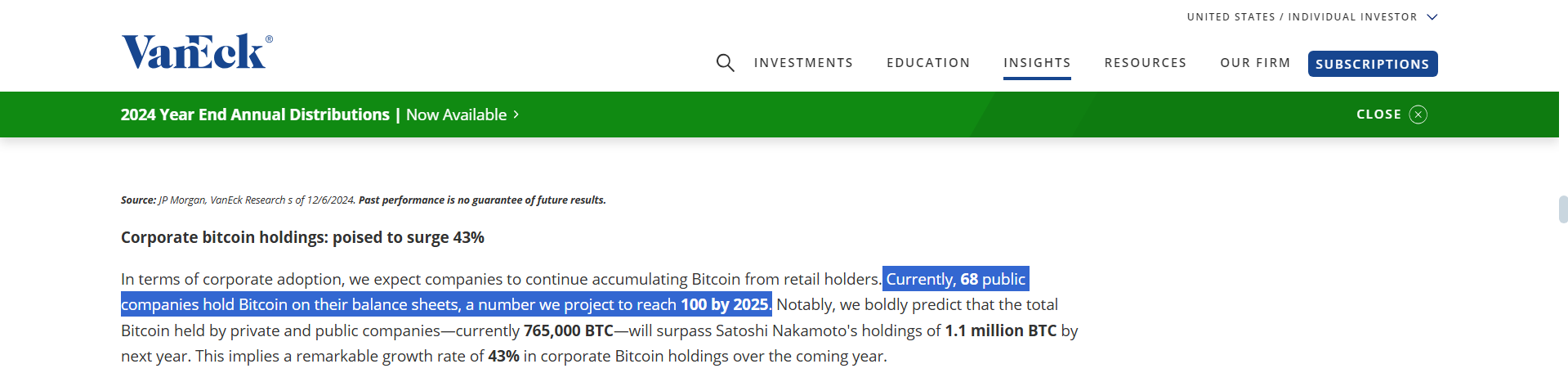
Even Corporate interest in Bitcoin continues to gain momentum. This Bitwise Asset Management’s recently proposed Bitcoin Standard Corporations ETF aligns with VanEck’s prediction report.
This new fund is currently pending SEC approval. It plans to trade on NYSE Arca and complements Bitwise’s existing Bitcoin ETF.
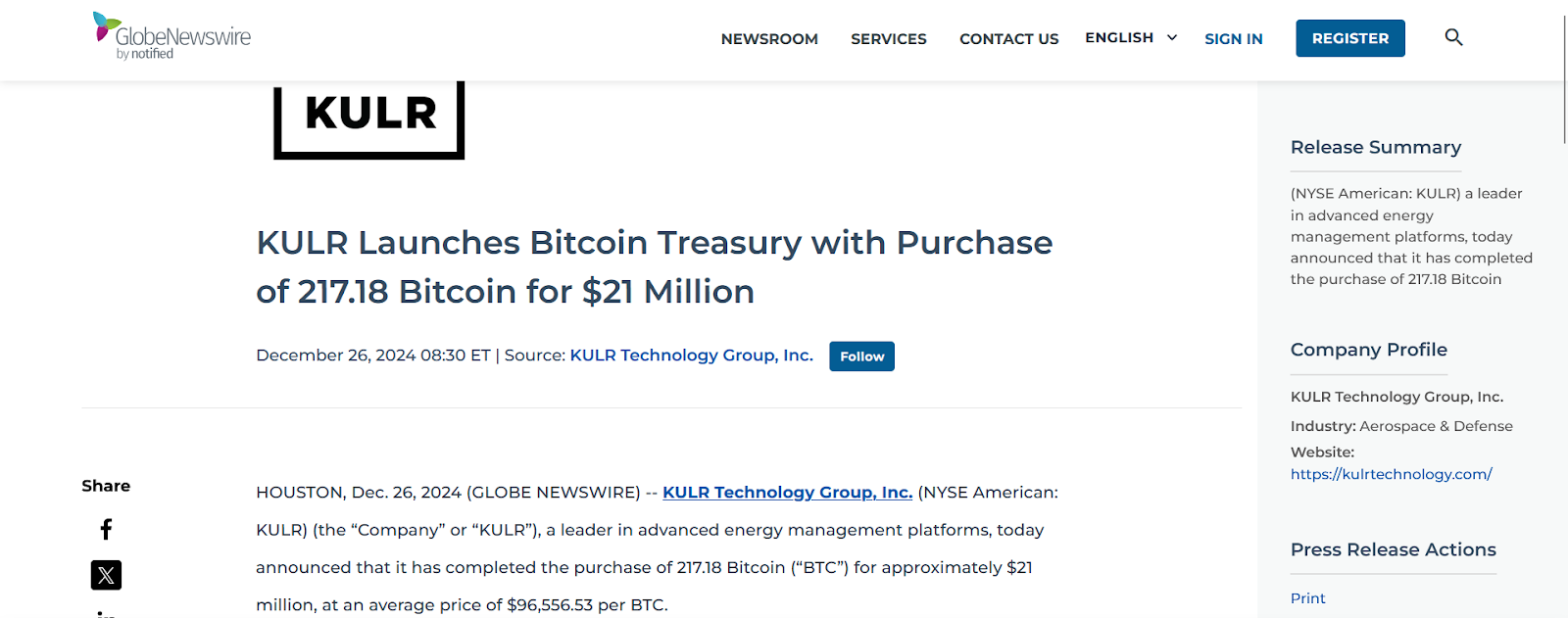
Adding to the growing corporate activity, KULR Technology Group announced a $21 million investment in 217.18 Bitcoin. The move led to a 40% surge in the company’s stock price, reflecting the market’s enthusiasm for Bitcoin adoption.
On the same day, Vivek Ramaswamy’s Strive Asset Management filed for a Bitcoin ETF targeting convertible bonds issued by companies with substantial Bitcoin holdings, such as MicroStrategy.
These developments underline Bitcoin’s expanding influence as Russia’s adoption and corporate investments signal broader trends in global trade and institutional strategies. As nations and companies increasingly integrate Bitcoin into their frameworks, the crypto’s role in shaping economic and financial systems is set to grow significantly.
Bitcoin ETFs Experienced a Robust Rebound This Week, Reversing a Recent Trend of Outflows.
Following the U.S. market closure on December 25 for Christmas, Bitcoin ETFs experienced a significant resurgence on December 26. They recorded inflows totaling $475.15 million. It marked a stark contrast to the preceding four trading days, during which Bitcoin ETFs suffered net outflows amounting to $1.52 billion between December 19 and December 24.
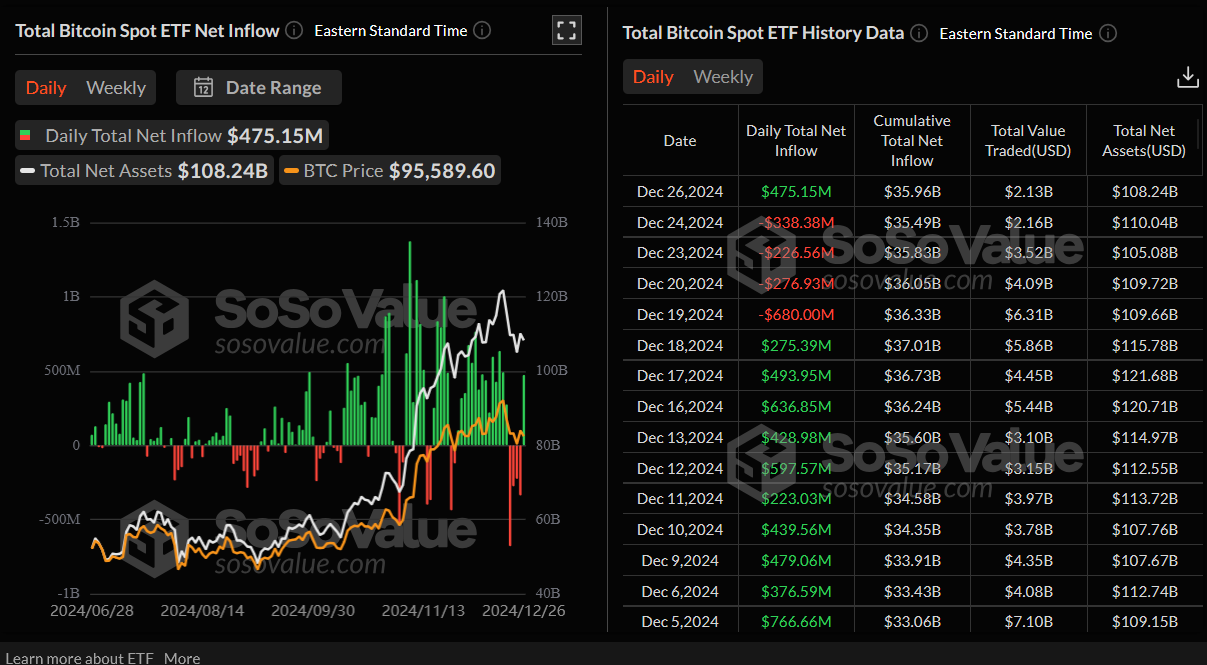
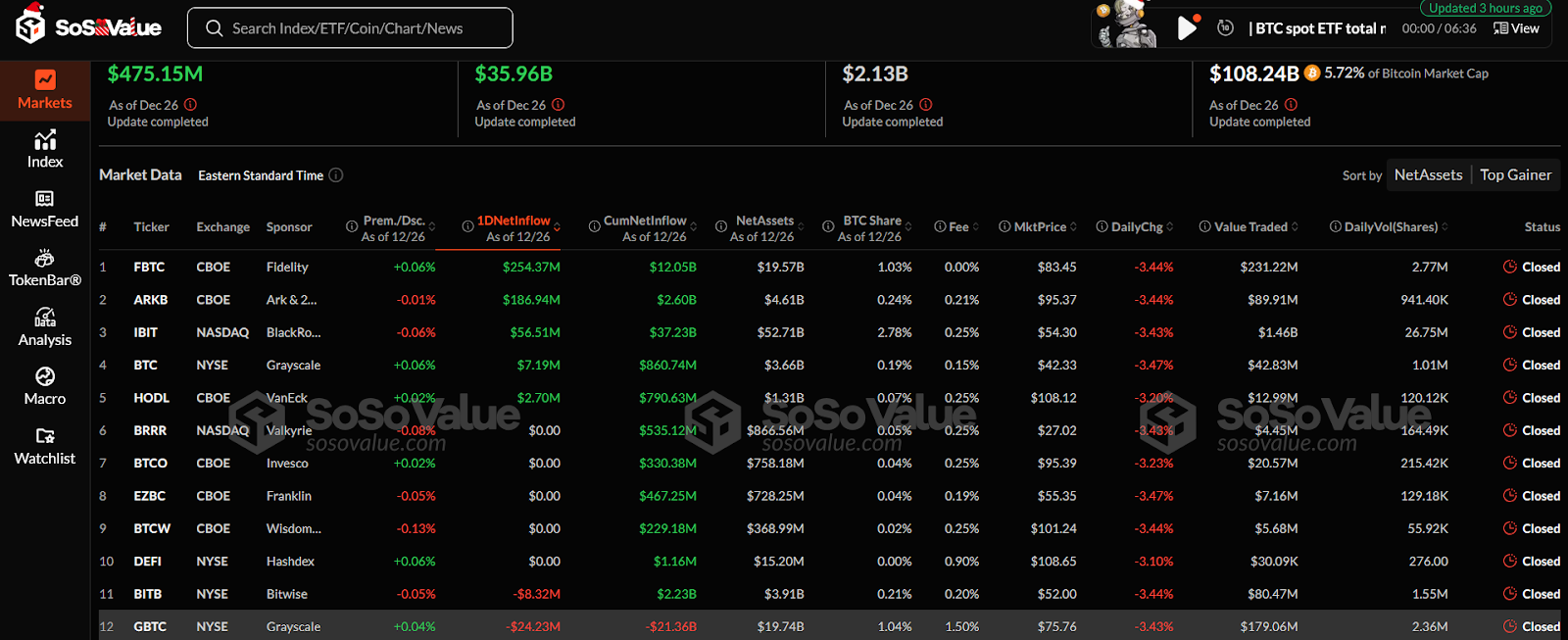
Fidelity’s FBTC spearheaded the recovery, drawing in $254.37 million. ARK 21Shares’ ARKB also saw a strong rebound.
BlackRock’s IBIT contributed $56.51 million, while Grayscale’s Bitcoin Mini Trust and VanEck’s HODL reported smaller inflows of $7.19 million and $2.7 million, respectively.
However, not all funds experienced gains. Grayscale’s GBTC saw significant withdrawals, losing $24.23 million. While Bitwise’s BITB recorded $8.32 million in outflows, driving GBTC’s total historical net outflows to $21.36 billion. Meanwhile, five other Bitcoin ETFs reported no activity, maintaining stable flow levels during the day.
Trading volumes for the Bitcoin ETF remained consistent, with December 26 closing at $2.13 billion, nearly mirroring the previous day’s $2.16 billion. These inflows signal a revival of investor interest in Bitcoin ETF following a period of heightened uncertainty and sustained outflows.
This momentum could pave the way for optimism as the year draws to a close, potentially setting the stage for increased activity in the months ahead. This, in particular with Bitwise’s recent ETF filing, is expected to attract further institutional liquidity.
Additionally, the outflows from Bitcoin ETFs earlier in the month aligned with a notable uptick in exchange reserves, as approximately 33,000 BTC flowed onto exchanges between December 18 and December 25.
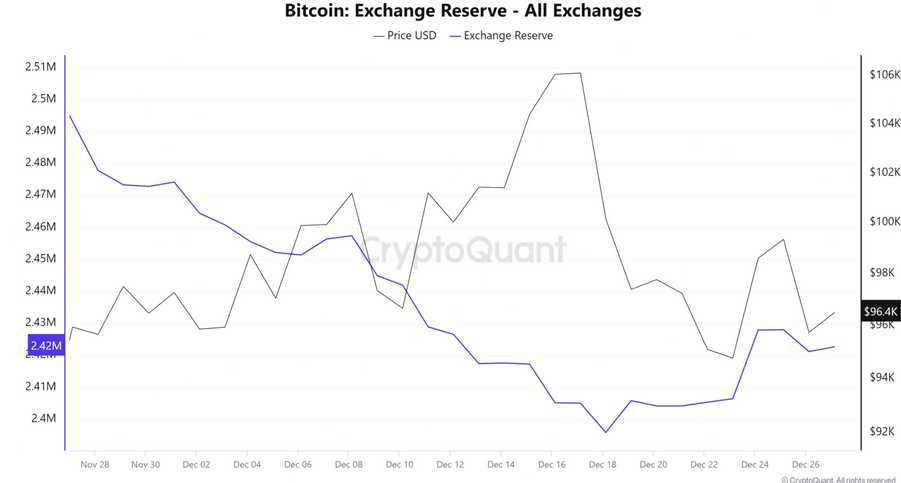
In contrast, roughly 6,000 BTC have since exited exchanges, indicating a possible accumulation phase. Despite this, the Bitcoin price action suggests that the cryptocurrency remains in a short-term support zone, underscoring cautious market sentiment.
Can Bitcoin Shake Off the Selling Pressure?
Bitcoin’s lack of strong demand raises the possibility of a capitulation phase, where prices could drop to the $85,000 range or lower. This outcome might unfold if bullish expectations for 2025 remain unmet, exacerbating downward pressure on the cryptocurrency.
At its current price of $94,412, Bitcoin reflects a 144% increase from its lowest valuation in 2024. Approximately 85% of Bitcoin holders are in profit at this level, indicating widespread gains.
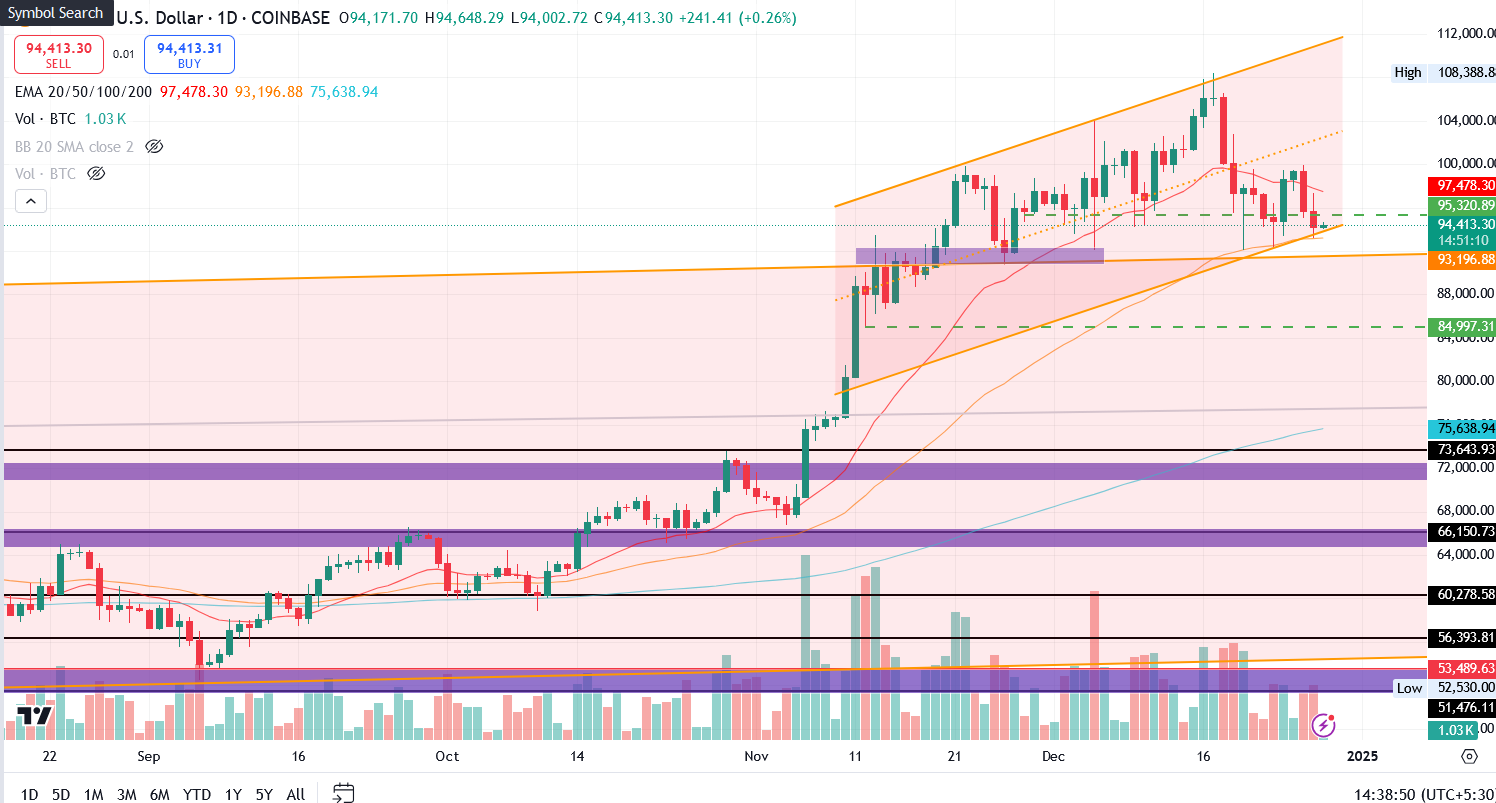
This profitability, coupled with relatively low selling pressure, suggests a sense of optimism among investors for 2025. However, the same conditions also present a risk of a significant selloff if demand falters or if Bitcoin breaches its current support level.
While the potential for a bearish downturn exists, any such decline would likely be temporary due to strong institutional demand. Moreover, the shifting political climate, favorable regulatory progress, and rising interest in Bitcoin ETF’s have played critical roles in sustaining optimism about the future of Bitcoin.
Disclaimer
In this article, the views, and opinions stated by the author, or any people named are for informational purposes only, and they don’t establish the investment, financial, or any other advice. Trading or investing in cryptocurrency assets comes with a risk of financial loss.