
 Bitcoin
 Ondo
Ondo NEAR Protocol
 Walrus
 Pearl
Pearl Pons
Pons Ethereum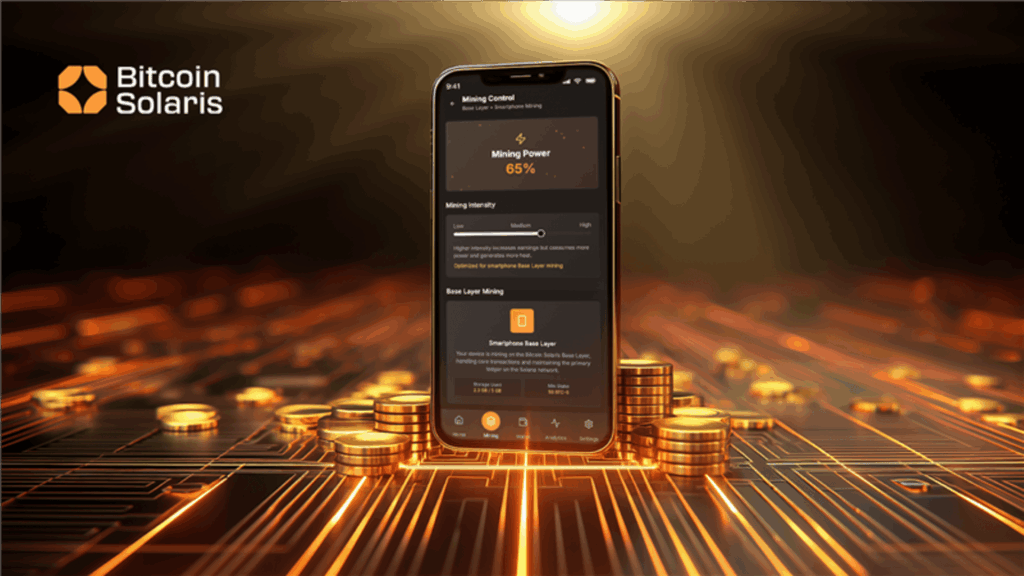
For most people, a smartphone is an expense. It loses value the moment users buy it. Bitcoin Solaris flips that script. The network’s upcoming Nova App will allow users to mine its native token, BTC-S, simply by allocating a few gigabytes of idle storage and minimal CPU power.
It’s a mobile-native mining system that runs silently in the background, even while you sleep. Bitcoin Solaris’s infrastructure is already live and audited, and the Nova App has completed security checks. Over 11,000 users are already in position for rollout. The protocol doesn’t emphasize selling the idea of mining; it aims to make it work at scale.
Built for Passive Rewards, Not Price Hype
Most new crypto projects try to generate attention through promises of short-term price spikes. Bitcoin Solaris focuses instead on system design that creates real participation-based demand. The core of this system is its token distribution and mining logic.

Out of the total 21 million BTC-S token supply:
- 66.66% (14 million tokens) is for long-term mining.
- 20% (4.2 million tokens) was allocated across presale phases.
- 13.34% (2.8 million) supports exchange liquidity and ecosystem expansion.
This distribution locks in future demand. The only way to access the majority of BTC-S is to participate in the network, either as a miner or contributor. And because mining requires users to hold tokens, demand increases as the user base grows. That dynamic can compress the circulating supply over time, especially once the Nova App launches.
Real Tokenomics, Not Circular Economics
Where many projects rely on staking gimmicks or emissions-based inflation to simulate growth, Bitcoin Solaris focused on durability. There is no post-launch minting mechanism. No stealth seed rounds. No private unlock schedules.
The token’s scarcity model is enforced on-chain. BTC-S is capped at 21 million — permanently. That makes Bitcoin Solaris one of the few modern protocols operating with non-inflationary mechanics, verified through a full Freshcoins and Cyberscope audit and reinforced through KYC-verified leadership.
Analysts tracking the presale have already flagged BTC-S as an outlier. Its structure doesn’t rely on speculative listings or trend-chasing — it leans on scarcity, functionality, and proof of contribution.
Helios Architecture: Low-Energy, High-Throughput Mining
Helios made mining on Bitcoin Solaris possible. It is a hybrid blockchain architecture that merges Proof-of-Stake, Proof-of-Capacity, Proof-of-History, and Proof-of-Time.
This multi-layer system enables the network to process over 10,000 transactions per second with under 2 seconds of finality — all while reducing energy demand by over 99.95% compared to Bitcoin mining. The result is a validation model that anyone can participate in using devices they already own.
It also ensures decentralization without sacrificing performance. There’s no reliance on a validator cartel, no expensive hardware gatekeeping, and no geographic concentration of power. Whether through mobile, browser, or desktop interfaces, BTC-S mining will remain globally accessible.
Bitcoin-Backed Integration: What Comes Next
Long-term, Bitcoin Solaris is preparing for a new phase of growth: Bitcoin-backed BTC-S tokens. This planned integration will link each BTC-S token 1:1 with actual Bitcoin reserves, creating intrinsic value without giving up the benefits of speed, energy efficiency, and smart contract functionality.
When implemented, the Bitcoin reserve will be transparently managed, time-locked, and secured through multi-signature protocols. These future upgrades, combined with cross-chain bridges and liquid staking, are already in development, positioning Bitcoin Solaris not just as a new blockchain but as a modern extension of Bitcoin’s original value layer.
Phase 6 is Live, and It’s a Functional Entry Point
Phase 6 of the presale is now live, with BTC-S priced at $6. It isn’t an early bird round or a discount-for-marketing tactic. It’s part of a clear allocation strategy. With central exchange listing targets set at $20, and token demand built directly into the network’s architecture, the current price reflects protocol participation before saturation.
New buyers aren’t purchasing a placeholder token. They’re entering an operational economy where mining mechanics, supply limits, and verified infrastructure all point to long-term value.

Bitcoin Solaris isn’t chasing trends; it’s solving problems, such as unscalable mining, centralized token control, and hype-driven pricing. By making passive income tools available on the devices people already use, it’s offering a simple proposition: turn what you already have into something that works while you sleep.
Website: https://bitcoinsolaris.com/
X: https://x.com/BitcoinSolaris
Telegram: https://t.me/Bitcoinsolaris


