no crying in the casino
 NEAR Protocol
 Starknet
 Pyth Network
 Pearl
Pearl Quantus
 Pudgy Penguins

Key Insights:
- Bitcoin rebounds to $105K after whale-triggered drop to $100,430.
- Traders warn of bull trap unless BTC reclaims $106K resistance.
- Custody concerns and macro risks keep investor sentiment fragile.
Bitcoin (BTC) climbed back toward $105,000 on June 6, just a day after plunging to its lowest level in four weeks. While the rebound brought temporary relief, traders are growing uneasy. Many now warn the recovery could be a trap.
The market’s sharp downturn on June 5—sending BTC as low as $100,430—sparked widespread speculation. Analysts and traders blamed everything from overleveraged positions and macro fears to whispers of re-hypothecation at major custodians.
Now, even with price back near $105,000, key resistance remains in place. And with no clear resolution to the underlying concerns, market sentiment remains fragile.
Liquidations and Leverage Trigger the Fall
Bitcoin’s sharp drop was brutal—and fast. Data from CoinGlass showed heavy futures liquidations in a short window, triggered by a wave of forced selling.
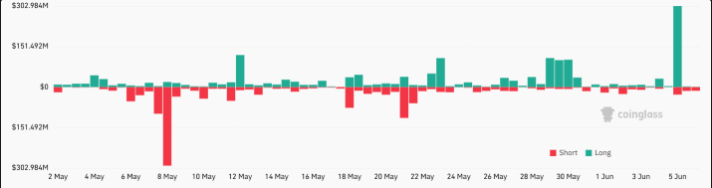
One name stood out: the so-called “Hyperliquid whale.” According to X user SuperBitcoinBro, this trader got liquidated near $104,000 and reportedly lost over $100 million across the week.
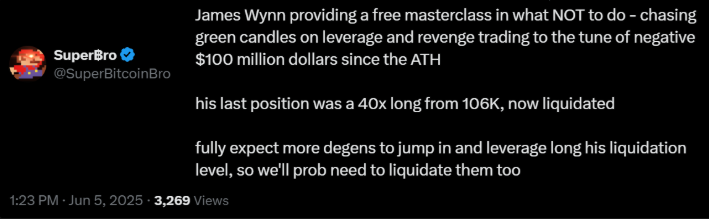
The analyst noted that overconfident bulls flooded the market with leverage after seeing Bitcoin push above $110,000 in recent weeks. “They got trapped,” he wrote. “This was a classic bull trap. Big players let retail overextend, then flipped the script.”
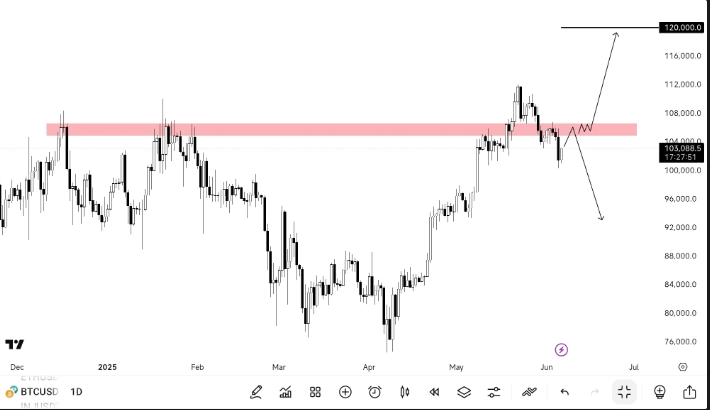
The bounce from $100K to $105K hasn’t changed the narrative for many. “It’s just a retest,” posted Friedrich, who tracks daily chart structure. He added that if BTC can’t reclaim the $105,800–$106,000 zone, it could break lower and bleed toward $87,000.
Trump, Tariffs, and Recession Talk Add to the Mix
Reports surfaced that U.S. President Donald Trump and Chinese President Xi Jinping had resumed talks on trade tariffs. That alone raised eyebrows. Tariff tension often spills over into global markets—and crypto tends to respond with volatility.
Then came the jobs data. U.S. unemployment claims reached their highest level in eight months, according to the Department of Labor. Fed Governor Adriana Kugler warned that rising tariffs could hurt both jobs and economic growth.
Bitcoin Custody Faces New Scrutiny
Investors were rattled after Michael Saylor’s firm, Strategy, refused to share its on-chain BTC addresses. That silence led some to speculate about possible re-hypothecation—where the same Bitcoin gets pledged multiple times for different obligations.
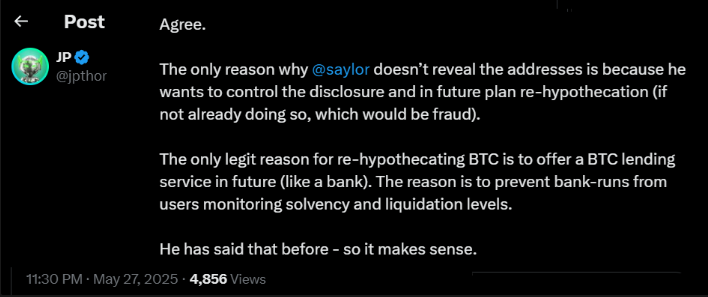
While there’s no direct evidence against major custodians like Coinbase Custody or Fidelity Digital Assets, the timing has investors on edge. Many are still waiting on clear updates regarding the U.S. Strategic Bitcoin Reserves program, which was announced months ago and has seen no visible follow-up.
“There’s just a lot of missing pieces,” one X user posted. “No one’s accusing anyone. But we want transparency.”
BlackRock Buys ETH—Is Bitcoin Being Left Behind?
James Wynn claimed the asset manager had bought Ethereum for nine consecutive days. “Is this a psyop to keep people from buying BTC?” he asked.
While speculative, the post reflected broader sentiment. Ethereum-based ETF products have gained momentum, while BTC ETFs still lack essential features like staking and in-kind redemptions.
It’s unclear whether BlackRock’s activity signals a true rotation or simply diversification. But the effect is the same—investors are asking whether Bitcoin is losing favor.
Support Holds, But for How Long?
Technically, BTC is still holding the lower support of its rising wedge pattern. The structure began forming in April, with the latest dip testing its lower boundary near $100,000.
A clean move above $106,000 could flip momentum. But so far, volume remains weak, and buyers seem cautious. If BTC loses this channel, a drop toward $87,000 becomes a realistic scenario.
As one trader put it on X: “This isn’t a recovery—it’s a pause.”
Disclaimer
In this article, the views and opinions stated by the author or any people named are for informational purposes only. And they don’t establish the investment, financial, or any other advice. Trading or investing in cryptocurrency assets comes with a risk of financial loss.