
 Bitcoin
 Solana
 Pearl
Pearl Zerebro
 Aerodrome Finance
 LayerZero
 NEAR Protocol

Key Insights:
- Polygon price has plunged to a crucial support level this week.
- It has formed the highly bullish double-bottom pattern.
- Ecosystem data like transaction volume and active addresses are encouraging.
Polygon price crashed to a critical support level and formed a double-bottom pattern, pointing to a rebound. Encouraging ecosystem metrics, like the growing stablecoin supply and decentralized exchange volume, may fuel this recovery.
Polygon Price Has Crashed to a Key Support Level
The daily timeframe shows that the POL price has been in a free fall this year. It formed a series of lower lows and lower highs. This plunge began in December last year, peaking at $0.7663. Also, it has mirrored the performance of other altcoins.
Polygon price has plunged below all moving averages, signaling that bears are in control. On the positive side, it fell to a low of $0.1647 in April this year. Then, as many altcoins did, it bounced back to the key resistance point at $0.2763 in Mid.
Most recently, the token plunged and retested to the lowest level in April, forming a double-bottom pattern. This pattern comprises two distinct low levels and a neckline, which, in this case, is at $0.2763.
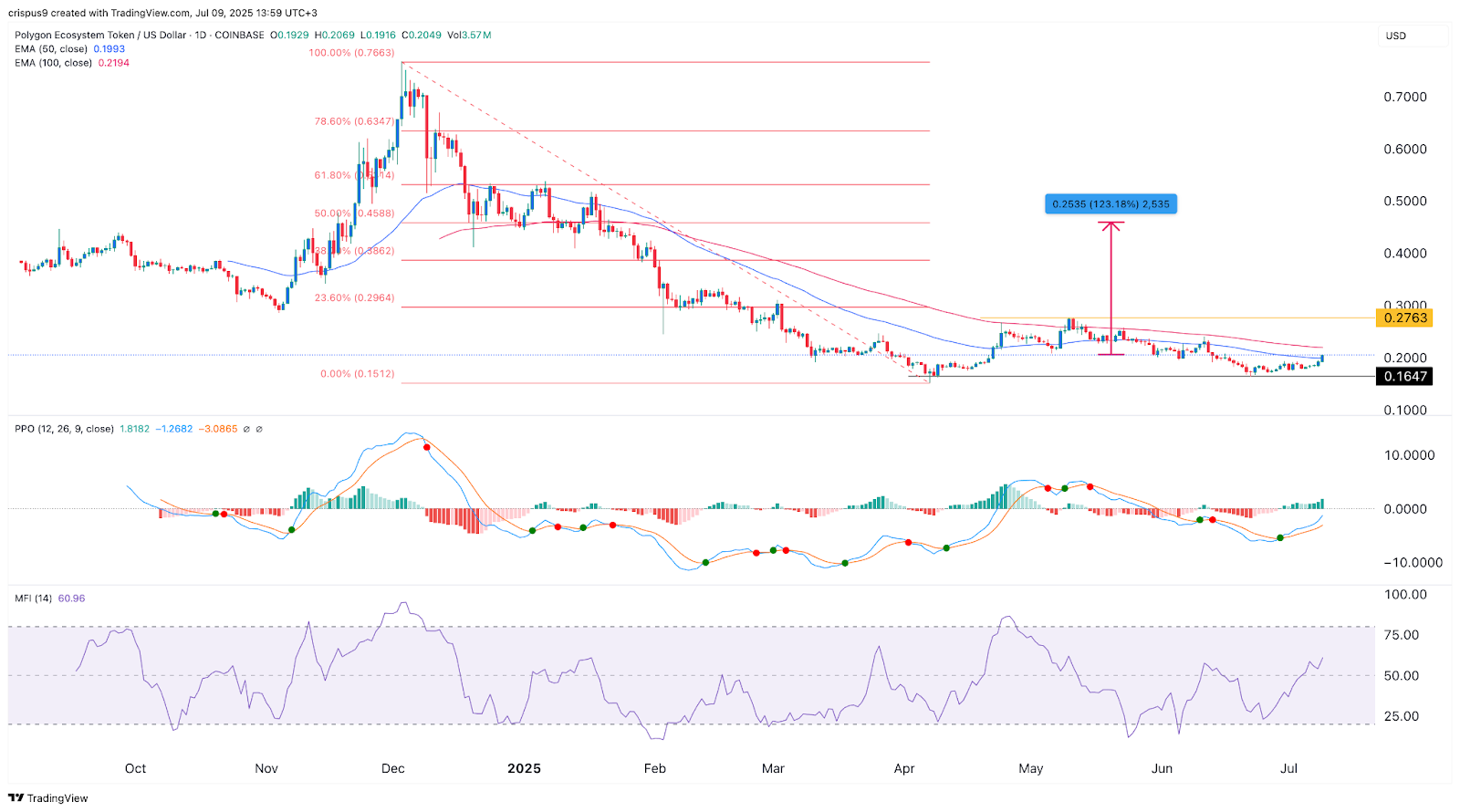
A double-bottom means that short-sellers are afraid of placing bearish trades below that level. This explains why an asset often bounces back after hitting bottom.
The Percentage Price Oscillator (PPO) lines have made a bullish crossover pattern and pointed upwards. The Money Flow Index (MFI) has also increased above the neutral point of 50.
Therefore, the POL price will return if the double bottom works well. The initial target for this trade will be at $0.2763, the neckline of the double-bottom and the 23.6% Fibonacci Retracement.
A break above the neckline suggests more price gains ahead. The target could be the 50% retracement level at $0.4600. That’s around 123% above the current price.
But if the Polygon price drops below $0.1647, the bullish outlook is invalidated. This signals strong selling pressure. Such a move will likely indicate further downside, potentially reaching the psychological level at $0.1.
Polygon Ecosystem is Making Progress
Several third-party data sources show that the Polygon network has started to do well. This may support its recovery. First, active addresses and transactions have jumped sharply in the last 30 days.
Polygon handled over 95 million transactions in this period, a 51% surge. Its transaction count was much higher than popular blockchains like Arbitrum, Ethereum, Optimism, and Avalanche.
Additionally, the number of active addresses soared by more than 25% to over 7.69 million. Again, this was a higher number than most blockchain networks, including Ethereum and Arbitrum.
The combination of rising active addresses and transactions is positive because it signals that more users are interacting with it. POL price is regaining momentum in the market. It had previously lost ground to layer-2 rivals like Base, Unichain, and Arbitrum.
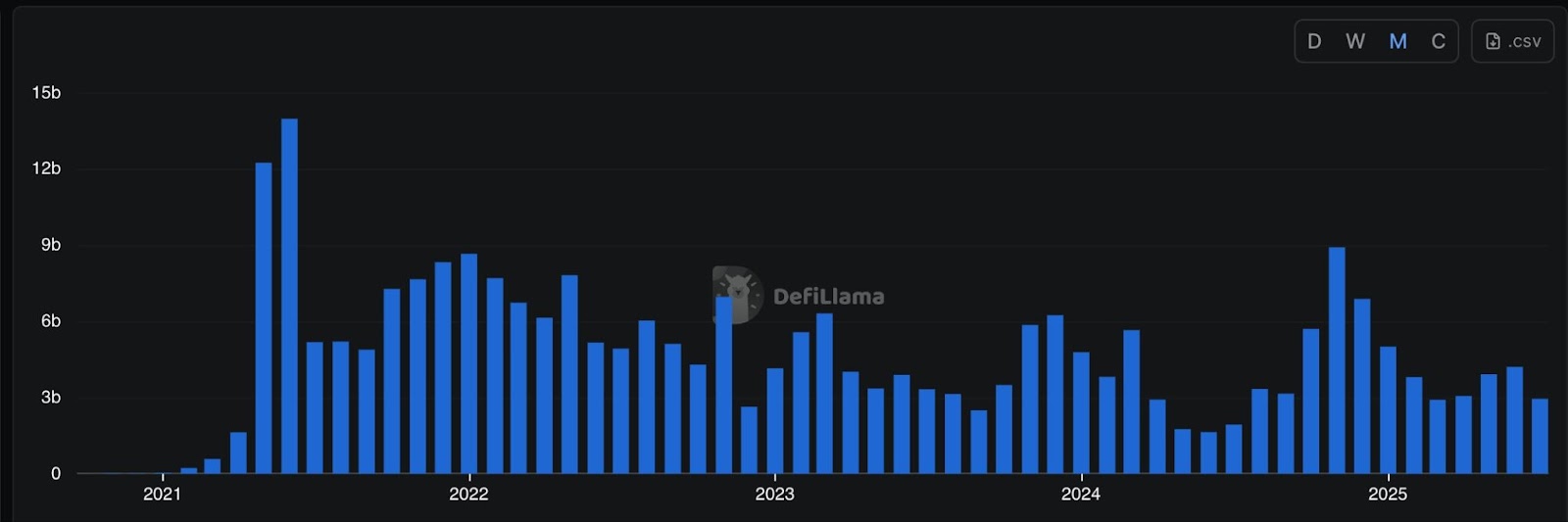
Another notable metric that may stimulate the Polygon price is the volume in its decentralized exchange protocols. Polygon’s DEX volume surged to $5.6 Billion in the past 30 days, according to DeFiLlama.
Platforms like Quickswap, Polymarket, and Uniswap mainly drove this growth. The chart below shows that the monthly volume has risen over the past four months.
Polygon has other bright spots that may trigger a rebound of its token. It has become a major player in the stablecoin market with over $2.5 Billion in supply. Its monthly stablecoin transactions jumped to over $4o billion.
Further, thanks to Polymarket, which uses Polygon’s blockchain, it has become the biggest chain for the booming prediction market.
Polygon price has dropped sharply this year. It’s been losing market share to layer-2 competitors such as Base, Arbitrum, and Optimism.
However, data shows that its network is recovering, which may boost its price. On top of this, it has formed a double-bottom and a bullish divergence pattern.
Disclaimer
This article is for informational purposes only and provides no financial, investment, or other advice. The author or any people mentioned in this article are not responsible for any financial loss that may occur from investing in or trading. Please do your research before making any financial decisions.



