
 NEAR Protocol
 Pearl
Pearl Bitcoin
 Puffer
 ZKsync
 Pudgy Penguins
 Hyperliquid
Key Insights:
- The US has officially recognized Bitcoin as a treasury reserve asset.
- Corporate Bitcoin holders and the spot ETFs show confidence in the leading coin.
- BTC is set for new highs as rising adoption and recognition as a legitimate asset in the U.S.
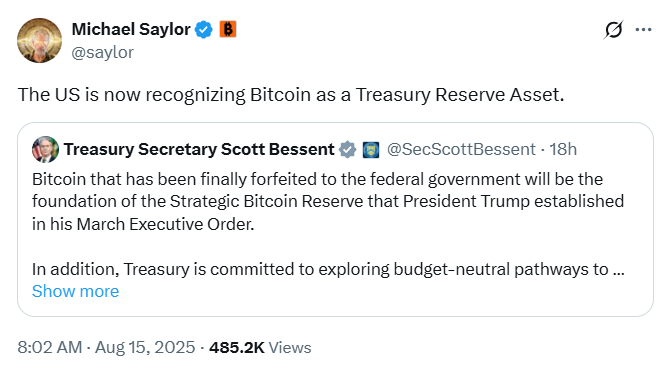
Strategy Chairman Michael Saylor announced earlier today that the U.S. has officially recognized Bitcoin (BTC) as a treasury reserve asset.
The US recognition marks a major shift in global finance and a massive step toward the adoption and legitimacy of the coin.
More Details of the US Bitcoin Reserve
Taking to the X platform, US Treasury Secretary Scott Bessent shared key details about the strategic Bitcoin reserve.
He noted that taxpayers are not required to fund the initiative. Rather, Bitcoin previously forfeited to the federal government will be the foundation of the Strategic Bitcoin Reserve.
Notably, the U.S. government currently holds about 200,000 BTC, confiscated through criminal and civil proceedings.
Scott added that the Treasury is committed to exploring budget-neutral pathways to acquire more Bitcoin to expand the reserve.
Notably, the Federal government has disclosed no intention to sell its Bitcoin. This strategy may help create market stability and eliminate the risk of a large-scale BTC dump, boosting investors’ confidence.
Scott emphasized that the Treasury aims to execute on the promise of President Donald Trump to make the U.S. the “Bitcoin superpower of the world.”
Discussions about the US Bitcoin strategic reserve have intensified since President Trump signed an executive order in March.
Many analysts and economists believe a Bitcoin reserve could help the US mitigate its financial struggles.
They claim the reserve could generate trillions in new demand for the US dollar, potentially reducing long-term interest rates.
The announcement from Saylor comes shortly after the White House released a digital asset report on July 30.
The White House called for scrapping the capital gains tax for small transactions involving Bitcoin payments.
Strong Institutional BTC Accumulation
Meanwhile, Bitcoin has continued to see strong accumulation from institutional investors in recent times.
For instance, Michael Saylor’s Strategy has continued to accumulate Bitcoin, recently acquiring 155 BTC for approximately $18.0 million.
The firm currently holds 628,946 BTC, acquired for approximately $46.09 billion, bought at about $73,288 per coin.
In Q2, Strategy reported earnings of $14 billion. The firm’s unrealized Bitcoin gains in Q2 placed it at the top of the corporate BTC treasury rankings.
Japan’s Metaplanet has also followed in the footsteps of Strategy in purchasing Bitcoin. Metaplanet recently announced buying 780 BTC at an average price of $118,622 per BTC.
This purchase pushed its total holdings to 17,132 BTC, worth approximately $1.73 billion, with a YTD BTC yield of 449.7%.
Besides the increasing accumulation by corporate holders, the spot BTC exchange-traded funds (ETFs) have also recorded rising inflows.
On August 14, the spot BTC ETFs saw inflows reaching $230 million. This marks the 6th consecutive day of funds flowing into the market, per data from Farside Investors.
Implication for Bitcoin Price
Despite the initial controversy trailing Bessent’s remarks, the US officially recognizing Bitcoin as a treasury reserve asset is a massive step for adoption and legitimacy.
Retail and institutional investors are likely to find BTC more appealing as it gains recognition in the White House.
This entry of new buyers would further increase demand. Once adoption increases, the price is expected to rally to new highs, especially considering rising volumes.
Additionally, the U.S. could treat BTC as a reserve asset similar to gold. This could reinforce Bitcoin’s narrative as a hedge against inflation.
At the moment, BTC is valued at $117,839, down 0.6% over the past 24 hours. BTC daily trading volume has also plummeted by 26.9%, suggesting reduced interest among traders.
Still, community sentiments remain bullish as institutional buying and ETF inflows are cushioning deeper declines.
Disclaimer
This article is for informational purposes only and provides no financial, investment, or other advice. The author or any people mentioned in this article are not responsible for any financial loss that may occur from investing in or trading. Please do your research before making any financial decisions



