
 Bitcoin
 Starknet
 Pearl
Pearl ZKsync
 NEAR Protocol
 Quantus
 Zerebro

Dogecoin crypto hashrate has printed a new all-time high (ATH). After recording a price rally of 1.06% on the daily charts, Dogecoin hashrate reached well over 2.5PH/s (petahashes per second).
This is the highest level observed in the history of Dogecoin. The new ATH also strengthens Dogecoin’s defense against a Monero-like takeover.
Dogecoin Crypto Hashrate Boom
On August 27, 2025, the Dogecoin hashrate hit an ATH of over 2.5 PH/s. The spike in hashrate implies more miners are securing the network than ever.
It also shows a major sign of strength, adoption, and growing interest in the Dogecoin crypto.
High hashrate often precedes price rallies, as seen in past cycles. Miners are most likely to add new hardware to the network when looking for gains, which is reflected in increased hashrate.
Hashrate measures the total computational power of miners on a network. This metric means that the miners are putting in work to secure the network from external attacks and defaults.
CoinWarz data showed Dogecoin hashrate has continued on an upward trajectory since 2014.
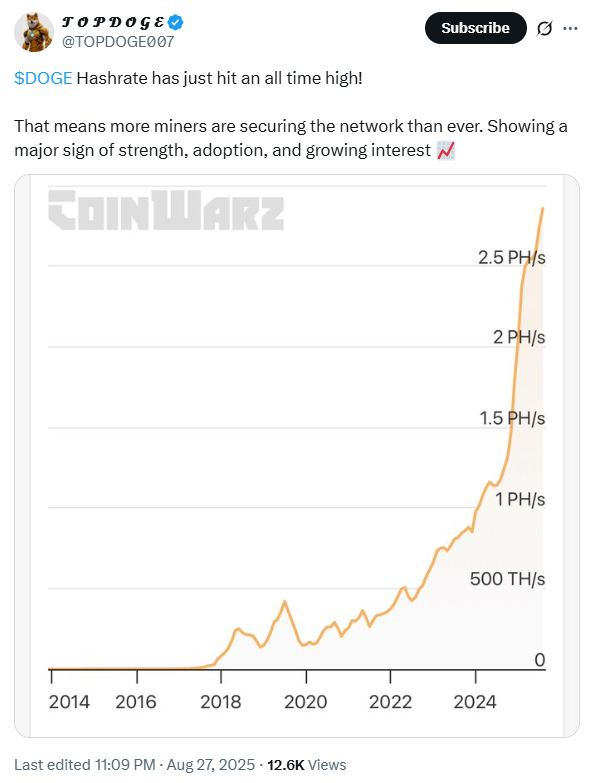
At 2.5 PH/s, the DOGE network is exponentially harder to attack. It strengthens its defenses against a Monero-like takeover, where a single entity gains enough mining power to manipulate the network.
Monero (XMR), a CPU-mined coin, recently faced a takeover scare involving Qubic, a compute-sharing platform. Qubic redirected massive CPU power to mine XMR, briefly controlling over 51% of Monero’s hashrate.
A 51% attack is when a single entity controls over half of a blockchain’s mining power or stake. As such, the entity can rewrite transactions or block them entirely.
This exposed Monero’s vulnerability, where CPU mining allows sudden surges from non-dedicated hardware, unlike ASIC-dominated chains like Dogecoin.
It also highlights that a single entity could repurpose CPUs to dominate, risking chain reorganization.
Is Dogecoin Crypto Memecoin Moving to a Proof-of-Stake Chain?
Meanwhile, a recent debate about the network switching from Proof-of-Work (PoW) to Proof-of-Stake (PoS) has sparked heated discussions within the community.
PoS advocates claim the transition could enable faster transactions and lower fees for Dogecoin. Others suggest PoS could attract institutional investors or align Dogecoin with other innovative blockchains.
Commenting on the discourse, Dogecoin founder Billy Markus said the debate in itself is “annoying.”
He explained that a transition towards PoS consensus would fracture the community and cause a fork, resulting in multiple dogecoins.
Responding to Billy’s post, Dogecoin Foundation Director Timothy Stebbing highlighted efforts to push for technical progress. Timothy emphasized that he had always pushed for evaluating ideas based on their technical quality to help improve the Dogecoin crypto chain.
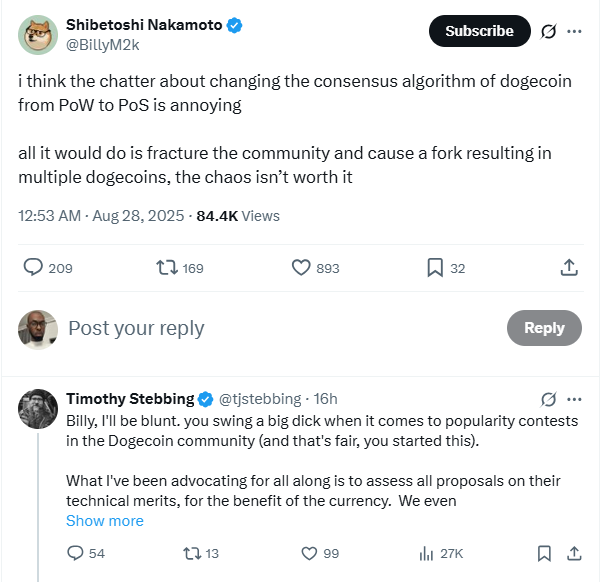
He even highlighted the launch of Dogebox, which allows the community to compare consensus mechanisms between PoW and PoS.
Timothy concludes there is no point wasting engineering effort on major upgrades to speed things up.
“The Dogecoin community seems happy with 40 transactions a second and imagining that will move the needle as a global currency,” Timothy wrote.
Dogecoin as an ETF Asset
Besides the PoS transition discussions, other developments, such as the approval of the DOGE ETF, are spreading within the community.
Although not yet approved, the number of firms filing to list and trade DOGE exchange-traded funds (ETFs) is growing.
Firms that have applied to list a DOGE ETF include Bitwise, Canary Capital, and Grayscale Investments.
It will become one of the top altcoin ETF products available to U.S. institutional investors if approved.
The instrument may also drive a price rally for the Dogecoin crypto in the long term. Analysts have predicted that ETF could push the DOGE price to a target of around $0.43.
Currently, DOGE is valued at $0.2232, up 1.06% over the past 24 hours, with a market cap of $33.5 billion.




