
 Pearl
Pearl Bitway
 Pudgy Penguins
 Quantus
 Walrus
 Quant
Quant Artificial Superintelligence Alliance

Ethereum price has crashed this week, coinciding with the ongoing crypto market crash that accelerated after the Federal Reserve slashed interest rates last week. This crash could be a shakeout ahead of the upcoming rebound, potentially to $5,000 and beyond.
Ethereum Price Technical Analysis: Break and Retest Forms
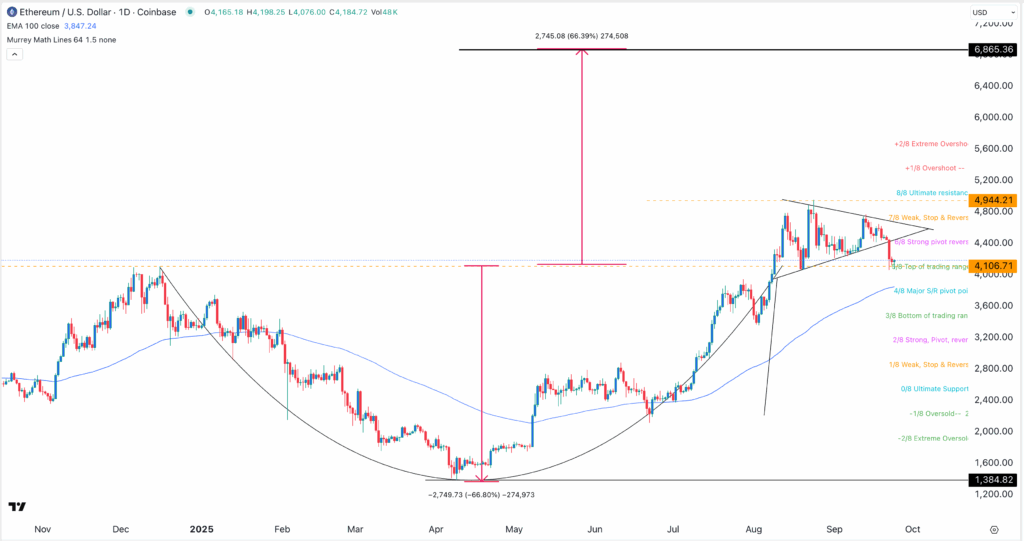
The chart below shows that the Ethereum price has crashed after hitting its all-time high of $4,945 in August.
The crash accelerated this week as exchanges liquidated leveraged trades worth over $490 million on Monday.
Liquidations happen when crypto exchanges close loss-making leveraged trades to preserve their collateral, which is commonly known as a margin.
This Ethereum price crash could be a shakeout, which is a situation where an asset experiences a sharp decline that forces weaker investors out as they panic sell. In most cases, this pattern often leads to a strong bullish breakout as experts buy the dip.
A shakeout usually happens when an asset forms a highly bullish chart pattern. In this case, it happened after Ethereum price formed a bullish pennant pattern, which is made up of a vertical line resembling a flagpole and a symmetrical triangle.
The crash is also significant because it has settled at the important support at $4,106, which was the highest level in December last year and the upper side of the cup-and-handle pattern whose depth is about 65%. Measuring the same distance from the cup’s upper side gives it a target of $6,865.
ETH Price Boosted by Institutional Demand
One of the most important catalysts for the bullish Ethereum price prediction is that the coin is seeing strong institutional demand in terms of exchange-traded funds (ETF) and ETH treasuries.
While Ethereum ETFs had a slow start, they have gained momentum since April. Data compiled by SoSoValue shows that all spot Ethereum ETFs have had inflows in the last six consecutive months, bringing the total inflows since their approval to $13.7 billion.
All these ETFs now hold about $27 billion worth of assets, representing about 5.45% of Ethereum’s market capitalization. It is widely believed that institutions hold most of the assets in Ethereum ETFs.
At the same time, more companies are setting up Ethereum treasuries as they seek to copy Michael Saylor’s strategy with Bitcoin. Data shows that companies now hold over 3.6 million ETH coins.
BitMine Immersion, which is associated with Tom Lee, holds over 7.155 million coins worth over $7.6 billion. SharpLink Gaming now holds tokens worth $3.35 billion. The Ether Machine, Coinbase, and BitDigital are other companies with these holdings.
These companies believe that holding Ethereum is better than Bitcoin because of its staking potential. Ethereum has a staking APY of almost 3%, meaning that BitMine makes about $210 million annually.
Ethereum is a Market Leader in Key Areas
The other reason why retail and institutions are buying Ethereum is that it has a substantial market share in the most important industries in the crypto industry.
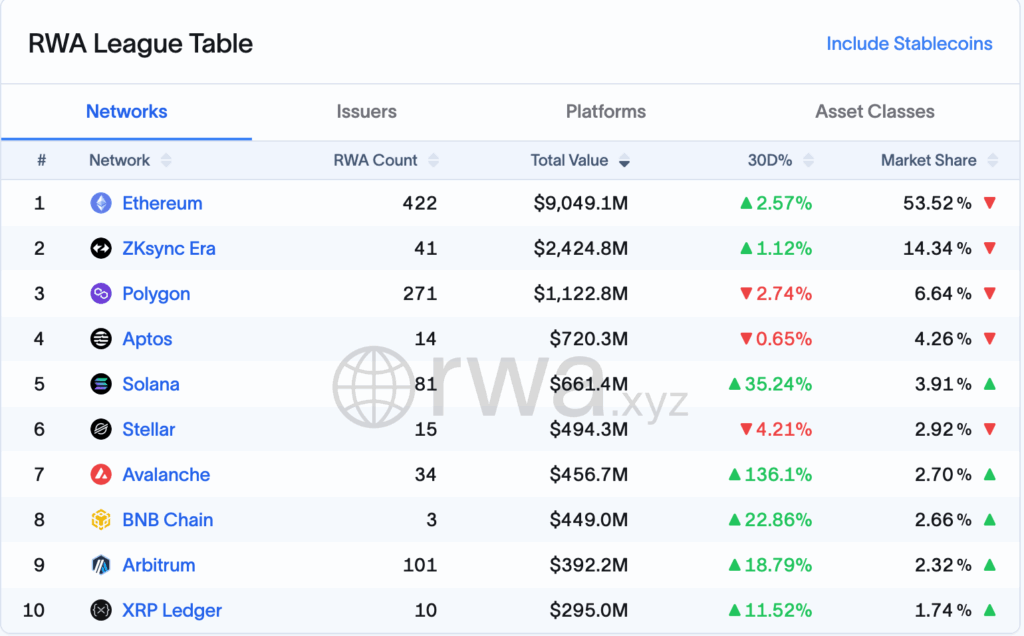
For example, Ethereum has 422 projects in the real-world asset (RWA) tokenization and over $9 billion in assets. This growth makes it much higher than the other networks like ZkSync, Polygon, and Aptos.
Ethereum also leads in the decentralized finance industry, where its total value locked (TVL) stands at $195 billion and the bridged TVL moved to $490 billion. The biggest players in the network are Lido, Aave, and EigenLayer, which dominate their respective industries.
Ethereum’s stablecoin supply continues growing, with the total supply hitting $161 billion, up from below $150 billion when the month started. Growing stablecoin market share is important after Donald Trump signed the GENIUS Bill.
Therefore, ETH price will likely rebound because of the break-and-retest pattern on the daily chart, growing demand among institutions, and the substantial market share in key industries like DeFi, stablecoins, and gaming.



