
 Wisp
Wisp Doge Pepe
 Zylo Ecosystem
 Crawlerpad
 Pearl
Pearl Starknet
 NEAR Protocol

Key Insights:
- Hunter Horsley has linked the stablecoins’ rise to the impact e-commerce had on retail.
- Analysts are discussing the stablecoin’ role as collateral in global finance.
- Tether and OpenAI both seek $500 billion valuations, sparking grounds for comparisons.
Stablecoins may change the banking industry in the same way e-commerce changed retail, says Bitwise CEO Hunter Horsley.
His remark comes as stablecoins grow in use and value, while investors debate their role as collateral and compare the valuations of Tether and OpenAI.
Hunter Horsley Says Stablecoins Could Reshape Banks
Bitwise CEO Hunter Horsley has said that stablecoins are going to do to banks what e-commerce did to retail.
His short remark has drawn attention because it links the rise of digital currencies to one of the largest changes in modern business.
E-commerce changed how people shopped, and it caused major problems for traditional retail chains.
In his latest post on X, Horsley suggests that stablecoins could have a similar effect on banks.

If stablecoins become more widely used, they might reduce the role of traditional financial institutions in payments, lending, and transfers.
Stablecoins have grown quickly in recent years. Their combined market value is now around $275.77 billion.
They are used for trading, sending money across borders, and storing value with less volatility compared to other cryptocurrencies.
Supporters say stablecoins can make payments faster and cheaper than bank transfers.
They also argue that stablecoins are open to anyone with internet access, which could widen financial inclusion.
Critics note that regulation is still uncertain, and risks remain if issuers do not keep enough reserves.
Some new companies are also testing stablecoin-backed services. For example, Beeline Holdings, launched in June 2025, uses a model of fractional property ownership backed by stablecoins.
It offers cash without creating debt, which could change how people access money tied to real estate. Such ideas show how stablecoins might expand beyond payments.
Stablecoins and the Role of Collateral
Some investors believe stablecoins will not only be used for payments but also as collateral in global finance.
DCinvestor, a well-known commentator, argues that the United States may push stablecoins as part of a new settlement system.
He suggests this could also support demand for U.S. treasuries if the assets are linked.
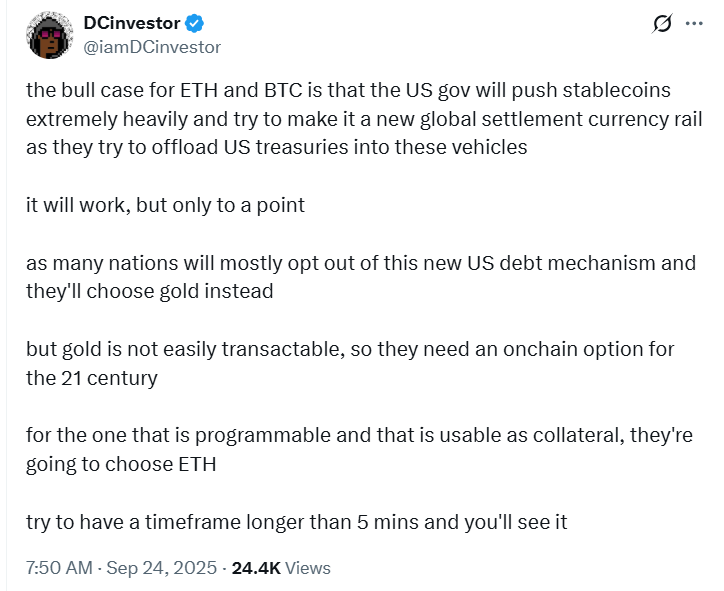
Not all countries would follow such a plan. Many may prefer to keep gold as a reserve asset rather than adopt a digital system tied to the dollar.
Gold, however, is hard to use in daily trade. To solve this problem, some may look for a digital alternative.
Ethereum is one option because it is programmable and can be used as collateral in decentralized systems.
If more nations adopt blockchain-based assets, stablecoins, and Ethereum, they could play a role in international finance that was once limited to banks and governments.
This discussion shows how stablecoins could move far beyond their current role.
What started as a tool for traders may become part of larger debates about the future of reserves and collateral.
Tether and OpenAI at $500 Billion Valuations
It is important to add that the rise of stablecoins is also tied to the debate about company valuations.
Commentator John Wang pointed out that both Tether and OpenAI are seeking valuations of $500 billion. However, he noted the sharp differences between the two firms.
He spotlighted the stablecoin firm as one with just about 50 employees. It also reports very high profit margins because its business is built on reserve management and simple operations.
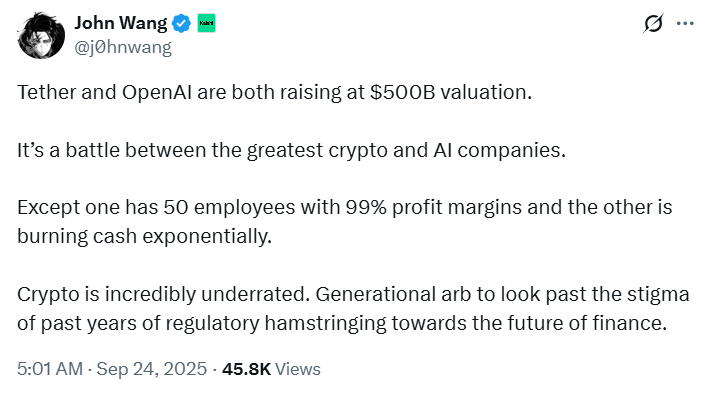
OpenAI is growing fast but is spending heavily and reports high costs. This contrast has led some to argue that crypto firms may be undervalued when compared to large technology companies.
Tether shows strong earnings with few expenses, while OpenAI invests in research and expansion that may take years to pay off.
The comparison also highlights two different paths for growth.
Stablecoin firms rely on lean operations and global demand for liquidity, while artificial intelligence firms rely on constant funding and long-term bets.
How investors value these approaches may shape both industries in the years ahead.





