
 Zylo Ecosystem
 Pearl
Pearl Walrus
 Derive
 Quantus
 Aerodrome Finance
 Sui
Sui

VanEck filed with the U.S. SEC for a Lido Staked Ethereum ETF, aiming to bring institutional exposure to stETH within a regulated structure. The move marked a major step in merging Ethereum’s liquid staking with traditional financial products.
VanEck Files for Lido Staked Ethereum ETF
Asset manager VanEck filed an S-1 registration statement with the U.S. Securities and Exchange Commission (SEC) for the VanEck Lido Staked Ethereum ETF, according to filings and statements from the company and Lido Finance.
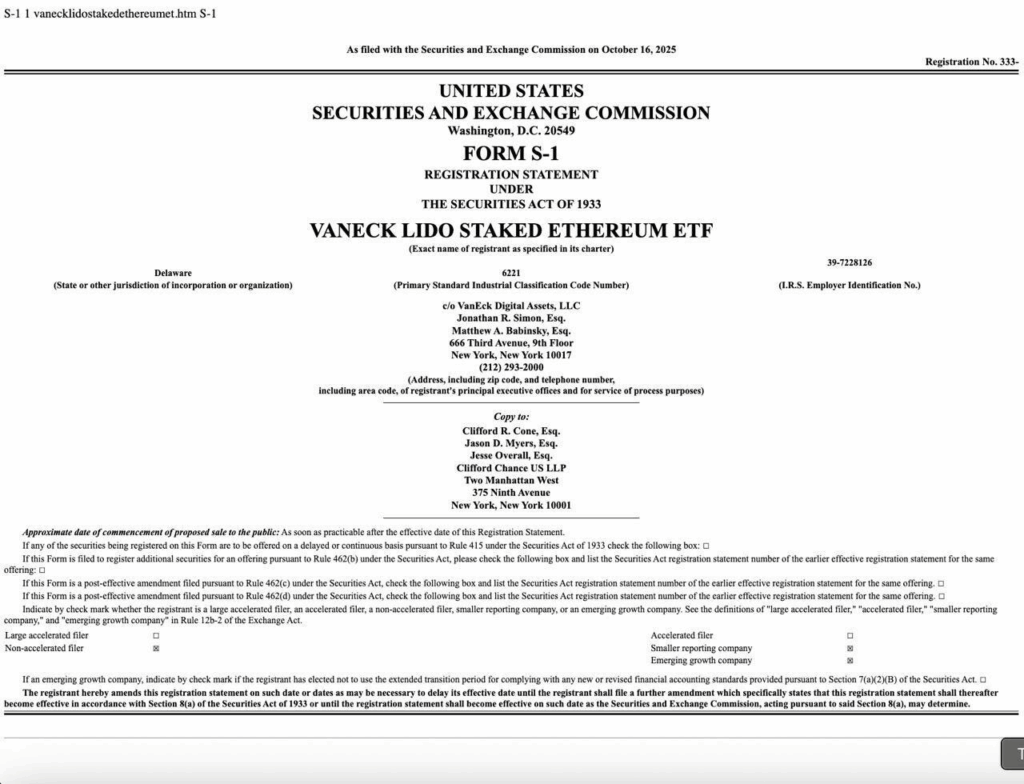
The proposed exchange-traded fund (ETF) aims to give investors regulated exposure to Ethereum (ETH) staked through the Lido protocol, represented by the derivative token stETH. If approved, it would mark the first U.S. ETF referencing Lido Staked Ethereum, deepening the integration between decentralized finance and traditional markets.
A Step Toward Institutional Staking Exposure
The filing described the ETF as a fund designed to mirror Ethereum’s staking economics while maintaining daily liquidity and transparent on-chain backing. This would allow institutions to gain exposure to ETH staking without managing validator infrastructure or dealing with withdrawal delays.
VanEck’s proposal follows the SEC’s recent guidance clarifying that liquid staking tokens, such as stETH, do not constitute securities if issued and redeemed under administrative and ministerial parameters. This clarification opened a pathway for regulated financial products referencing liquid staking assets.
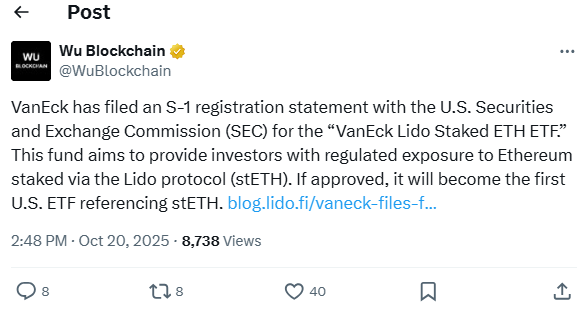
According to Wu Blockchain, the ETF would “provide investors with regulated exposure to Ethereum staked via the Lido protocol.” The proposal underscores growing recognition of liquid staking’s role in Ethereum’s ecosystem.
Lido: A Milestone for Ethereum’s Institutional Evolution
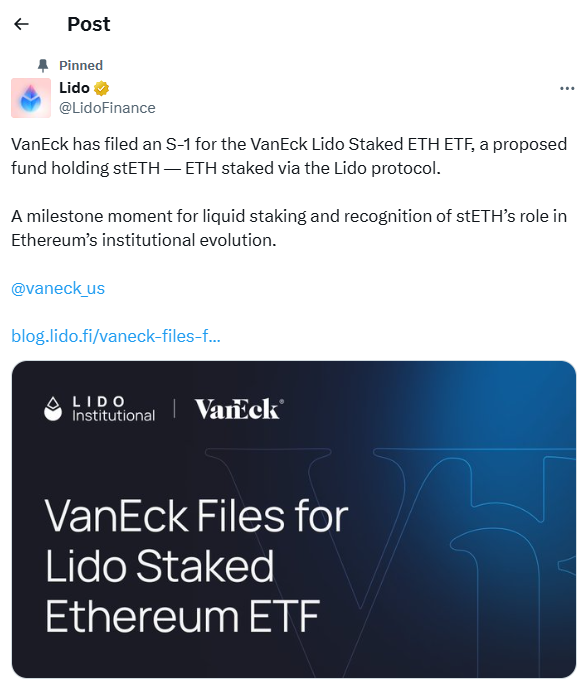
In a post on X, Lido Finance called the filing a “milestone moment for liquid staking and recognition of stETH’s role in Ethereum’s institutional evolution.”
He added that Lido had been active in policy discussions through groups such as the Crypto Council for Innovation (CCI) and the Blockchain Association to promote transparency and compliance in staking practices.
Lido’s Head of Institutional Relations, Kean Gilbert, noted that stETH had shown “that decentralization and institutional standards can coexist.” He said the filing demonstrated how compliant frameworks could leverage audited smart contracts and deep secondary-market liquidity.
Market Context and Industry Reaction
The filing came as Ethereum traded around $2,940 on Monday, consolidating below the $3,000 level after last week’s ETF inflow surge. On-chain data showed over $236 million in inflows into Ethereum spot ETFs, including $154.6 million in Fidelity’s Ethereum fund, according to Coin Bureau.

The VanEck Lido Staked ETH ETF could reinforce that momentum by introducing a regulated avenue for institutional ETH staking exposure. Analysts viewed the move as a possible step toward merging on-chain yield mechanisms with traditional investment vehicles.
The Lido protocol currently secures nearly $40 billion in total value locked (TVL) and has distributed over $2 billion in staking rewards to users. These figures underline Lido’s dominance in Ethereum’s liquid staking sector, which continues to attract institutional attention amid evolving regulatory clarity.
Regulatory Clarity Fuels ETF Innovation
The SEC’s Division of Corporation Finance recently clarified that routine staking receipt token issuance and redemption do not constitute securities transactions. This provided the legal foundation for new ETF models that can reference tokens like stETH.
Such guidance enables issuers like VanEck to propose funds offering direct exposure to liquid staking derivatives, without violating securities regulations. By eliminating Ethereum’s withdrawal delays, stETH simplifies fund management for ETF issuers, ensuring continuous exposure while maintaining redemption efficiency.
Industry experts said this structure could improve capital efficiency and make Ethereum staking more accessible to large institutions. It also aligns with recent moves by major asset managers to incorporate crypto-native yield products into regulated portfolios.
Institutional Integration and Market Impact
VanEck’s filing signals the deepening alignment between decentralized protocols and traditional finance. If approved, the ETF would provide institutional investors with a tax-efficient, compliant gateway to Ethereum’s staking economy, marking another phase of crypto’s integration into mainstream capital markets.
The Lido Foundation emphasized that this move highlighted growing regulatory acceptance of decentralized protocols. By leveraging audited smart contracts and established custodial infrastructure, Lido’s model could serve as a blueprint for future ETF designs tied to on-chain assets.
Market observers compared the filing’s implications to the approval of spot Bitcoin ETFs earlier this year, which triggered major institutional inflows. While Ethereum ETFs have already drawn attention, a Lido Staked ETH ETF introduces a distinct yield-bearing dimension to regulated crypto products.
Broader Implications for Liquid Staking
The VanEck proposal reflects a broader shift toward bridging on-chain liquidity and traditional investment frameworks. By referencing stETH the most liquid staking token on Ethereum the ETF design demonstrates how decentralized systems can function within established regulatory parameters.
As Coin Bureau noted, the filing “shows growing recognition that liquid staking is an essential part of Ethereum’s infrastructure.” With over 30% of all ETH supply now staked, the introduction of such products could further normalize staking as a mainstream investment strategy.
VanEck’s move, therefore, not only expands Ethereum’s institutional footprint but also sets a precedent for future hybrid financial instruments that merge decentralized yield generation with regulated access.
The VanEck Lido Staked Ethereum ETF filing marks a pivotal development for both Ethereum and liquid staking. It bridges regulatory progress with technological maturity, offering investors exposure to staking rewards through a familiar ETF structure.
Whether the SEC approves the proposal remains uncertain, but the filing already underscores a growing trend: traditional finance is no longer ignoring decentralized infrastructure it is adopting it.




