
 Bitcoin
 Pearl
Pearl Starknet
 Zerebro
 NEAR Protocol
 Solana
 Quantus

The markets could be gradually shifting into risk-on assets as the stablecoin market cap declined. This signalled that the capital was shifting into risk-on assets, such as stocks, cryptocurrencies, and bonds. On that note, the main dominant stablecoin remained the US dollar, but there were new frontiers making way.
Bitcoin (BTC) is still trading above $ 100,000 but in the lower range of prices above this mark. Altcoins have been performing selectively over the past week, confirming this potential capital rotation.
With the capital rotating in, can this procedure flip the market back to bullishness amid a recovery from the bottom?
Stablecoin Capital Rotation
The stablecoin market cap declined by more than $770 million in the past week as the markets slightly rebounded. AI and privacy coins have led the crypto markets since the crash that caused the entire drop to a $3.50 trillion valuation.
Stablecoins were primarily bridged into the BNB Smart Chain (BSC) and Hyperliquid L1. The fact that both BNB Smart Chain (BSC) and Hyperliquid L1 are exchange chains further validates the purpose of bridged stablecoins in facilitating trading. BSC led this group with more than $10 billion, followed by Hyperliquid L1 with $4.74 billion. Arbitrum and Polygon appeared in the billion category with $1.83B and $2.06B, respectively.
In terms of chain dominance, most of the stablecoin capital was concentrated on the Ethereum (ETH) blockchain, accounting for 55.62%. Tron (TRX) ranked closest with a dominance of 25.77%.
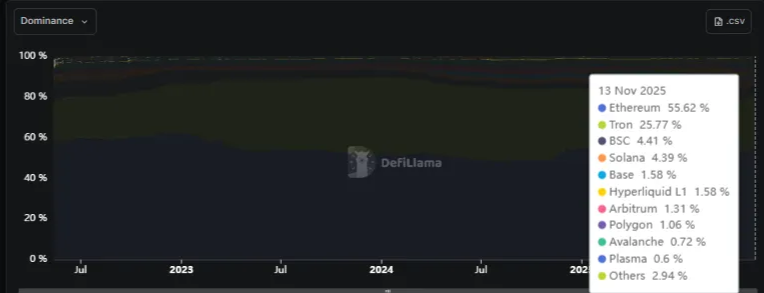
Stablecoin capital continued to drop, with $154 million lost in the past 24 hours. While the capital of stablecoins fluctuates, USDT remains the dominant player, despite the growth of gold and the euro.
US Dollar Stablecoin Dominance
The US dollar stablecoins continued to dominate the crypto markets. However, it was Tether‘s USDT that led this front for the fifth year, averaging over 40% during this period.
USDT accounted for 60% of the market, USDC represented 24%, and other stablecoins made up the remaining 9%. Tether maintained its dominance, while new entrants struggled to keep up with the pace. Ethereum and Tron still led in issuing USDT.
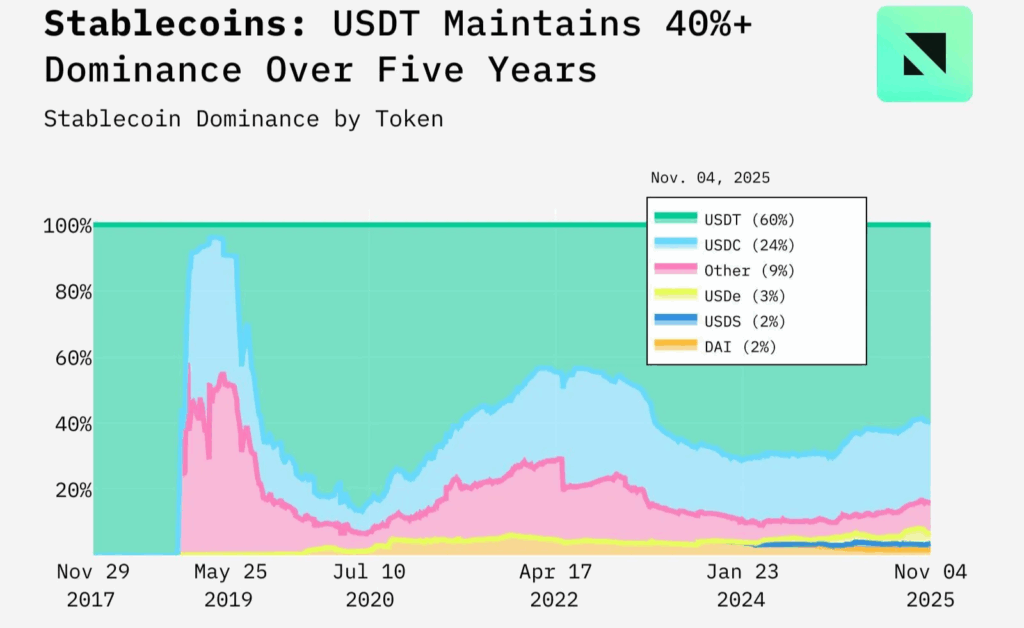
The bubble was highest in 2019, dipped in 2020, and was revamped in April 2022. The year 2025 has seen the reemergence of these stablecoins, especially after the US put bills to streamline stablecoin operations. The GENIUS and Stablecoin Act will bring more exposure for these products.
US dollar stablecoins are not the only products seeing growth; gold and the euro are also gaining traction.
Gold and Euro Lead The New Frontier After USD Stablecoins
As per data from Token Terminal, euro stablecoins were also growing at an accelerating rate. The supply of tokenized euros reached a new peak of $750 million. This was a 7x growth since the start of 2023.
Additionally, gold’s tokenized market cap almost reached $4 billion. The supply of gold on-chain reached $3.6 billion, representing a nearly 50-fold increase since the start of 2021. Gold was tokenized by Tether (XAUT and XAUTO), Paxos (PAXG), and ComTech Gold.
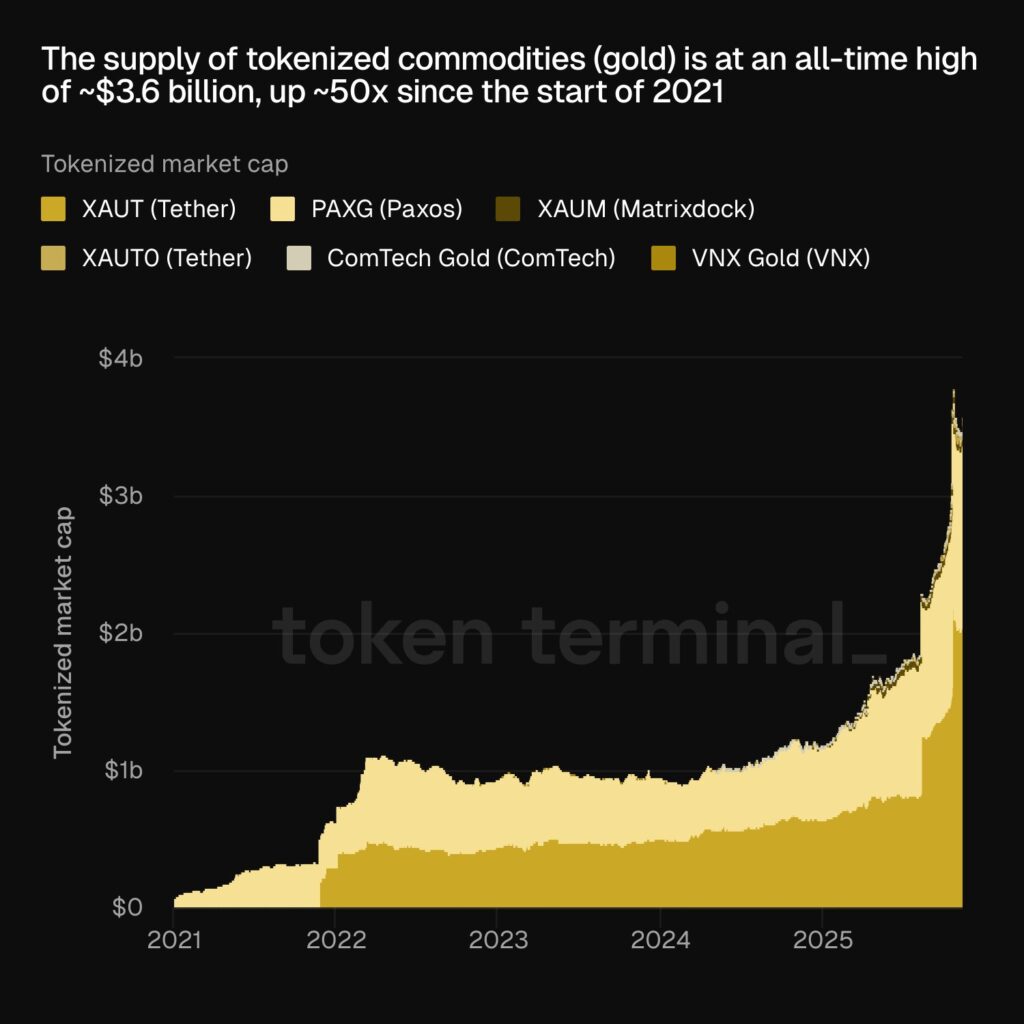
Altogether, the stablecoin market cap was generally growing, although the current decline indicated a shift in capital toward risk-on assets. The euro and gold were also making their way into the tokenized market cap.




